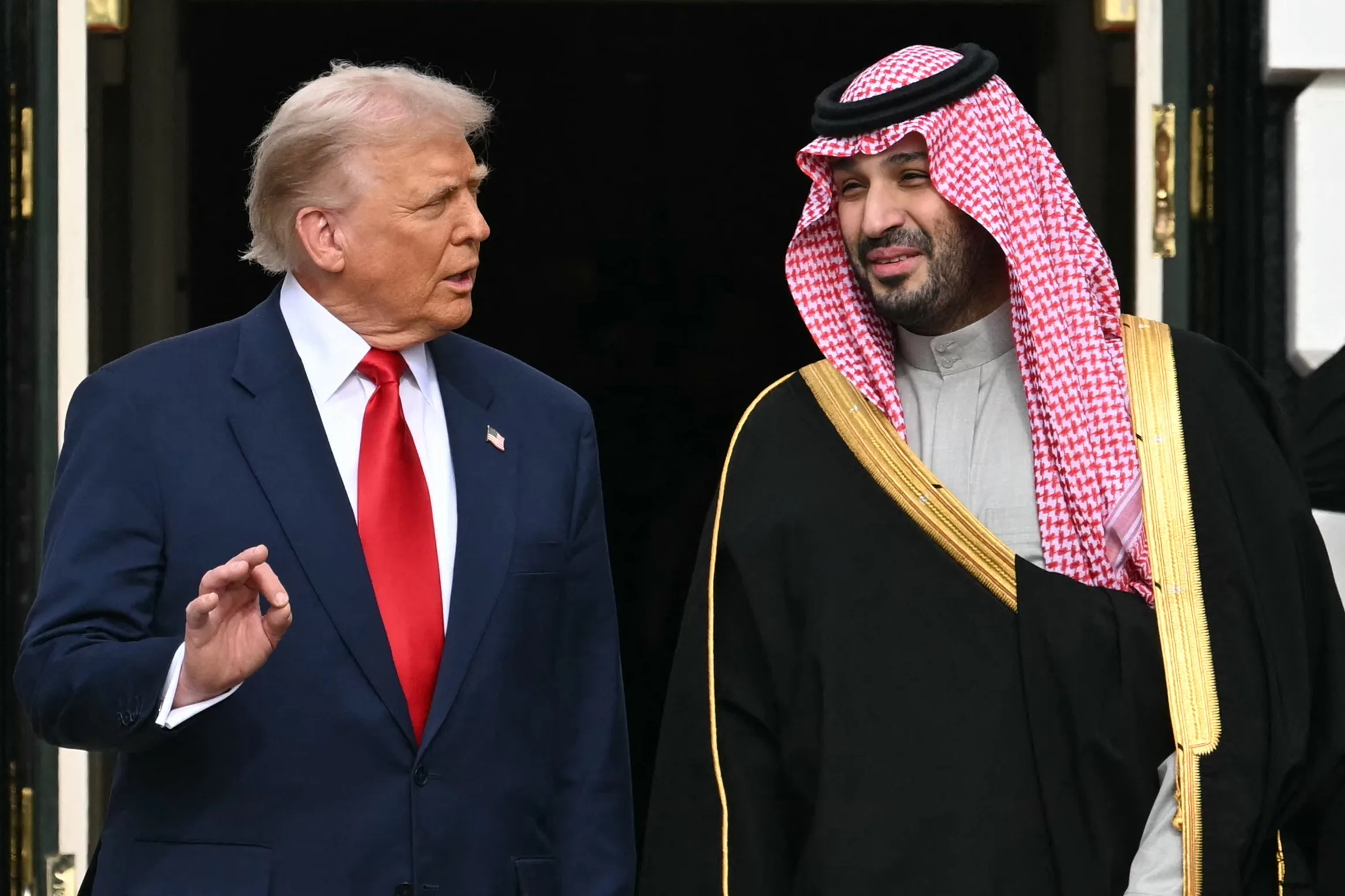
United States President Donald Trump gave new details about the nuclear agreement between the country and Saudi Arabia. The president took to social media this Thursday (23), the day after confirming the decision, to announce that the agreement would be fully conditioned on Saudi Arabia’s adherence to the Abraham Accords, which were defined by the republican as “very respected and successful”.
Trump did not provide further details on whether Riyadh would, in fact, be willing to join the Abraham Accords. Saudi Arabia also did not comment, unlike Israeli Prime Minister Benjamin Netanyahu, who, on social media, mentioned that a possible Saudi accession “would be a historic step forward for peace in the Middle East”.
A hypothetical accession by Saudi Arabia to the Abraham Accords would be a turnaround in its stance. The arrangements were signed in 2020, during Trump’s first term, and provide for Bahrain, the United Arab Emirates, Morocco and Sudan to normalize relations with Israel, in exchange for commercial facilities.
In practice, detente with Israel has functioned as a first step towards the fundamental strategic movement: isolating Iran in the context of the Middle East.
Riyadh, however, resists the idea, arguing that any improvement in relations with Israel would necessarily involve the creation of the State of Palestine. Since the start of the Israeli genocide in Gaza, this argument has gained even more force for Saudi Arabia.
“Without Saudi Arabia, the Abraham Accords are not complete,” explains Najad Khouri, founder of the Study and Research Group on the Middle East (GEPOM) and professor at Fundação Getúlio Vargas (FGV) for the Army Command and General Staff School (ECEME) and the Aeronautics Command and General Staff School (ECEMAR).
The changes in context have not altered Saudi Arabia’s stance, which, even when formulating the Arab Peace Initiative in 2002, already demanded Israel’s recognition of a Palestinian state.
The relationship with Iran, however, has changed. Historically, Saudi Arabia has harbored fears about Iran’s nuclear program. Crown Prince Mohammad bin Salman has already stated that, if Iran develops nuclear weapons, his country will do the same.
“Since the Iran nuclear deal happened in 2015, it has always been a concern for Saudi Arabia. That’s why it, along with Israel, objects to the nuclear deal,” says Khouri. Trump withdrew the US from the pact in 2018, during his first term.
For historian Gabriel Mathias Soares, Global Fellow at Habib University in Karachi, Pakistan, even if part of the Saudi elite does not attach great importance to the Palestinian cause, there is a significant portion of the population that would be unlikely to accept this movement without resistance.
“There is yet another element to remember: parts of southern Saudi Arabia have strong historical, cultural and even linguistic ties with Yemen. The Houthis, although they originate from Zaydi Islam, have expanded their support base beyond this religious group, including within the Yemeni Armed Forces. The movement has a nationalist discourse of Yemeni unity, not territorial separation”, he assesses.
Saudi Arabia, the jewel in the crown
Upon returning to power, in January 2025, Trump made a move that contradicted his predecessors. “Normally, the head of state inaugurates international visits by going to neighboring countries. In this case, Canada and Mexico. But, now, Trump chose Saudi Arabia, and did not choose Israel”, says Khouri, who recalls that the Saudi kingdom is “the jewel in the crown of the Middle East, both in terms of oil and as a middle power”.
The numbers are robust. According to data from the International Energy Agency (IEA), Saudi Arabia is the second largest oil producer in the world, and the Organization of Petroleum Exporting Countries and Allies (OPEC+) points out that the country also has the second largest reserves in the world.
It is no coincidence that the country has had to redirect more than 70% of its crude oil exports, which had a crucial flow channel in the Strait of Hormuz, to the port of Yanbu, on the Red Sea. But this week, the Houthis returned to the theater of operations and attacked Saudi Arabian vessels, making threats again.
Trump, keeping an eye on Saudi Arabia’s strategic weight, had already been saying, in recent months, that a possible agreement (like the one announced yesterday) would involve Riyadh’s accession. According to the Republican’s logic, the more countries agree to the Abraham Accords, the greater the strangulation of Tehran’s position would be in the course of the war that has been going on since February.
But the nuclear agreement between Washington and Riyadh itself has been subject to doubt. Without giving great details about what is to come, the US confirmed that the text paves the way for uranium enrichment on Saudi soil, if it is commercially viable. If the United States vetoes the advance, Saudi Arabia would be prevented from pursuing the technology for ten years.
Another point of concern in the agreement, expected to last 30 years, is the exemption from the so-called “gold standard” of international supervision, which serves as the most rigorous level of supervision provided for by the International Atomic Energy Agency (IAEA).
A Saudi concession on this point, in particular, could create a precedent for other Middle Eastern countries to claim similar terms. “There is a serious risk that the region could become highly atomized,” warns Khouri.
Uncertain developments
In the geopolitical field, a possible improvement in relations between Riyadh and Tel Aviv “would place Saudi Arabia much more in the sights of Iran and other groups that oppose Israel”, according to Soares, who raises the following question: to what extent does Saudi Arabia really benefit from a rapprochement with Israel? “In recent conflicts, much of the military infrastructure installed in the region served mainly Israeli interests, and not necessarily those of the Arab countries themselves,” he explains.
Another aspect has to do with the internal Saudi situation. “Although the country is extremely rich in natural resources, not all of its population enjoys the same pattern of development observed in other major oil producers. Furthermore, the main oil-producing regions have a Shiite majority, especially the Eastern Province. These areas have already seen protests and repression over the years”, ponders Soares.
Not that adherence is impossible, but the balance between gains and losses will be necessary. “It would be difficult to imagine Saudi Arabia accepting the proposal without obtaining much greater compensation than those offered so far, even with the promise of a nuclear agreement. The risks seem to outweigh the benefits”, assesses Soares.
Source: www.brasildefato.com.br