Published 12/09/2025 13:35 | Edited 12/09/2025 14:31
Prime Minister Benjamin Netanyahu stated on Thursday (11) that “there will be no Palestinian condition” and signed an agreement to advance with the expansion of the settlement of Ma’ale ADUMIM in the occupied Whell.
The project known as E1 foresees the construction of 3,412 houses and, according to monitoring organizations, will make it impossible to create a viable Palestine by cutting the Someline in two and isolates eastern Jerusalem.
The agreement signed by Netanyahu, presented as a symbolic ceremony, ensures the continuity of a project paralyzed for years in the face of international pressure. The E1 area, with 12 km², connects Jerusalem to the settlement of Ma’ale Adumim and is considered strategic by defenders of colonization.
The Israeli Ministry of Defense formally approved the plans, which involve estimated investment of nearly $ 1 billion, including road opening and infrastructure modernization. The government has announced that the goal is to “double the population of the city” and consolidate the link between dozens of existing settlements in the region.
International law experts warn that the measure violates the fourth Geneva Convention and configures war crime.
For entities such as Peace Now, which accompanies the activity of settlers, E1 is “lethal for the future of Israel and for any chance of achieving a peaceful solution of two states.”
The project also has a political dimension: Western governments, such as the United Kingdom and France, recently announced their intention to recognize Palestine in the UN, and ministers of the Israeli right reacted by intensifying the defense of the Bathingan annexation.
SMOTRICH PREACHES ANNEXATION OF THE BY WINDONY
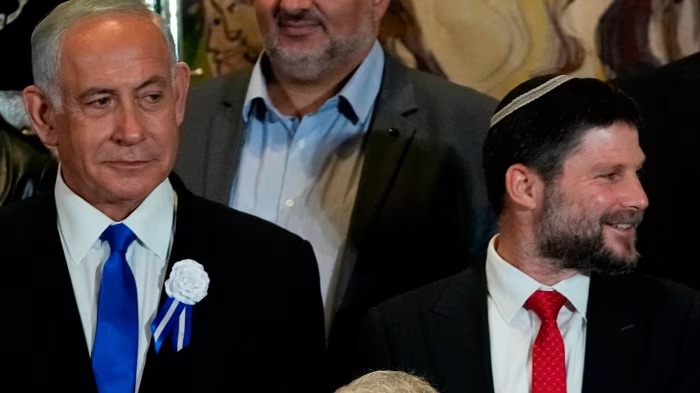
At the ceremony, Netanyahu was accompanied by Finance Minister Bezalel Smotrich, leader of religious Zionism and responsible for pressuring the acceleration of the plan. Smotrich stated that the next step will be to “celebrate the application of sovereignty throughout Judea and Samaria”, a biblical name used by the Israeli right to refer to the West Bank.
According to him, the expansion of the E1 not only makes a Palestinian state unfeasible but definitely “buries” any possibility of peace negotiation. In previous statements, the minister had already argued that the Palestinian authority “disappears from the map” and that the occupied territories are formally attached to Israel.
Netanyahu, in turn, insisted that the decision is a “big step to perform a vision” of Jewish national security and identity. He repeated that “this place belongs to us” and assured that Israel will continue to build new settlements.
The statements are inserted into a political trajectory marked by Netanyahu’s historical opposition to Oslo’s agreements, signed in the 1990s. In a 2001 video, he even boasted from having “put an end” to the process that provided for a Palestinian state.
Palestinian reaction and appeal to the international community
Palestinian authority presidential spokesman Nabil Abu Rudeineh condemned the announcement and said Netanyahu is “pushing the whole region into the abyss.” For him, the creation of an East Jerusalem state as capital is “inevitable” and represents the only key to peace.
Rudeineh recalled that 149 UN-member countries have officially recognized Palestine and appealed to those who have not yet done so to the diplomatic pressure. He also stressed that all Israeli settlements are illegal according to international law.
Palestinian discourse is supported by recent decisions of the international community. In 2024, the International Court of Justice stated that the Israeli presence in occupied territories is illegal and required the withdrawal of settlers. The UN General Assembly approved similar resolution in the same year, with support from over 100 countries.
Now, France, Belgium, Malta and other European governments are articulated to officialize the recognition of Palestine in this UN session, expanding Israel’s isolation. Germany, in turn, has announced that he will support the Franco-Saudi proposal for the solution of two states.
Climbing Violence in West Bank
The announcement of expansion of settlements occurs amid a new wave of violence. Earlier this week, two armed Palestinians performed an attack on Jerusalem, leaving six dead and several injured at a bus stop.
The Israeli forces responded with military operations in West Bank cities, including the demolition of suspects’ homes and new arrests. This cycle of action and reprisal reinforces instability and increases the risk of large -scale confrontations.
The West Bank, which houses about 3 million Palestinians and 500,000 Israeli settlers, lives under increasing militarization. With each new settlement project, the local population is surrounded by exclusive roads for settlers, control posts and severe circulation restrictions.
For Palestinians, the Israeli expansion policy is equivalent to a systematic process of annexation and ethnic cleaning. For Netanyahu allies, it is a matter of consolidating a territorial hegemony that buries any possibility according to the coexistence of two states.
Source: vermelho.org.br