Published 04/09/2025 12:28 | Edited 04/09/2025 13:26
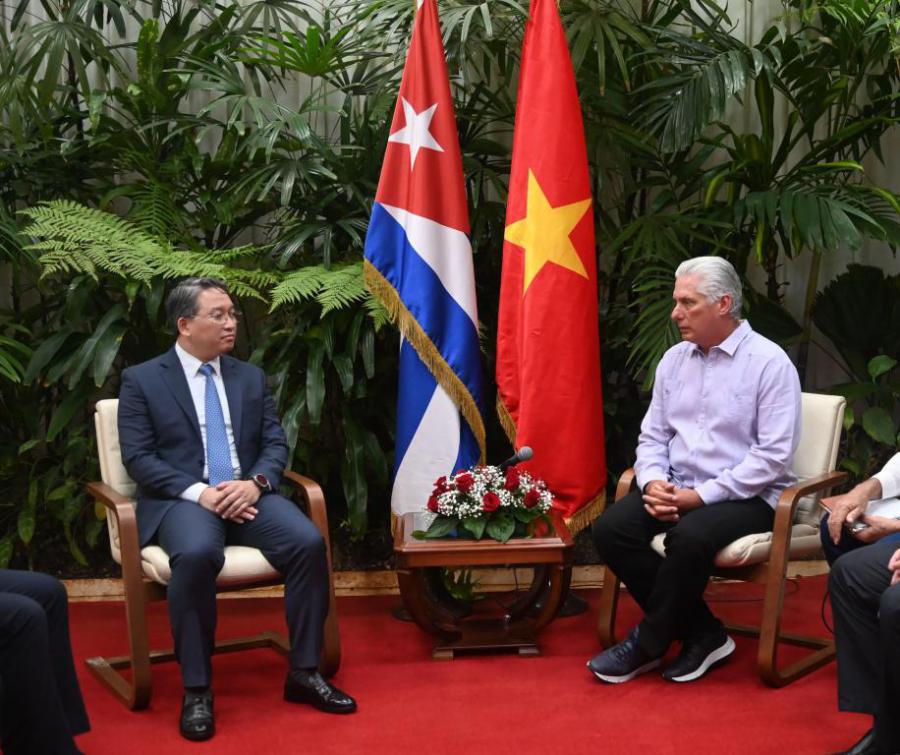
The President of Cuba and the first secretary of the Communist Party, Miguel Díaz-Canel Bermúdez, concluded on Tuesday (2) a state visit to Vietnam marked by the signing of new strategic agreements and the celebration of the 65 years of diplomatic relations between the two countries.
The trip coincided with the 80th anniversary of Vietnamese Independence and reaffirmed the historical alliance among communist parties, projecting cooperation for areas such as agriculture, energy, biotechnology, health and defense.
At the meeting with the Secretary-General of the Vietnam Communist Party (PCV), Tô Lam, Díaz-Canel stressed that the bond between PCV and PCC is the cornerstone of the bilateral relationship, acting as a political basis and strategic guidance for all levels of cooperation.
The two announced joint theoretical seminars, framework exchanges and strengthening academic cooperation between the National Academy of Ho Chi Minhine and the ñico López University.
The two parties also agreed to hold the 7th Vietnam Theoretical Seminar – Cuba and the 3rd Scientific Conference “Fidel Castro – Chi Minh: Vision of Revolution”, in the centenary of the birth of the Cuban leader.
In addition to the ideological dimension, the agenda provides for greater approximation between mass organizations, communist youths and official publications, such as Communist magazine from Vietnam and the Socialist magazine of Cuba.
The statements of Tô Lam and Díaz-Canel converged on the defense of socialism and the valorization of the resistance of the two peoples, which transformed party relations into reference to the world left.
“It is an exemplary relationship that resists time and strengthens in the midst of huge challenges for peace,” said the Cuban leader.
Genfarma symbolizes jump in scientific cooperation
Among the milestones of the visit was the inauguration of Genfarma, a biopharmaceutical joint venture installed in Haa Lac High -tech park, outside Hanoi. The venture, designed at the meeting between Díaz-Canel and Tô Lam in 2024, was erected in less than a year and is considered the fastest joint venture ever realized between the two countries.
With direct support from PCV’s political bureau, Genfarma will produce innovative medicines, allow the transfer of technologies and position the Cuban industry in the Asian market, especially at Asean.
“We have already overcome the dream of creating Genfarma; now it is a reality that we will show the world with industrial efficiency and a lot of innovation,” said Díaz-Canel.
The inauguration was attended by Cuban ministers such as Álvaro López Miera (Far), Bruno Rodríguez (Foreign Relations) and Mayda Mauri Pérez (Bocubafarma).
Vietnamese Health Minister Dao Hong Lan said the project “received support from the highest level of leadership” and highlighted the law approved in July to boost the biopharmaceutical sector as a national development engine.
In the economic sphere, governments signed five cooperation documents in food security, economy, science and technology, health and file management. The most relevant agreement provides for rice production at 15 to 20 thousand hectares in Cuba by 2027, covering the provinces of Pinar del Río, Sancti Spiritus and Granma.
New cooperation priorities were also defined in three strategic sectors: agriculture, energy and biotechnology. To this end, both countries have committed to creating companies favorable policies and fostering joint ventures in areas of common interest.
According to Vietnamese Deputy Minister Dang Hàng Giang, the visit produced “nouns” results and opened “new guidelines” for comprehensive cooperation. In all, there were 16 official activities in less than three days, demonstrating the strategic weight of the bilateral relationship.
Popular solidarity and historical legacy
The popular dimension was at the center of the celebrations. The Vietnamese Red Cross organized a national solidarity campaign that raised US $ 14.5 million in a few days to support Cuba in the face of current difficulties.
Millions of Vietnamese contributed, evoking the historical phrase of Fidel Castro in 1969: “By Vietnam, we are willing to give to our own blood”.
Reports remembered by the press highlight how solidarity among peoples remains alive from the War of Resistance against Yankee Occupation to current cooperation in times of peace.
For Díaz-Canel, this gesture “confirms that our ties are not just diplomatic, but are rooted in the fraternity among peoples.”
Military and Political Cooperation
The relationship also advanced in the field of defense with Cuban Minister Álvaro López Mirera met with General Trịnh Ván Quyết, head of the political department of the Vietnam Popular Army.
Both highlighted the results of the memo of understanding of 2022, which expanded cooperation in political party affairs.
Among the fruits is the documentary series “Two Hearts, a beat”, already with five episodes completed and a sixth scheduled for 2026, in the centenary of Fidel Castro. Díaz-Canel and López Mirera also visited the memorial to Cuban military specialists in Hanoi, a symbol of internationalist solidarity.
The Cuban military chief praised the September 2 Military Parade and stressed that the two countries obtained “concrete results” in various areas of cooperation in defense. The expectation is to deepen the coordination, especially in communication and political education of new generations.
International Projection and UN Coordination
In multilateral forums, Cuba and Vietnam reaffirmed the willingness to act together, with an emphasis on the UN. Cuba announced support for the Hanoi holding of the UN Convention signing ceremony against the cybercrime, scheduled for October, and confirmed official participation.
A joint statement was published reaffirming that solidarity and comprehensive cooperation constitute a strategic legacy to be preserved. For Díaz-Canel, the alliance with Vietnam is a “living symbol of how socialism and mutual trust can generate real advances.”
Source: vermelho.org.br