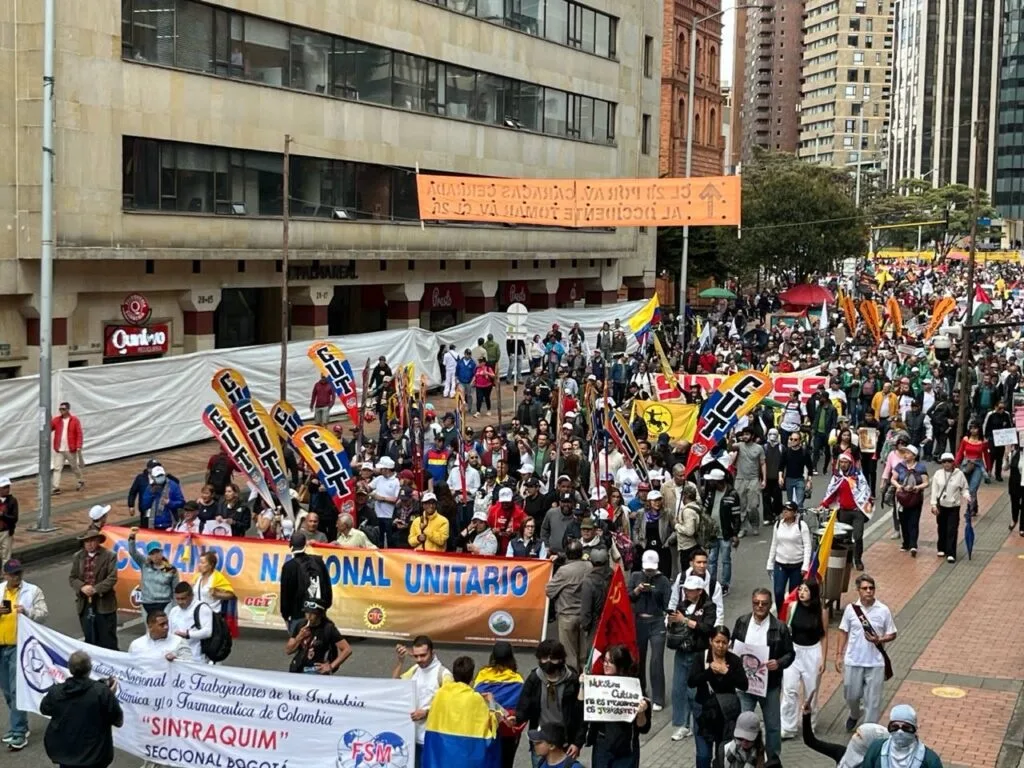
The government of Abelardo de la Espriella barely completed two months in power in Colombia and, this Wednesday (14), it faced a major challenge on the streets, with the first national strike in protest against its administration.
In a context of great political and social tension, thousands of people marched through Bogotá, Cali, Medellín, Bucaramanga, Pereira and Riohacha to express a frontal rejection of the Espriella government’s economic and security agenda, the increase in the cost of living, the wave of violence, the regression of social achievements and the attempts to criminalize and coerce the right to protest.
The demonstration brought together unions, student groups, opposition parties, labor federations and the Cauca Indigenous Regional Council (CRIC). The scope of the alliance, which included everything from the teachers’ movement to indigenous communities, set the tone for a day of actions that took over the capital and was replicated in six other cities in the country.
Former president Gustavo Petro and other progressive figures are expected to participate in the demonstration in Bogotá. The protesters emphasized the peaceful nature of the protest, contradicting statements coming from the Presidential Palace (Casa de Nariño) that attempt to delegitimize the demands of Colombian civil society.
The trigger was Decree 1525, signed by Espriella. The decree establishes rules for the actions of security forces in demonstrations and authorizes authorities to disperse them in the event of serious disturbances. Local governments responded with large contingents of uniformed police officers in major cities.
The opposition interpreted the operation as an attempt to preventively restrict the right to protest. This interpretation further heightened tensions on a day that organizers had billed as an expression of accumulated discontent over the cost of living and the dismantling of social programs.
Discontent is not limited to the decree. The mobilized sectors question all of the Executive’s initial decisions, which they accuse of dismantling social achievements and making daily life more expensive for the majority.
Fecode, the Colombian Federation of Educators, came out in defense of public education and teachers’ health. The union also demanded the reconstruction of school infrastructure damaged by previous emergencies, such as the earthquake and aftershocks in the Cauca Valley, and denounced the stigmatization suffered by teachers’ unions.
Indigenous and peasant communities, in turn, rejected the megaprojects and economic measures that threaten their ancestral territories. CRIC warned that the Espriella government is trying to undermine the autonomy of its organizations.
The economic agenda was the focus of much of the discontent. The increase in the cost of living and policies that, according to organizers, erode acquired rights, have led workers from various productive sectors to the streets.
Source: www.brasildefato.com.br