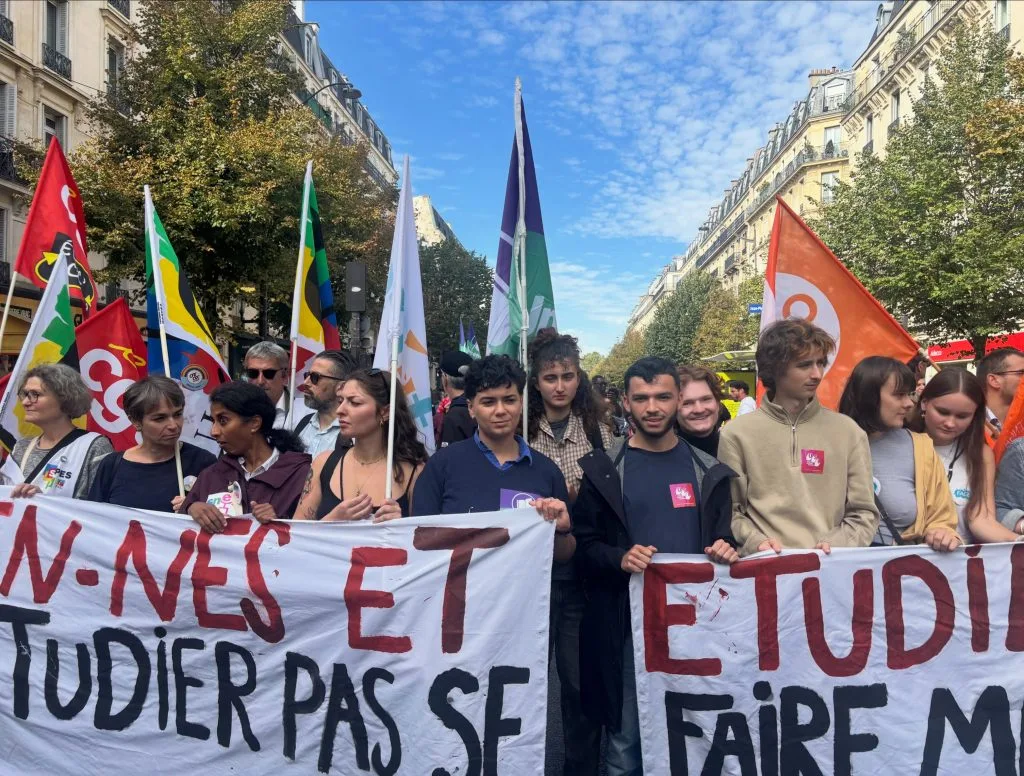
The third week of student mobilizations in France reached its peak with serious episodes of police violence, mutilations of teenagers and strong condemnation from international human rights organizations.
The movement, started in September by high school students against the precariousness of public schools and budget cuts by President Emmanuel Macron’s government, has already accumulated more than 6,800 detainees, of which 86% are minors, and hundreds injured.
The advance of repression generated commotion in the country after the record of severe injuries caused by dispersal weapons used by security forces. In Lens, in northern France, a 15-year-old student had one of his hands amputated after the explosion of a grenade thrown by police during a school blockade on Monday (5).
In the northwest of Paris, in Saint-Ouen-l’Aumône, a 14-year-old teenager suffered a double fracture to his jaw and lost several teeth when he was hit in the face by a tear gas canister fired at a very close range.
In another case, in the city of Belfort, the Vesoul prosecutor’s office opened an investigation for attempted murder after a 17-year-old boy reported that police officers tried to drown him in a stream during an approach.
Official data from the French government records at least 215 students, 85 teachers and 715 police officers injured since the attacks broke out. Faced with the repercussion of the mutilation episodes, the Minister of the Interior, Laurent Nuñez, announced the suspension of the use of stun grenades in protests by high school students and reported the opening of 18 internal investigations within the police internal affairs department.
Prime Minister Sébastien Lecornu declared that security forces “did not receive instructions to confront the students” and sought to hold left-wing parties, such as La France Insubmissa (LFI), responsible for allegedly encouraging the confrontation.
The opposition refuted the statements. “It took several young people to be mutilated for the rest of their lives for Nuñez to give up using grenades against high school students,” criticized LFI national coordinator, Manuel Bompard.
International complaints
The escalation of violence against minors prompted warnings from global entities this Friday (9). The United Nations High Commissioner for Human Rights (OHCHR) declared that it is following the incidents recorded in the European country with “concern”. France’s National Advisory Commission on Human Rights and Amnesty International also condemned the conduct of police forces.
Lawyers linked to the Collective for Judicial Action and defenders of detained minors stated that the majority of students arrive at police stations injured by baton blows or after being dragged along the ground.
Student outrage began with the blocking of high schools in the Paris metropolitan region and spread to dozens of cities, such as Rennes, Toulouse, Strasbourg and Lyon. Students protest against the chronic shortage of teachers, the precariousness of school buildings during heat waves and deficiencies in the Parcoursup platform, which regulates entry into higher education.
The backdrop to the crisis is the 2027 budget project forwarded by the Macron government, which foresees a cut of 54 billion euros in public spending to try to contain the fiscal deficit and public debt of 119% of the Gross Domestic Product (GDP).
The austerity measures affect school infrastructure, public health and civil servants, arousing support from parents and unions such as the General Confederation of Labor (CGT).
In last week’s edition of The Foreignerinternational policy program of the Brazil in factanalyst Hugo Albuquerque pointed out that the popular uprising highlights the limits of the neoliberal policy adopted by Macron on the eve of the pre-election year of 2027:
“The movements have put a limit on Macron. Macron, obviously, is a figure linked to French liberalism”, highlighted Albuquerque, pointing out that the government tries to impose austerity required by the European financial structure, but comes up against the organization tradition of the French people.
Also heard on the BdFpolitical scientist Florence Posnansky highlighted that discontent has the capacity to articulate different social sectors: “The fact that we managed to mobilize one in every ten public servants in all categories is already a great demonstration of strength.”
Continuous mobilization
Although the Ministry of Education announced, on Thursday (8), the emergency hiring of 3,000 substitute teachers, the student movement considered the proposal insufficient. This Friday, 141 high schools remained with activities completely paralyzed or blocked by trash can barricades.
The political fragility of the Macron government, unpopular, without a parliamentary majority and less than six months before the start of the 2027 electoral cycle, intensifies the impasse.
According to research by the Elabe institute for the broadcaster BFMTV55% of French people support student protests and 72% consider their demands legitimate. Faced with the rejection of the responses from the Élysée Palace, secondary education organizations and unions have already called for a new national day of strikes and demonstrations for next Tuesday (13).
Source: www.brasildefato.com.br