Published 01/05/2026 16:29 | Edited 05/01/2026 17:17
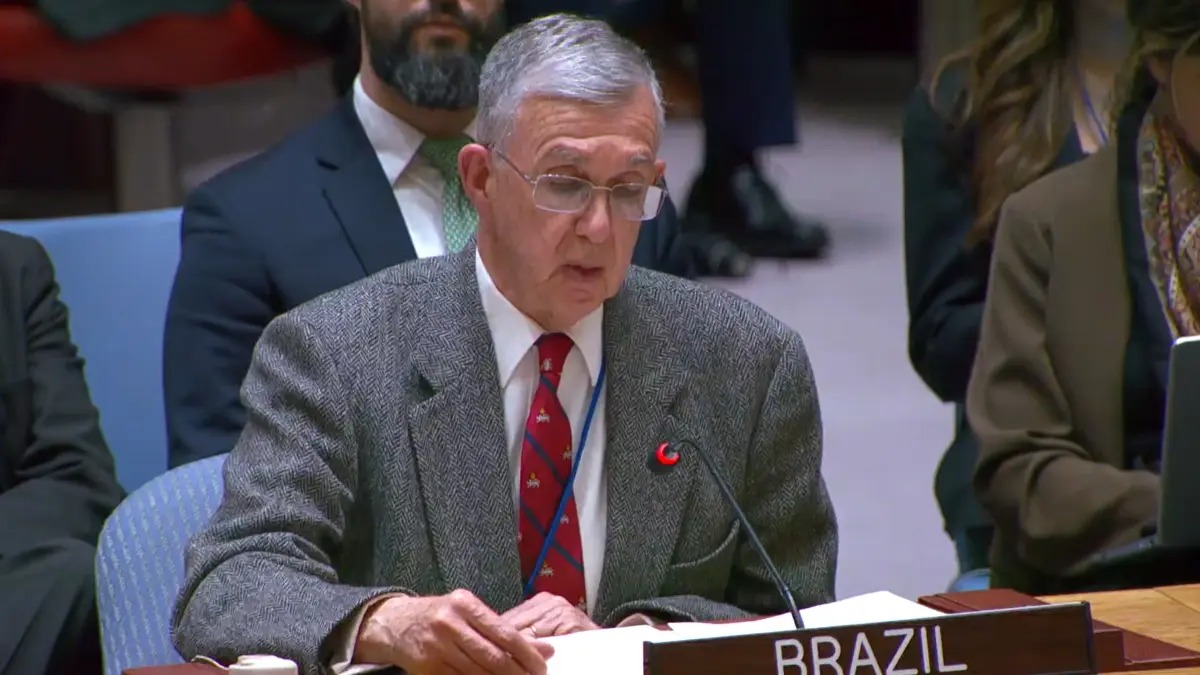
Brazil condemned this Monday (5), at the UN Security Council, the armed intervention of the United States in Venezuela and classified the bombings and capture of President Nicolás Maduro as a violation of the United Nations Charter, international law and Venezuelan sovereignty.
“Brazil categorically and firmly rejects armed intervention in Venezuelan territory, in flagrant violation of the United Nations Charter and international law,” said Sérgio Danese, Brazil’s ambassador to the UN.
The ambassador stated that the bombings carried out by the United States on Venezuelan territory and the capture of President Nicolás Maduro “cross an unacceptable line” and represent a violation of the country’s sovereignty in light of international law.
“These acts constitute a very serious affront to Venezuela’s sovereignty and establish an extremely dangerous precedent for the entire international community,” he protested.
Danese stated that the UN sets objective parameters for the use of force in international relations.
“The Charter of the United Nations establishes, as a pillar of international order, the prohibition of the use of force against the territorial integrity or political independence of any State, except in the circumstances strictly provided for therein”, he declared.
The ambassador also warned of the broader effects of normalizing this type of action.
“The acceptance of actions of this nature could lead to a scenario marked by violence, disorder and the erosion of multilateralism, allowing the law of force to override the force of law,” he said.
read more: Far beyond oil: why Trump wants to submit Venezuela to the USA
According to Brazil’s ambassador to the UN, it is not possible to “accept the argument that the ends justify the means”.
Danese stated that this reasoning “lacks legitimacy and opens up the possibility of granting the strongest the right to define what is fair or unfair, correct or incorrect, and even to ignore national sovereignties, imposing decisions on the weakest.”
He also highlighted that Latin America and the Caribbean made the choice for peace and recalled that armed interventions in the past had profoundly negative consequences, as they produced authoritarian regimes and rights violations.
“The use of force in our region evokes chapters of history that we believed had been overcome and puts at risk the collective effort to preserve the region as a zone of peace and cooperation, free from armed conflicts, respectful of international law and the principle of non-interference”, he argued.
The diplomat also stressed that Brazil believes in a solution that respects the self-determination of the Venezuelan people with a focus on the country’s Constitution, and that the North American action affects the international community.
“This and other cases of armed intervention against the sovereignty of a country, its territorial integrity or its institutions must be vehemently condemned. It is up to this Council to assume its responsibility and react with determination, clarity and obedience to international law, in order to prevent the law of force from prevailing over the force of law”, he reaffirmed.
Strengthening multilateralism
According to the Brazilian representative, “the effects of the weakening of international governance and cooperation mechanisms are already evident”.
In its intervention, Brazilian diplomacy stated that the acceptance of the unilateral use of force tends to deepen this process, warning that “the acceptance of actions of this nature would inexorably lead to a scenario marked by violence, disorder and the erosion of multilateralism, to the detriment of international law and institutions”.
Danese framed the Brazilian position as the repeated defense of the rules that govern coexistence between States.
“As Brazil has repeatedly maintained, the norms that govern coexistence between States are mandatory and universal. They do not admit exceptions based on ideological, geopolitical, political, economic or any other interests or projects”, he warned.
The speech also associated this process with a scenario of increasing warmongering in international relations.
“The effects of the weakening of international governance and cooperation mechanisms are already evident. The record number, since the Second World War, of 61 active armed conflicts, as well as the unprecedented figures of 117 million people in situations of humanitarian catastrophe around the world, reflect the increase in wars, displacement and crimes against humanity”, he concluded.
Source: vermelho.org.br