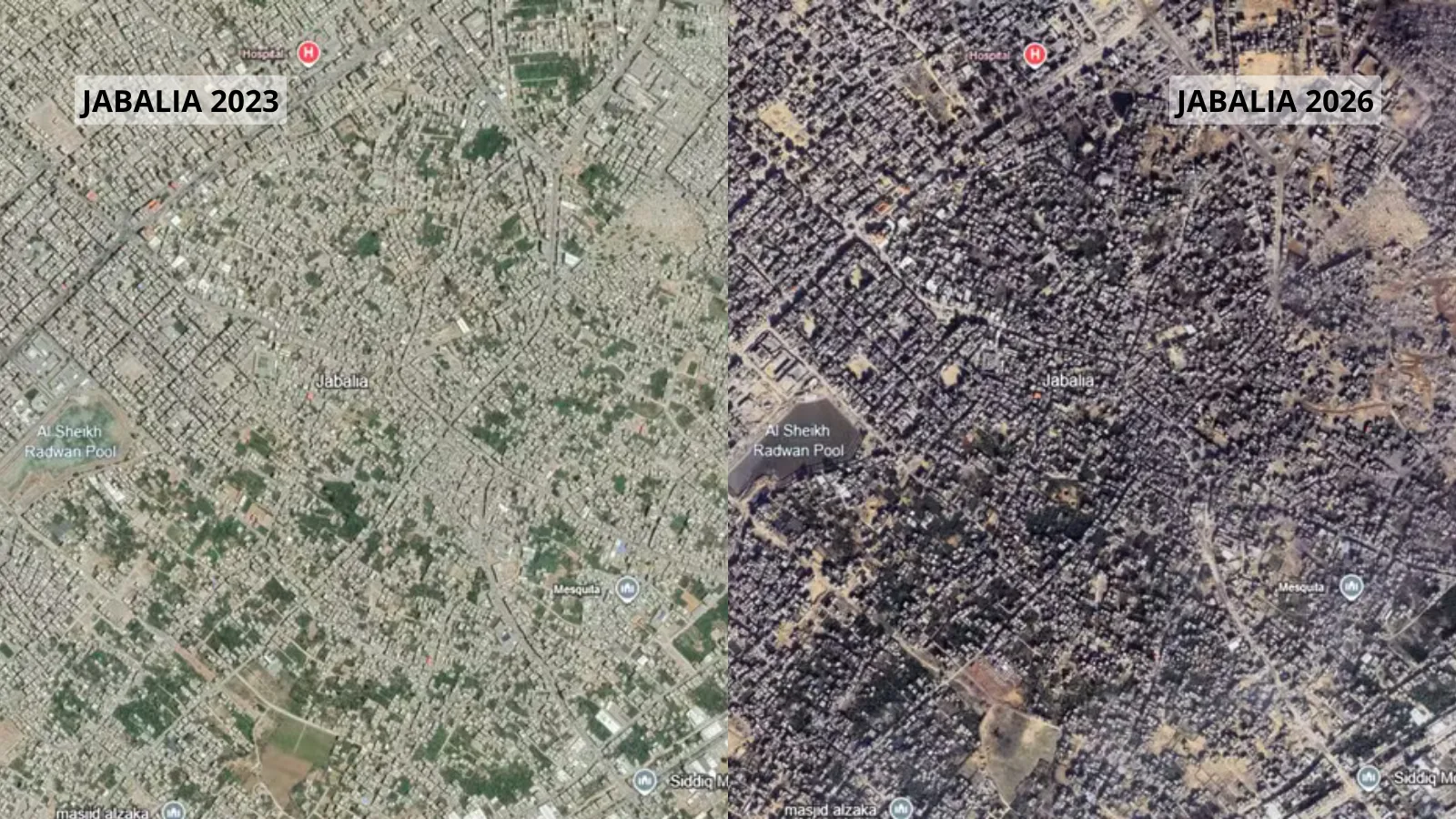
The Hamas attack against Israel on October 7, 2023 turns three years old this Wednesday (7), with the “peace plan” mediated by the United States without advancing in the Gaza Strip, while Israel maintains 60% of the Palestinian territory occupied.
The report on Gaza by the United Nations Office for Humanitarian Affairs (Ocha), published on Monday (5), highlighted that Israeli aerial bombardments against densely populated areas are daily.
Between September 23 and 30, 29 Palestinians were killed and 147 injured, according to data from the local Ministry of Health. This means that there have been 1,431 deaths since the ceasefire was announced about a year ago, on October 10, 2025, which represents almost four deaths per day.
The professor of international relations at Fundação Escola de Comércio Álvares Penteado (Fecap) Isabela Agostinelli assessed, in an interview with Brazil Agencythat the situation of almost 2 million Palestinians “has not improved in any sense” with the supposed ceasefire.
“The humanitarian situation is still catastrophic. Little humanitarian aid is allowed to enter from Israel, which continues to be the sovereign actor that controls the borders. The Peace Council chaired by Trump did not bring peace in any sense, there is no prospect of reconstruction of Gaza”, said the expert.
UN OCHA highlights that the daily production of hot meals in Gaza will decrease “significantly” from this month due to a lack of funding. This is because only 40% of the US$4 billion requested for humanitarian aid in occupied Palestine was transferred.
“1.4 million people (67% of Gaza’s population) are expected to face levels of acute food insecurity between July and December,” Ocha calculates.
Hamas disarmament
Professor of international relations at the Pontifical Catholic University of São Paulo (PUC-SP), Bruno Huberman explained to Brazil Agency that one of the impasses in US President Donald Trump’s “peace plan” is the fact that Hamas only agrees to disarm after Israel leaves Gaza, which has not happened.
“For Israel to vacate Gaza, they say that Hamas has to disarm. We are in this impasse, and the US is not stepping up to unlock it”, commented the coordinator of the International Conflict Study Group (Geci) at PUC-SP.
Huberman added that Israel prevents the return to Gaza of the “technocratic committee” of Palestinians, with no connection to parties, which would be responsible for monitoring the reconstruction of the territory.
“These Palestinians went to Cairo to discuss the reconstruction of Gaza in November last year, when Trump announced the peace plan. Since then, they have been exiled in Egypt because Israel prohibits their entry into Gaza. This is an example of how Israel impedes any effort for reconstruction”, he highlighted.
Israel’s Foreign Minister, Gideon Sa’ar, has highlighted that the transfer of the civilian government from Hamas to the National Committee for the Administration of Gaza (NCAG) would only be accepted with the total demilitarization of the Palestinian groups in the enclave.
Anti-Hamas militias
Professor Isabel Agostinelli recalls that, while the impasse remains frozen, militias are being financed by Israel in Gaza to dispute territories with Hamas.
“This ceasefire was a fallacy. Of course, the bombs stopped falling steadily, there are fewer bombs falling in Gaza, but Palestinians continue to be killed, directly or indirectly, by the Israeli policies carried out in that region”, he concluded.
In June 2025, Israel’s Prime Minister, Benjamin Netanyahu, acknowledged that he supports armed groups in Gaza that oppose Hamas to “spare the lives of Israeli soldiers”, as revealed by the newspaper The Times of Israel.
Palestinian hopelessness
The three years of the current phase of the conflict in occupied Palestine have tested the resilience of the Palestinian people. Middle East Conflict Observatory researcher Bruno Huberman highlighted that he has observed unprecedented apathy and hopelessness in the ten years he has had contact with Palestinians.
“The Palestinians have always been very famous for maintaining great pride in their resistance, despite any setback. But the little contact I have with the Palestinians who are there, and also with the Palestinians who live abroad and go to visit, is a hopelessness that, for me, is unprecedented”, he said.
On the other hand, Huberman assesses that October 7th strengthened the plan of Benjamin Netanyahu’s party, Likud, for the Palestinian territories. This strengthening would have buried, once and for all, the internal position that proposed peaceful coexistence in Israel.
“Until October 7th, there was a reasonable democratic and liberal resistance in Israel. With October 7th, this democratic resistance, which even dreamed of peace with the Palestinians, no longer exists. The peace camp in Israel sort of ceased to exist”, he assessed.
For the analyst, October 7th was a “strategic error” by Hamas, which would not have predicted the scale of the Israeli and US reaction.
“October 7 weakened the image of Israel, brought solidarity to Palestine, but at a gigantic human cost, and we do not see a Palestinian state being created on the near horizon,” he said.
At the same time, Hamas has agreed to lay down its weapons in a fragile agreement with Trump in exchange for the reconstruction of Gaza, which has not begun.
“Hamas, consequently, is not completely demilitarizing. Meanwhile, Israel continues, in some way, this erosion of Hamas. Every week there is a Hamas leader killed. And, at the same time, Israel is arming militias to replace Hamas in Gaza”, he added.
At the same time, the experts consulted by Brazil Agency emphasized that colonization in the West Bank has accelerated since October 7, with the expansion of violence in the other occupied Palestinian territory.
“The West Bank has been following the unbridled expansion of settlers, settlements and the attempt to expel Palestinians from their own homes. The violence of settlers against the Palestinian population has the consent of the Israeli State itself”, pondered Isabela Agostinelli.
Israel tends to justify its actions in the West Bank as part of the “fight against terrorism”, at the same time that the Netanyahu government has not recognized the right of Palestinians to West Bank lands.
PUC-SP professor Bruno Huberman highlighted that attacks by Israeli settlers in the West Bank have increased the isolation of the head of the Palestinian Authority, Mahmoud Abbas.
“Faced with the impossibility of the most popular Palestinian politician being released, who is Marwan Barghouti, we have seen a more left wing of Fatah [partido do Abbas] seeking to ally with Islamic Jihad and Hamas for the next elections for a national coalition government that, in some way, seeks to replace Abbas”, he informed.
Almost 20 years after the last legislative election, the Palestinian Authority has scheduled a vote to define the Parliament that could replace Abbas as head of the Palestinian organization based in the West Bank for November 28th.
Source: www.brasildefato.com.br