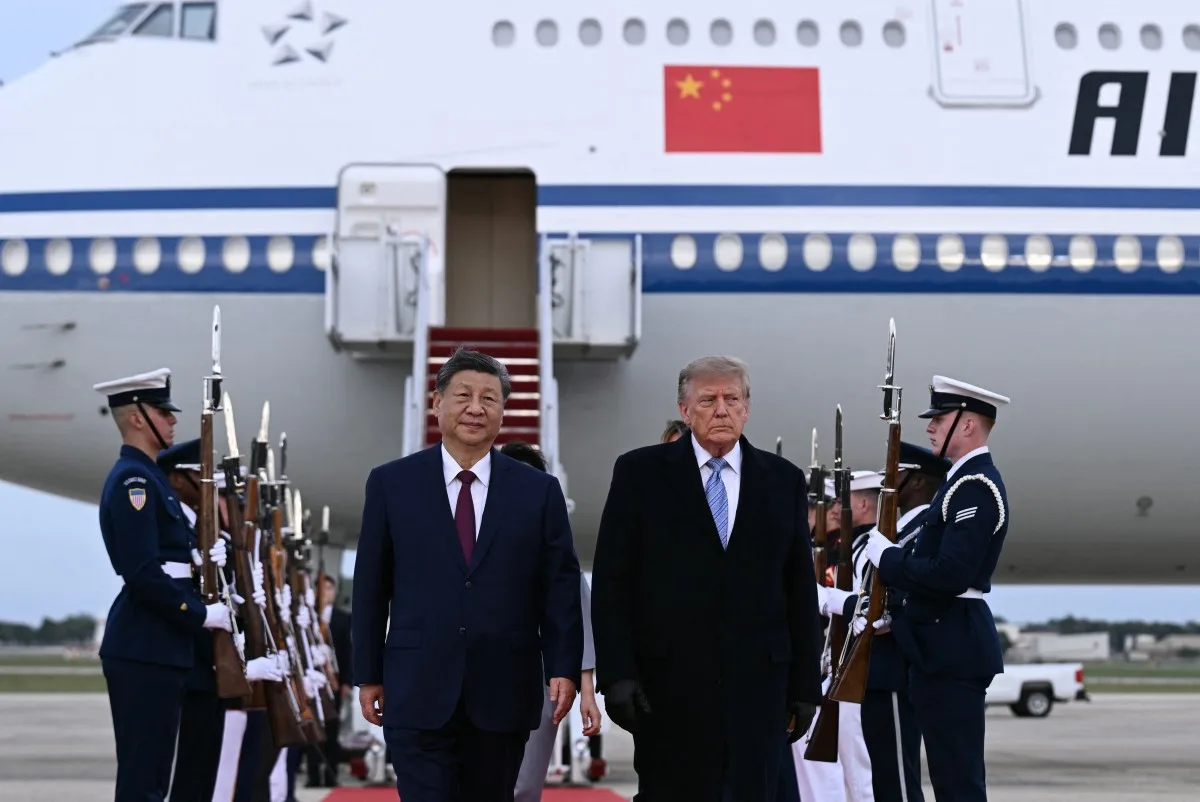
Chinese President Xi Jinping arrived in the United States this Wednesday (23) and was received by Donald Trump, at the beginning of an agenda that will last three days. The visit takes place four months after Trump’s trip to China and should deepen dialogue on trade relations between the two countries, peace and global development.
Trump received Xi at Andrews Joint Air Force Base in Washington. Talks at the White House should begin this Thursday (24). A ceremony hosted by the American first lady, Melania Trump, and a visit to the National Archives conclude the official visit on Friday (25), when Xi will return to Beijing.
Chinese Foreign Ministry spokesman Guo Jiakun said that China hopes the meeting will contribute to consolidating a relationship of strategic stability with the United States, combining dialogue and cooperation with the management of differences.
Guo said China will work with the United States to strengthen dialogue and cooperation, properly manage differences, expand benefits for the two peoples and contribute to “world peace, stability and prosperity.”
Relations between the world’s two largest economies continue to be marked by disputes in areas such as tariffs and trade, technology, artificial intelligence, rare earths and other critical minerals.
Relations with Taiwan also remain one of the main strategic issues in the relationship between Beijing and Washington. At the same time, the two governments have sought to maintain negotiation channels and avoid further escalation.
In an exclusive interview with Brasil de Fato, held in Beijing on the eve of the meeting, professor Zhao Hai, director of International Political Studies at the National Institute for Global Strategy, of the Chinese Academy of Social Sciences (CASS), believes that, after a period of tension, the two countries must move towards mutual understanding.
“There are people in the United States pushing to suppress China’s development and trying to contain the country, just as happened during the Cold War against the Soviet Union. China stood up against pressure from the United States, fought for its own sovereignty and defended its own interests. And it was very successful in standing up to American imperialism. President Xi’s visit to the United States demonstrates that China was successful in dealing with the American strategy,” he said.
Zhao assesses that there are many issues on the table, but the priorities are trade and technological disputes, Taiwan, the impact of the bilateral relationship on the Global South, China’s role in the international order and the possibility of Chinese action in negotiations involving Iran and the United States.
Source: www.brasildefato.com.br