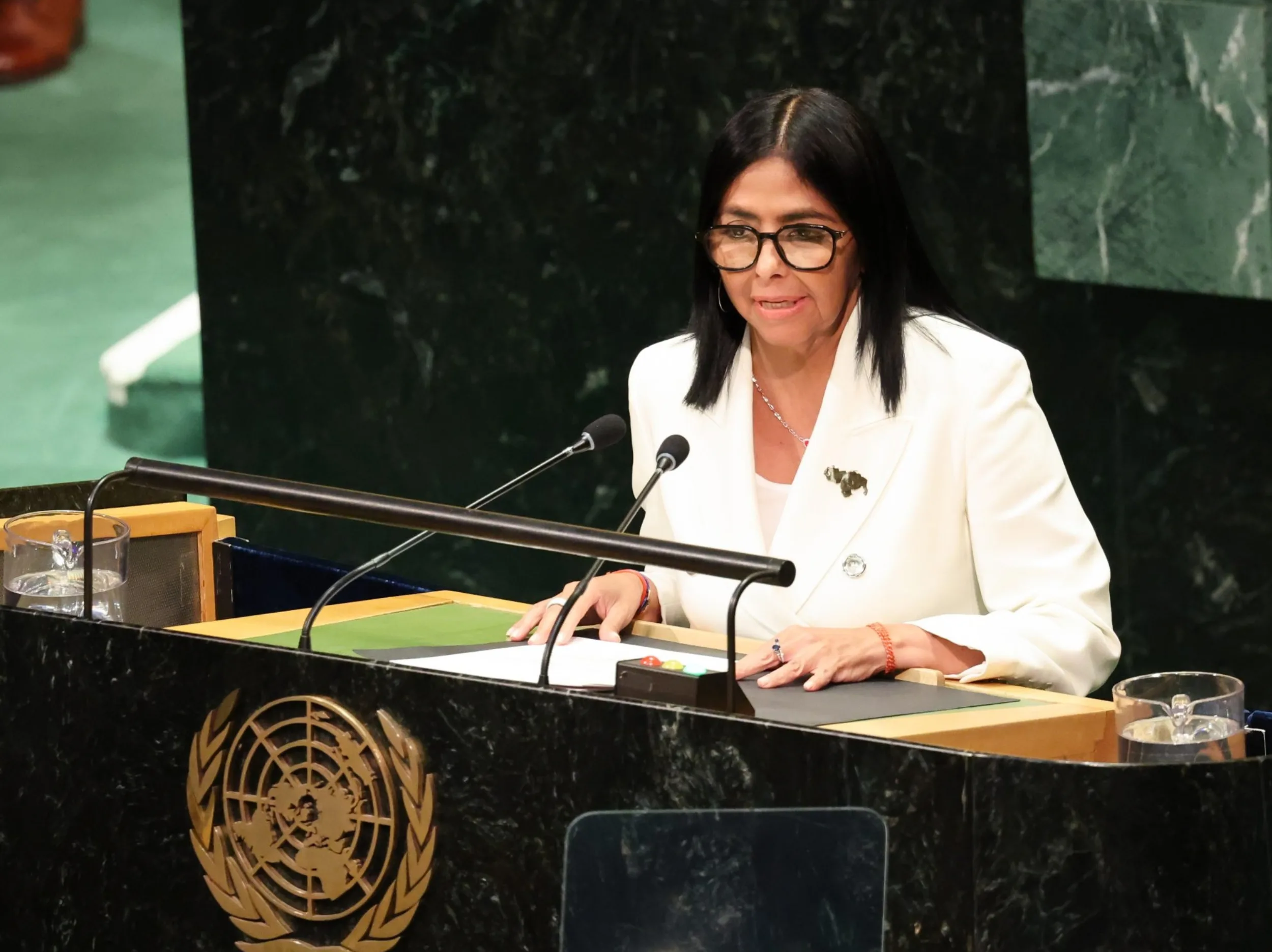
The acting president of Venezuela, Delcy Rodríguez, spoke at the 81st General Assembly of the United Nations, in New York, this Wednesday (23). In her intervention, the head of the Venezuelan Executive did not mention President Nicolás Maduro, who remains kidnapped in a US prison, and called the military aggression on January 3rd an “intensified confrontation with the United States”.
“In 2026, Venezuela experienced two great and painful trials in its life as a nation: one derived from the strangulation of its internal political life and the heightened confrontation with the United States of America; another arising from the ferocity of nature, the double earthquake of June 24. Despite these strong blows of life, as the poet César Vallejo would say, for Venezuelans, today Venezuela is reborn”, said the acting president, repeating the slogan of the campaign to rebuild the country after the tragedy.
Rodríguez mentioned the recent agreement signed with the United States for oil exploration by foreign companies in the country and thanked Donald Trump, with whom he met in New York on Tuesday night (22), to discuss strategic partnerships in the areas of energy, mining and combating transnational crime.
“I highlight the recent binational agreement between the United States and Venezuela as one of the greatest ever written, which will contribute to the energy balance of the hemisphere and the international economy. A separate mention is made of artificial intelligence, which represents a true technological revolution”, said the president in a speech read.
“I would like, in this 81st UN General Assembly, to thank President Donald Trump and his government for their willingness to resume the path of diplomatic relations and cooperation with Venezuela. The last time two presidents of Venezuela and the United States met was in 2009. Today we work seriously to resolve, through dialogue, existing differences, but mainly to prepare the paths for the energy relationship, the promotion of security, the common fight against transnational crime and economic cooperation for the benefit of both peoples and our continent”, declared Rodríguez.
Sanctions and reconstruction
The head of the Venezuelan Executive thanked the international community for its solidarity in the face of the double earthquake on June 24 and defended the end of economic sanctions, without mentioning the main applicator of these measures, the United States.
Rodríguez defended that the country’s national rebirth depends on dialogue, diplomacy and respect for sovereignty to overcome political conflicts.
“We know that sanctions undermine economic and financial freedoms and slow human development,” he said. “In the same way, the institutional failure of global trade is evident, because no nation can prosper under supranational schemes that do not promote national industry and reward relocation. International stability requires resolving the energy trilemma: simultaneously guaranteeing security of supply, affordable prices and environmental sustainability”, added the acting president.
‘There will be elections’
When dealing with domestic politics, the governor announced the beginning of a process of democratic and institutional transformation. The plan foresees a reform of the justice system to ensure legal guarantees for citizens and investors, in addition to promoting political dialogue with opposition sectors, with a view to holding future transparent and inclusive elections.
“Democracy is not measured by the existence of elections. Democracy is measured by the quality of the competition that precedes these elections”, declared Rodríguez, who, on the other hand, stated that “there will be elections” in the country.
“An election must be a solution, not a generator of irreconcilable conflicts. I want to say it very clearly in this General Assembly: in Venezuela there will be elections and, in this direction, we begin a political dialogue with sectors of the opposition that leads to a process with equal conditions for all”, said the leader.
Otherwise, he once again stated that he hopes to hold elections “in one that is not subject to economic restrictions”.
“The Venezuelan people, with their ancestral wisdom, will determine the correct moment and their institutions will be prepared to guarantee this inclusive and transparent process in a country that is not subject to economic restrictions of any kind so that their right to development is guaranteed”, said the president, who, for the first time, spoke of “democratic transition”, when defending that internal issues must be resolved internally.
“History has taught us that some of the most solid democratic transitions in the contemporary world were not born from rupture, but from transformation firmly led from the institutions themselves. That is the inspiration”, stated Delcy Rodríguez.
Appeal to the international community
The acting president appealed to the international community to support the changes that have been made in the country, and called for an end to the diplomatic isolation to which Venezuela has been subjected in recent years.
“I ask for the support of the international community so that it willingly supports the changes that Venezuela needs, based on respect for my country’s self-determination. Venezuela wants to breathe free, exercise its rights as a sovereign nation, without any type of interference; a Venezuela that is admired and respected.”
The acting president said she “assumes a historic responsibility” to lead Venezuela “from a stage of uncertainty and conflict to a stage of full democracy, recognized by its own people and the world”.
“To my beloved people I say: this is not the end of a speech, it is the beginning of a commitment. To the international community I say: Venezuela is ready to walk hand in hand with anyone who believes in a respectful international relationship, without interference or pre-judgment”, he highlighted.
Guyana Esequiba: territorial dispute
The Venezuelan leader also reiterated the country’s historical rights over the Guayana Esequiba region, defending the resolution of the territorial dispute with Guyana through bilateral negotiations.
“I cannot fail to mention in this space, the seat of international legality, our reaffirmation of Venezuela’s historic rights over Guiana Essequiba and the appeal to the Cooperative Republic of Guyana to resolve and return to negotiations, as mandated by the Geneva Agreement. The agreements that last the longest are those that come from bilateral negotiations through external bodies”, declared the president.
The International Court of Justice (ICJ) is judging a case, brought by the Guyanese government in 2018, to resolve the territorial dispute through the courts. In turn, Venezuela does not recognize the competence of the ICJ to judge the case and claims the validity of the so-called “Geneva Agreement”, signed in 1966, which provides for the resolution of the conflict in a “practical, peaceful and satisfactory way for the parties”.
Source: www.brasildefato.com.br