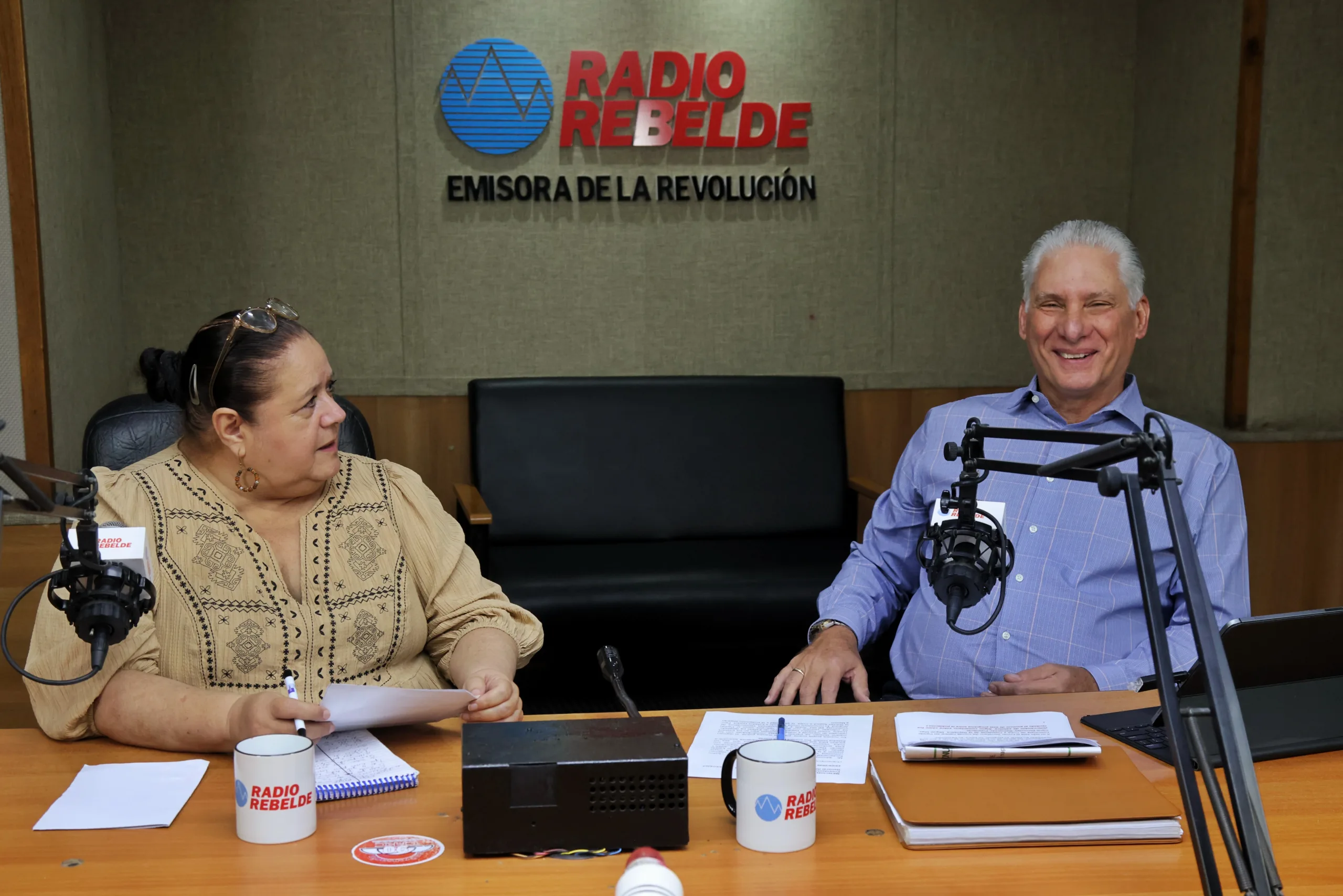
The president of Cuba, Miguel Díaz-Canel, debuted this Wednesday (23) Shared Criteriona radio program broadcast live by the national broadcaster Radio Rebelde and presented together with journalist Bárbara Betancourt. The new production will air every two weeks, on Wednesdays, and was presented as a space for citizen participation and direct dialogue with the population.
Under the slogan “Every voice in Cuba matters”, the program counts on the participation of listeners from different territories of the country, who can present opinions, complaints and questions. The first edition was dedicated to the economic and social transformations that Cuba is going through and the population’s concerns with the implementation of the new measures.
In this first edition, several people from different parts of the country reported problems and difficulties in their daily lives. Among them, a retiree stated that her pension is not enough to live on, while a worker spoke about high inflation.
The audio of a woman from the province of Cienfuegos, a member of a network of women food producers, was also broadcast. In her intervention, she questioned the distance between national policies and guidelines and their application in the territories and demanded greater control to ensure that decisions adopted at the central level are effectively fulfilled at the base.
As an example, he reported that he had been requesting uncultivated land for more than ten years to produce food for his community, but that it had not yet been granted due, as he explained, to bureaucratic problems at the municipal level.
“For more than ten years we have been requesting uncultivated land here within the community, which today is full of garbage and, even when the Ministry of Agriculture came, carried out the investigation and decided in our favor, the land was not handed over to us by the Arroyo Naranjo Municipal Police Station”, he stated.
Díaz-Canel recognized the problem and highlighted the need to strengthen popular control and participation.
“You will have an answer about your land, and I think so, that we have to give you the land, because, in addition, we are speeding up land deliveries,” he stated. He also defended the need to strengthen “control over how things also reach the municipality”.
A bet on listening
Shared Criterion It is Díaz-Canel’s second periodic communication space with the population. The first was From the Presidencya podcast that began to be broadcast at the beginning of 2024 and had 32 episodes, in which themes of the national situation were addressed, such as the increase in the price of internet service on the island and the crisis in the electrical system, before ceasing to be broadcast in mid-2025.
Unlike that experience, transmitted exclusively over the internet, Shared Criterion invests in radio, a means of communication that has a wide reach in Cuban homes and that allows it to reach the population in a context in which internet connection is unstable and expensive, while power cuts affect a large part of the country.
The focus on dialogue occurs, moreover, at a time when the island is going through a severe crisis, largely as a consequence of the effects of the economic war that, according to the Cuban government, the United States is waging against the country. At the same time, Cuba is experiencing intense debates about the economic and social transformations that are being implemented. Given this scenario, the program focuses on listening directly to the population and airing their concerns, demands, questions and criticisms.
The economic transformations
During the program, Díaz-Canel also referred to the 176 economic transformations that are being implemented in the country and defended popular participation as a central element of this process.
“Even if there is private initiative, even if there is a market, even if there is foreign investment, the people are in charge through their institutions,” stated the president. Along these lines, he maintained that “the market is a tool, and not a master, as it is in capitalism”.
Díaz-Canel insisted that ongoing economic changes require the participation and control of the population to respond to the needs of the majority.
“These transformations will only work if we participate as a people, if we control as a people, if we demand as a people and if, as a people, we get involved. This is the difference between a change that serves the people and a change that only serves a few”, he highlighted.
Likewise, he rejected that the transformations imply a turn towards capitalism.
“These transformations are not a turn towards capitalism nor are they a process of capitalist restoration. They are the updating of our economic and social model in a socialist construction that also needs to be innovative in the midst of the situation. No country under socialist construction in the world has been subjected to the longest blockade in history by the most powerful nation in the world. And now this blockade has worsened as an energy blockade”, he stated.
Díaz-Canel also recalled that, at other times, the Cuban Revolution resorted to mechanisms and made decisions that, according to him, were not to its liking, but that it considered necessary to preserve its achievements.
“And I remember that this is not the first time that the Revolution has had to resort to certain mechanisms, to certain decisions that we don’t like to save the Revolution. To save the Revolution’s achievements, and that is a revolutionary expression: defending socialism”, he stated.
Source: www.brasildefato.com.br