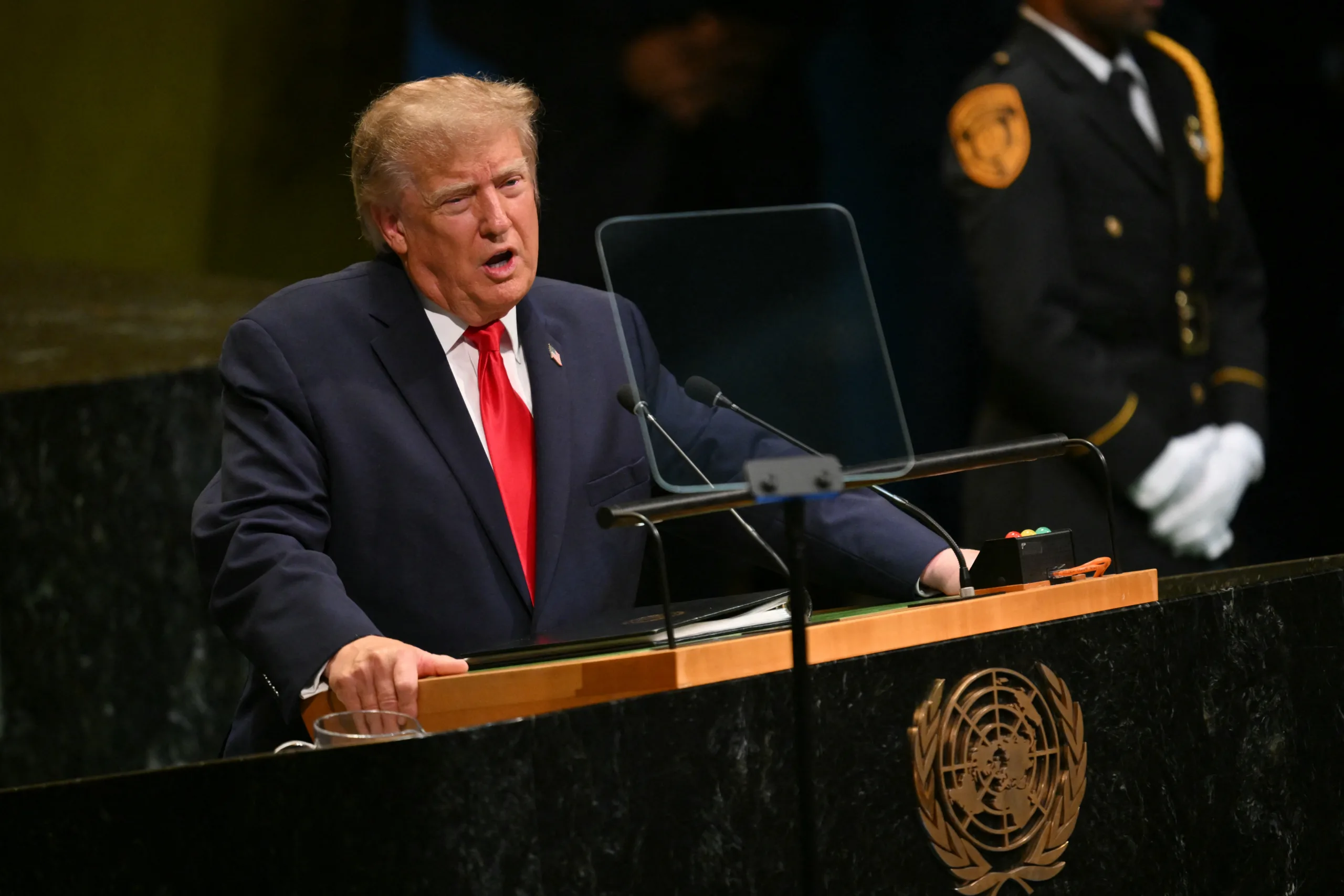
The President of the United States, Donald Trump, left aside moderation in his speech made this Tuesday (22) during the General Assembly of the United Nations (UN), in New York. The republican was the second international leader to speak at the event, right after President Lula (PT), and dedicated most of his time on the platform to talking about his own government, criticizing the main institutions of multilateralism. The general aspect of the speech, as usual, was the misalignment of Trump’s arguments with the concrete reality of the world.
The speech was marked by threats against Iran, which Trump said he could “annihilate to hell”; denial of the climate crisis, stating that the world “is colder and no one has died”; and rejection of attempts to regulate artificial intelligence, saying that “the United States embraces the world of superintelligence”.
Criticism of Iran
Trump once again said that Iran “will never have a nuclear weapon”, stating that his government would have “a big decision ahead”, but did not announce what exactly would be decided. “A deal will be made with Iran so that they can rebuild a great country, like it was before, perhaps one of the biggest countries in the Middle East, or do I have to annihilate the hell out of the Islamic Republic quickly? Let’s try to make a deal right after the elections”, speaking of the mid-term elections in the USA, scheduled for November 3rd.
The speech served to shape American foreign policy, marked by constant pressure on historical allies, attempts to contain China’s economic and geopolitical expansion and extensive use of customs tariffs. According to Trump, the practice is based on direct action. “While others spoke, I acted. While others spoke about peace, I made peace,” said the Republican. The US, however, remains at war with Iran.
Despite citing a hypothetical lull in the relationship between the countries, Trump’s speech was marked by a warlike tone. The president did not hesitate when celebrating the use of American military power in the Western Hemisphere. “Our actions in Venezuela are proof that the United States will no longer allow threats against America to create a foothold anywhere in the Western Hemisphere and, if necessary, we will use our unmatched military might to protect our vital national interests,” he mentioned. When talking about the Latin American country, Trump used a catchphrase: “To the winners, the spoils”. In his speech, the Republican denied that the war in the Middle East had exhausted US strategic ammunition reserves.
“We unleash the power of the U.S. Military to eliminate bloody gangs and drug cartels. The cartels are the Islamic State of the Western Hemisphere,” he said. Lula, in turn, said that the Brazilian government has acted to combat organized crime and rejected any attempt at foreign interference in this regard.
Despite the confrontational approach, Trump, this time, did not criticize Europe as much as he had done in recent months. However, the American spoke about a “northern border”, creating a new expression to refer to Greenland. Without providing any details, the president said that the US had reached an “unprecedented agreement” with Denmark, and that he would sign the agreement soon. In Trump’s words, the agreement “gives the US permanent control over the security and all needs in that territory”.
Artificial intelligence
Trump, who even opened a poll on social media to change the name of artificial intelligence, took advantage of the time at the UN Assembly to say that there would be unnecessary fear about the technology. He compared it, without providing reasons, with the debate on the environment.
“The same people who said we would all die in 12 years because of global warming, a name that was reborn for climate change because the planet was cooling, not warming, and no one had died,” he said. “I’m not going to stifle the growth of something that will be bigger than the industrial revolution, many say bigger than the industrial revolution or the internet itself,” he explained. This week, the Republican receives the president of China, Xi Jinping, in Washington, and AI should be at the center of the agenda.
Source: www.brasildefato.com.br