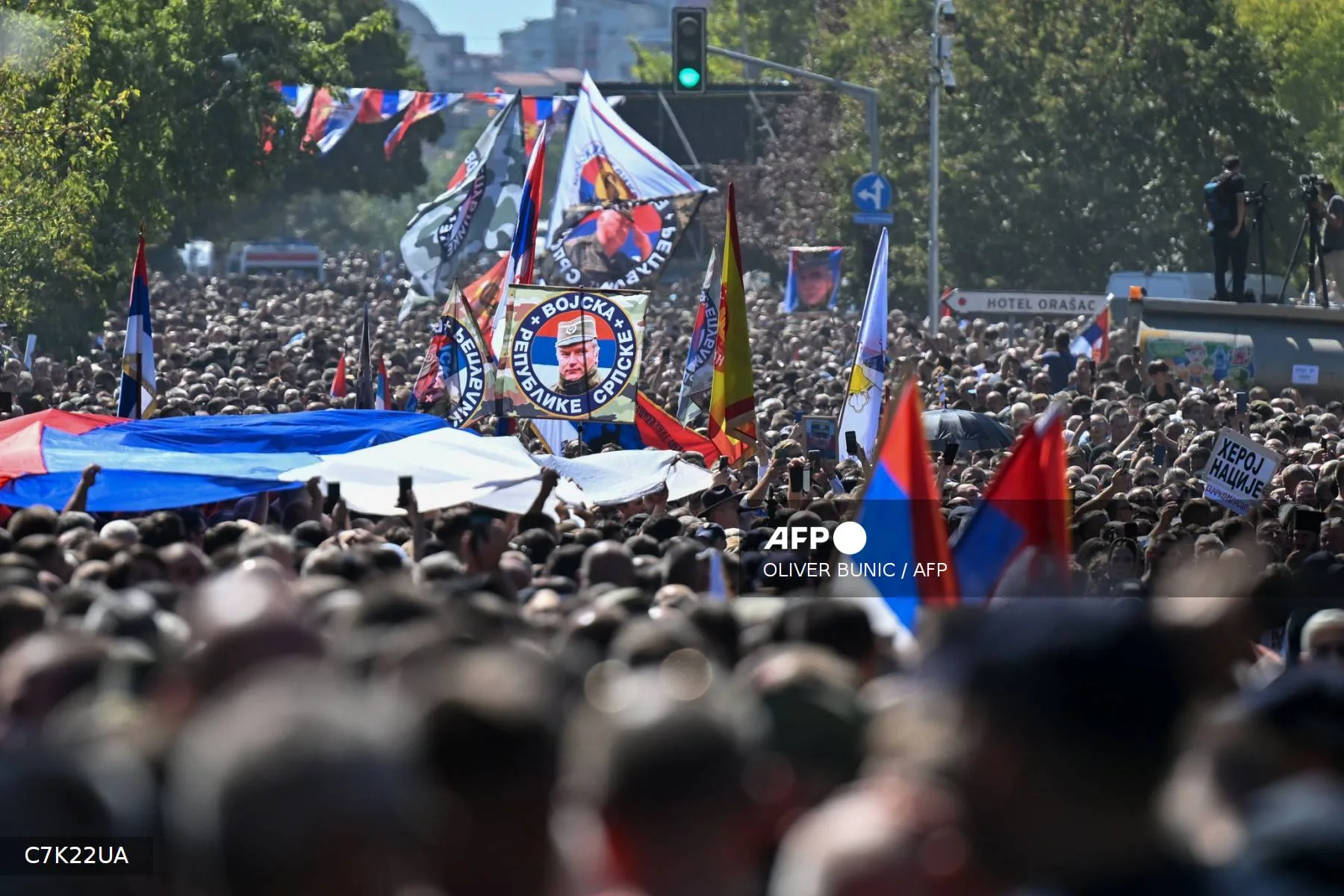
Thousands of people gathered this Monday (7), in Belgrade, capital of Serbia, for the funeral of Ratko Mladić, former commander of the Bosnian Serb forces sentenced to life imprisonment for genocide, crimes against humanity and war crimes committed during the Bosnian War, between 1992 and 1995.
Mladić died on August 27, aged 84, while serving time in The Hague, Netherlands. This Monday, supporters arrived at the Church of São Lucas from the early hours of the morning, where the body was laid to rest before the burial. According to the agency Reuters and the newspaper The Guardian, many carried Serbian flags and images of the former general.
Free buses were made available to transport participants from different cities in Serbia and Republika Srpska, an autonomous region with a Serb majority that is part of Bosnia and Herzegovina. Veterans of the wars of the 1990s stood guard at the coffin, while family members received condolences.
Despite international condemnation, Mladić continues to be treated as a hero by nationalist sectors in Serbia and Republika Srpska. After the soldier’s death, new murals in his honor appeared in Belgrade, and vigils were held in Republika Srpska.
The tributes to Mladić also provoked reactions in Belgrade. According to Jacobinresidents of a block in the center of the Serbian capital organized an action to erase a new mural dedicated to the former general, painted during the early hours of the morning. The publication reports that this type of tribute is recurrent in the city and usually provokes interventions from residents, peace activists and youth groups, who cover or damage the murals.
Opposition leaders also spoke out after Mladić’s death, arguing that the crimes committed during the war and the Srebrenica genocide should not be forgotten or relativized. Mladić’s death occurred amid preparations for new parliamentary elections in Serbia, called after protests against the current government, but no date has yet been set.
According to the Jacobinthe episode once again exposed the ambiguous relationship between the government of Aleksandar Vučić, leader of the Serbian Progressive Party (SNS) and the main force in the nationalist camp in the country, with the legacy of the former commander. The government operates in a nationalist camp and politically resorts to themes linked to Serbian identity, Kosovo and the memory of the wars of the 1990s.
The Minister of Justice initially stated that Mladić, having been a general, would be buried according to military and state protocols. Vučić, however, retreated from this sign and began to mention the “family’s wishes”, avoiding confirming the holding of a state-sponsored funeral.
Serbia has been a candidate for membership of the European Union since 2014, but the process has been at a standstill in recent years. European Commissioner for Enlargement Marta Kos canceled a planned visit to Serbia and stated that the glorification of Mladić is incompatible with the values demanded in the EU entry process.
In a statement, the bloc also declared that the glorification of those convicted of war crimes, the denial of genocide and revisionism have no place among candidate countries for membership.
Genocide in Srebrenica and siege of Sarajevo
Mladić was an officer in the Yugoslav People’s Army before becoming, in May 1992, commander of the General Staff of the Army of Republika Srpska (VRS), formed during the disintegration of Yugoslavia. He remained in command throughout the Bosnian War.
In 2017, the International Criminal Tribunal for the former Yugoslavia (ICTY), created by the United Nations, convicted Mladić of genocide in Srebrenica and of persecution, extermination, murder, deportation, forced transfer, attacks against civilians, terror and hostage taking. The life sentence was confirmed in 2021.
According to the court, Mladić participated in an operation aimed at permanently removing Bosnian Muslims and Croats from territories claimed by Bosnian Serb forces. He was also blamed for the campaign of bombings and sniper attacks designed to spread terror among Sarajevo’s civilian population.
The main conviction was for the Srebrenica massacre in July 1995. After taking over the region, which had been declared a safe area by the United Nations, Bosnian Serb forces killed around 8,000 Bosnian Muslim men and boys. The court ruled that there was an intention to eliminate the Muslim population of Srebrenica and classified the massacre as genocide.
The Bosnian War was one of the conflicts that accompanied the dissolution of socialist Yugoslavia in the early 1990s. The Srebrenica massacre occurred in the final months of the war and preceded a broad bombing campaign by the North Atlantic Treaty Organization (NATO) against Bosnian Serb positions.
Source: www.brasildefato.com.br