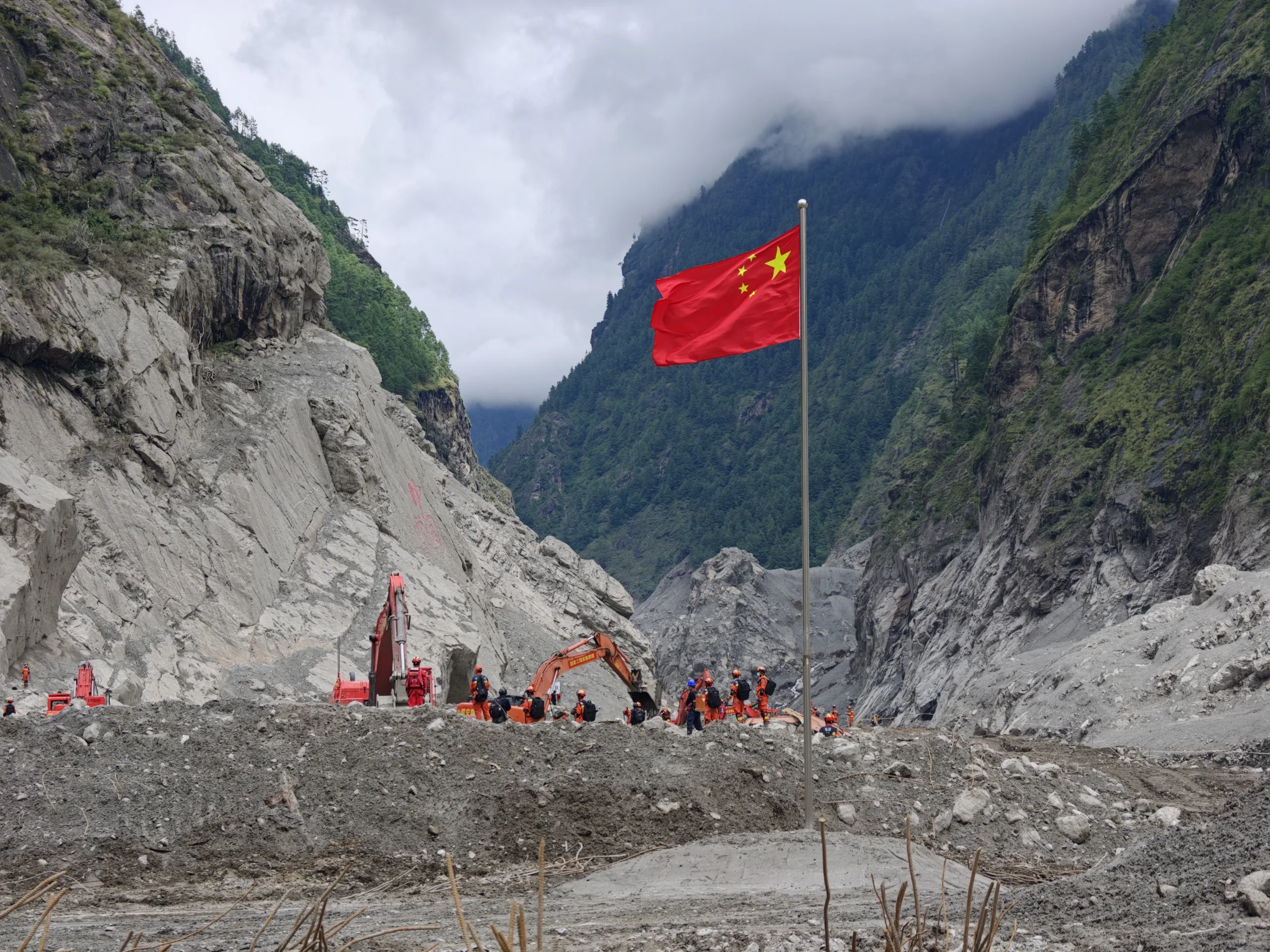
China updated the figures on the impacts of the landslide caused by the collapse of a glacier in Nepal, in Gyirong (also known as Jilong), a city located in the county of the same name, in the Xizang Autonomous Region (Tibet), China.
The death toll from the landslide that destroyed the Jilong border post has risen to 43; another 519 people remain missing. The data was released yesterday (6) at a press conference held in the disaster zone. THE Brazil in fact was present as part of the first delegation of foreign journalists that accessed the site.
Jilong is part of Shigatse prefecture, the second largest city in Xizang. At the press conference, the executive vice president of the Xizang Autonomous Region, Ren Wei, reported that, as of Friday (5), more than 2,500 workers, more than 500 vehicles and more than 9,000 sets of search equipment had been mobilized, with more than a thousand drone flights and 5.43 tons of supplies dropped by air. Also by August 27, two people had been rescued alive.
One of the main tasks after the disaster on August 26 was to clear and reconstruct part of National Highway G216, which is the only land route to the border post.
Ren Wei reported that around 500 residents from two municipalities and five villages have been transferred to nearby hotels and inns, and are receiving free food and medical attention; 555 stranded tourists and 1,720 Nepalese citizens at the border were also assisted, according to the region’s vice president.
O Brazil in fact asked about the current situation and secondary risk monitoring systems. Luobu Ciren and researcher Su Pengcheng, from the Institute of Mountain Disasters and Environment of the Chinese Academy of Sciences, said that there are four monitoring fronts: the damming lake formed in the disaster; of slopes with unstable residual material; geological in the five nearby villages and on National Highway 216; and satellite and drone tracking of glaciers and glacial lakes around the zone. Until yesterday morning, more than 20 experts operated 100 sets of equipment and recorded more than ten small ice detachments in the channel; the entry of journalists required risk assessment.
Su Pengcheng said that there are three needs regarding improving monitoring of this type of risks. The first is to deepen research into the mechanisms of chained disasters in the Himalayas: understanding the process of glacier instability at extreme altitudes, developing early warning models and simulating the progression of ice and rock avalanches before they reach inhabited areas. Second, build an integrated “contactless” satellite, air and ground monitoring system to reduce dependence on field personnel at extreme altitudes: synthetic aperture radar satellites (which can emit and analyze their own microwave pulses), capable of operating in clouds and heavy rain, and combined with low-power satellite communications terminals to transmit data from border areas without network coverage. The third is to build a cross-border cooperation mechanism.
Missing foreigners
A few days after the disaster, some Western media reported that China was censoring information about the disaster. The accusation was, in a way, made during the press conference by journalists from hegemonic media present.
The deputy director of the Xizang Foreign Affairs Office, Yang Lahong, confirmed that 261 foreigners from 23 countries were among those missing. In response to questions from journalists from United States outlets, Yang explained that the identities were not publicly disclosed for privacy reasons, and that they have been communicated through diplomatic channels to the embassies of the countries of origin.
Regarding whether families will be informed if belongings are found without a corresponding body, Yang said yes. Xizang Deputy Director of Public Security Pu Weidong said that 993 personal items were collected, numbered and catalogued; 60 forensic technicians in three laboratories are collecting DNA, fingerprints and physical characteristics, comparing them with samples provided by family members. A 24-hour hotline for foreign family members, in English and Nepali, has so far received 509 calls.
The port is a historic node on the historic Tea and Horse Route and the Tang-Tibet Road, accounting for 14 billion yuan (about R$10.8 billion) in trade over the past five years, accounting for more than 40% of Shigatse’s trade volume in 2025. Luobu Ciren said that studies are already underway to resume the port’s functions.
Source: www.brasildefato.com.br