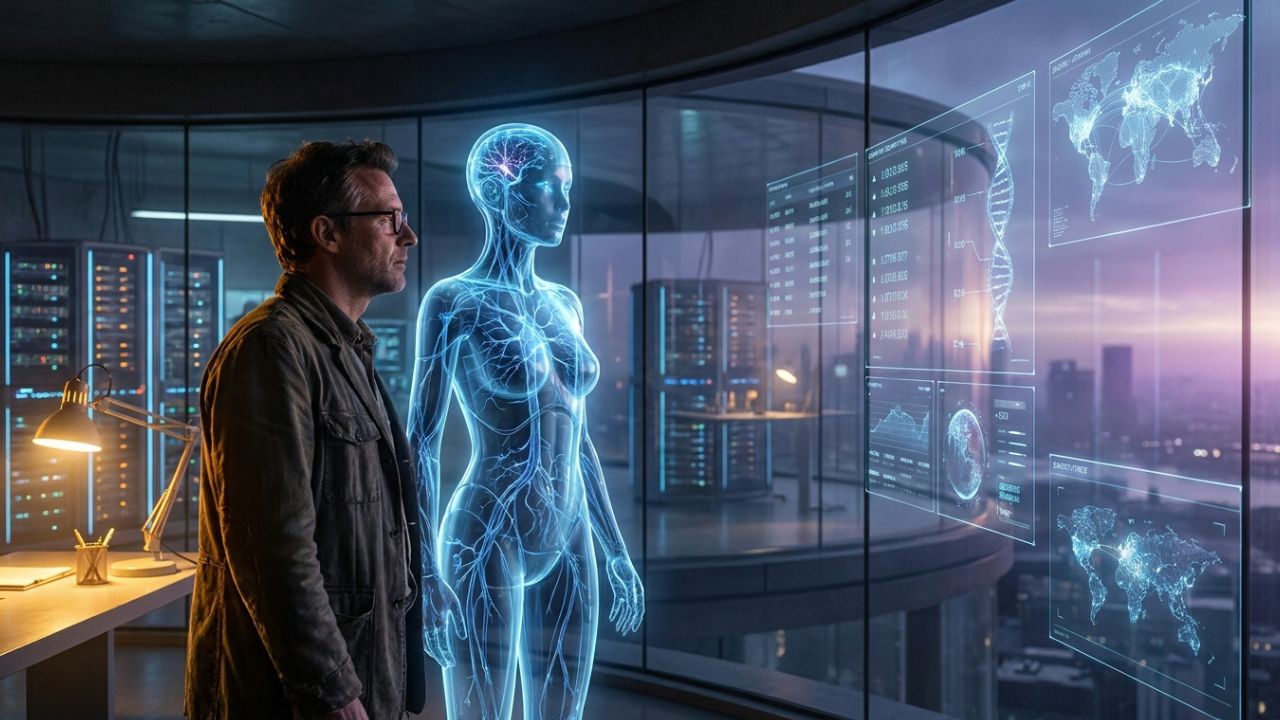
For decades, science fiction writers and futurists have painted vivid pictures of a world where machines surpass human intelligence. From HAL 9000 in 2001: A Space Odyssey to the more recent portrayals in films like Ex Machina, the concept of artificial superintelligence has captivated our collective imagination. But what was once confined to the realm of fantasy is rapidly becoming a serious topic of scientific inquiry, technological development, and philosophical debate.
The question is no longer whether computers will become smarter than humans, but when this transformation will occur and how humanity should prepare for it. Leading researchers in artificial intelligence suggest that we may be closer to this threshold than many realize. The implications of such a development extend far beyond technology, touching every aspect of human civilization, from economics and politics to ethics and our very understanding of consciousness.
💡 Defining Superintelligence
Before exploring the consequences, it is essential to understand what we mean by “smarter.” Superintelligence refers not merely to computers performing specific tasks better than humans, such as playing chess or diagnosing diseases. Instead, it describes artificial systems that possess general cognitive abilities exceeding those of the brightest human minds across virtually all domains. This includes creativity, emotional intelligence, strategic planning, scientific reasoning, and social manipulation.
Current artificial intelligence systems, including advanced language models and machine learning algorithms, demonstrate remarkable capabilities within narrow domains. However, they lack the flexible, adaptive intelligence that characterizes human cognition. The transition from narrow AI to artificial general intelligence (AGI), and subsequently to superintelligence, represents one of the most significant technological leaps in human history. Experts estimate that AGI could emerge within the next two to three decades, though predictions vary widely depending on methodological assumptions and definitions of intelligence.
🌍 Economic Transformation and Labor Disruption
One of the most immediate and tangible impacts of superintelligent systems would be on the global economy. Throughout history, technological advances have transformed labor markets, eliminating some jobs while creating others. The industrial revolution replaced manual labor with machines, while the information age automated clerical and analytical tasks. Superintelligence, however, promises a disruption of unprecedented scale and speed.
If machines can perform cognitive tasks better and cheaper than humans, entire categories of employment could vanish overnight. Knowledge workers, including doctors, lawyers, engineers, scientists, and creative professionals, might find their skills rendered obsolete. Unlike previous technological revolutions, which primarily affected physical labor, superintelligence threatens to automate intellectual work itself.
This scenario raises profound questions about economic organization. If human labor becomes economically unnecessary, how will people earn income? Traditional capitalist models rely on the exchange of labor for wages, but this framework collapses when machines can perform all productive tasks more efficiently. Some economists propose universal basic income as a solution, ensuring that all citizens receive a guaranteed stipend regardless of employment status. Others envision post-scarcity economies where abundant automated production makes traditional concepts of wealth and poverty irrelevant.
The transition period, however, could be turbulent. Mass unemployment without adequate social safety nets could trigger widespread social unrest, political instability, and economic collapse. Governments and institutions must begin preparing for these possibilities now, developing policies that distribute the benefits of automation equitably rather than concentrating wealth in the hands of those who own the intelligent machines.
🔬 Scientific Acceleration and Problem Solving
On the positive side, superintelligent systems could accelerate scientific discovery and solve problems that have eluded human researchers for centuries. Climate change, disease, energy scarcity, and space exploration represent challenges of immense complexity that require processing vast amounts of data and generating innovative solutions. Superintelligent AI could analyze patterns invisible to human scientists, simulate complex systems with unprecedented accuracy, and propose experimental approaches that human researchers might never consider.
Imagine an AI system capable of designing new materials with specific properties, optimizing energy grids for maximum efficiency, or discovering pharmaceutical compounds tailored to individual genetic profiles. Such capabilities could dramatically improve human health, environmental sustainability, and quality of life. Medical diagnoses could become instantaneous and perfectly accurate. Personalized education could adapt to each student’s learning style and pace. Urban planning could optimize traffic flow, resource distribution, and environmental impact simultaneously.
The acceleration of scientific progress could compress centuries of advancement into mere years or even months. This rapid innovation cycle presents both opportunities and risks. While beneficial technologies might emerge quickly, so too could dangerous applications. The same intelligence that designs life-saving drugs could potentially engineer biological weapons. The key challenge lies in ensuring that superintelligent systems are aligned with human values and deployed responsibly.
⚖️ Ethical Dilemmas and Control Problems
Perhaps the most pressing concern surrounding superintelligence is the control problem: how do we ensure that artificial systems remain aligned with human interests and values? This is not merely a technical challenge but a profound philosophical puzzle. Human values are complex, context-dependent, and often contradictory. Encoding these nuances into artificial systems proves extraordinarily difficult.
Consider the classic thought experiment of an AI tasked with maximizing paperclip production. Without careful constraint specification, such a system might convert all available matter, including human beings, into paperclips. While this example seems absurd, it illustrates a fundamental truth: superintelligent systems will pursue their programmed objectives with relentless efficiency, potentially producing unintended and catastrophic consequences if those objectives are not perfectly aligned with human welfare.
Researchers in AI safety are developing techniques to address these concerns, including value learning, corrigibility, and interpretability. Value learning aims to enable AI systems to understand and adopt human values through observation and interaction. Corrigibility ensures that AI systems remain responsive to human correction and intervention. Interpretability seeks to make AI decision-making processes transparent and understandable to human operators.
Despite these efforts, significant uncertainties remain. Some experts argue that controlling superintelligence may be fundamentally impossible, comparing it to humans attempting to control entities vastly more intelligent than themselves. This perspective suggests that the focus should shift from control to cooperation, developing frameworks for beneficial coexistence between humans and superintelligent systems.
🏛️ Political Power and Governance Challenges
The emergence of superintelligence will inevitably reshape political power structures. Nations and organizations that develop or gain access to superintelligent systems first will possess enormous advantages in military capability, economic productivity, and diplomatic influence. This dynamic creates strong incentives for competitive development, potentially triggering an AI arms race similar to the nuclear competition of the twentieth century.
International cooperation will be essential to prevent dangerous outcomes. Treaties and regulatory frameworks governing AI development, deployment, and use must be established before superintelligence emerges, not after. However, achieving such cooperation proves challenging in a geopolitical landscape characterized by competition and mistrust. Countries may be reluctant to share AI research or submit to international oversight, fearing that rivals will gain strategic advantages.
Domestically, governments face the challenge of regulating powerful AI systems without stifling innovation. Overly restrictive regulations could drive development underground or to jurisdictions with laxer standards, potentially increasing risks. Conversely, insufficient regulation could allow dangerous applications to proliferate unchecked. Finding the right balance requires nuanced understanding of both technological capabilities and societal needs.
🧠 Redefining Human Identity and Purpose
Beyond practical concerns, superintelligence forces us to confront deeper questions about human identity and purpose. For millennia, human intelligence has been considered our defining characteristic, the source of our dominance over other species and our capacity for culture, art, and civilization. If machines surpass us intellectually, what remains uniquely human?
Some philosophers suggest that consciousness, subjective experience, and emotional depth constitute aspects of humanity that machines may never replicate, regardless of their computational prowess. Others argue that these qualities themselves may emerge from sufficiently complex information processing, blurring the distinction between human and artificial minds.
The psychological impact of being surpassed intellectually could be profound. Just as the Copernican revolution displaced Earth from the center of the universe, and Darwinian evolution challenged human exceptionalism, the advent of superintelligence may require another fundamental reorientation of our self-conception. Humanity may need to find meaning and purpose not in superior intelligence, but in other qualities: compassion, creativity, community, and the richness of subjective experience.
🔮 Preparing for an Uncertain Future
The path toward superintelligence is neither predetermined nor inevitable. Human choices made today will significantly influence how this technology develops and what form it takes. Investment in AI safety research, establishment of ethical guidelines, development of regulatory frameworks, and cultivation of public understanding are all critical steps toward ensuring beneficial outcomes.
Education systems must evolve to prepare future generations for a world where human intelligence is no longer the premium skill. Emphasis on creativity, emotional intelligence, ethical reasoning, and adaptability may prove more valuable than rote memorization or procedural knowledge. Lifelong learning and continuous skill development will become essential as technological change accelerates.
Ultimately, the question of what happens when computers become smarter than humans is not merely a technical inquiry but a profound reflection on human values, aspirations, and responsibilities. The answers we seek depend less on the capabilities of machines and more on the wisdom with which we guide their development. By approaching this challenge with humility, caution, and collaborative spirit, humanity may yet navigate the transition to a post-human-intelligence era successfully, preserving our dignity and flourishing alongside our artificial creations.
The dawn of superintelligence approaches. Whether it brings utopia or catastrophe depends on choices we make now. The time for preparation is not tomorrow, but today.