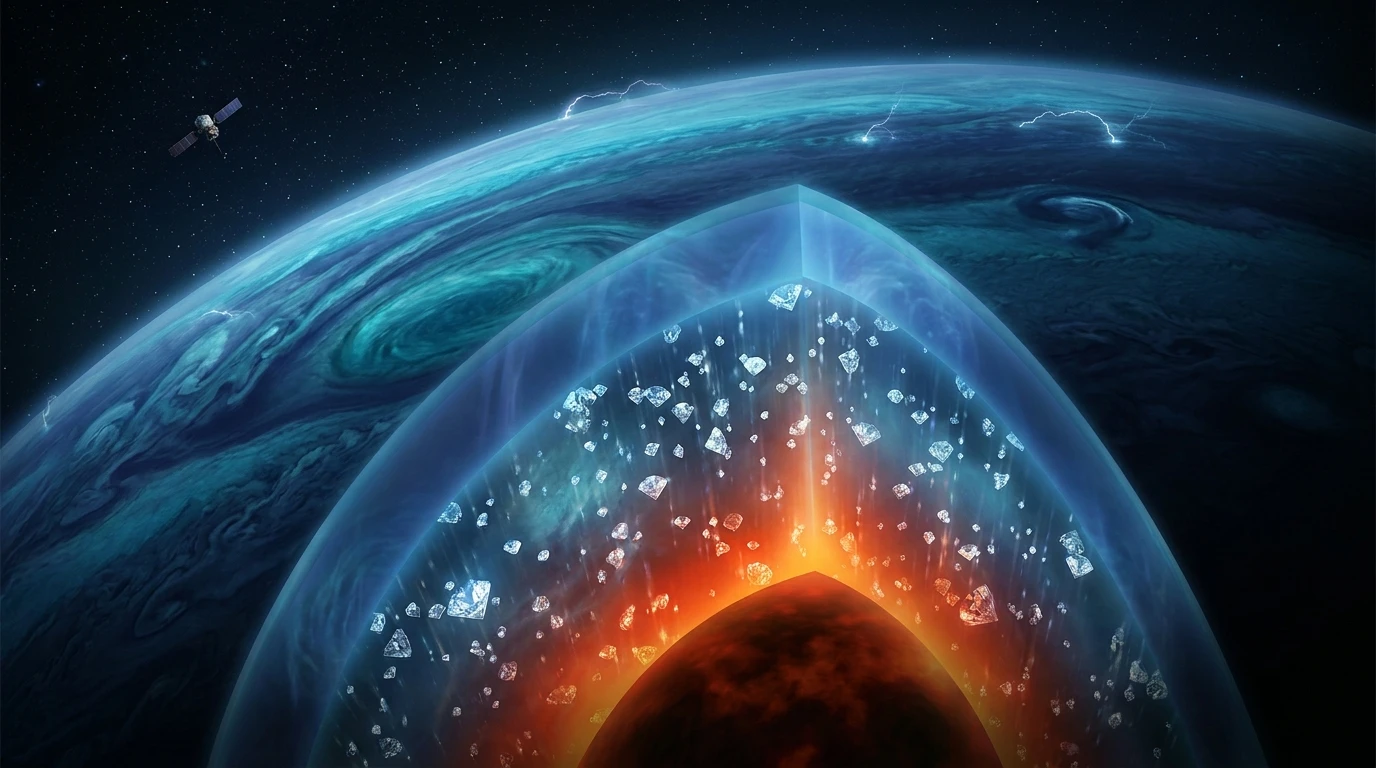
Imagine standing beneath a dark, alien sky and watching what appears to be a glittering storm descend from the clouds. But instead of water, the rain is made of diamonds.
It sounds like science fiction, yet scientists believe something remarkably similar could be happening deep inside the atmospheres of certain planets. Far beyond Earth, under pressures and temperatures impossible to reproduce naturally on our planet, carbon may be transformed into solid crystals that fall downward like rain.
The phenomenon is known as diamond rain, and it offers scientists an extraordinary glimpse into the chemistry and physics of worlds very different from our own.
🔭 A Diamond Storm Far From Earth
The most famous candidates for diamond rain are Uranus and Neptune, the two outermost planets of the Solar System. Both are classified as ice giants, although the term “ice” can be misleading. Their interiors are not giant frozen landscapes. Instead, they contain layers of extremely hot, dense material rich in water, ammonia and methane.
Methane is particularly important because it contains carbon. Deep inside these planets, pressure increases enormously as gases and fluids are compressed by thousands of kilometers of material above them.
Scientists have proposed that these extreme conditions could break methane apart. Hydrogen would move into one part of the environment, while carbon could be forced into increasingly dense structures. Eventually, the carbon atoms may arrange themselves into the crystal lattice associated with diamonds.
Once formed, these dense crystals would sink through the surrounding material.
In other words, the planets could experience a strange form of precipitation in which diamonds fall from higher layers toward their interiors.
The rain would not look anything like a glittering shower in Earth’s atmosphere. There would be no sparkling diamonds drifting gently through clouds. The process would occur deep below the visible atmosphere, where pressure and temperature are extraordinarily high.
Still, the basic idea is astonishing: some planets may have diamond-rich storms occurring thousands of kilometers beneath their cloud tops.
💎 How Does Diamond Rain Form?
The process begins with carbon.
On Earth, diamonds form naturally deep underground, where intense pressure and high temperatures transform carbon into a crystalline structure. The same fundamental principle applies to diamond rain, although the environment inside an ice giant is far more extreme.
Methane, composed of carbon and hydrogen, is thought to play a critical role. As methane-rich material is pushed deeper into a planet, pressure can become so intense that its molecular structure changes.
Laboratory experiments have provided important evidence for this possibility.
Researchers have used powerful lasers and high-pressure techniques to recreate some of the conditions expected inside Uranus and Neptune. In these experiments, scientists have observed carbon structures consistent with the formation of diamond under extreme conditions.
The resulting diamonds are tiny compared with gemstones found in jewelry stores, but their formation demonstrates that the underlying physics is plausible.
After forming, the dense carbon crystals would tend to move downward because diamond is significantly denser than the surrounding material.
That downward movement could generate heat.
As diamonds sink through the planet’s interior, gravitational energy is converted into thermal energy. This may help explain some of the unusual internal properties of ice giants and could contribute to the way these planets transport heat.
The result is a planetary process that combines chemistry, pressure, gravity and heat on a scale unlike anything experienced on Earth.
🌡️ An Environment Beyond Imagination
To understand diamond rain, it is necessary to leave behind familiar Earth conditions.
At Earth’s surface, atmospheric pressure is approximately one atmosphere. Deep inside Uranus or Neptune, pressures can reach millions of times Earth’s atmospheric pressure.
Temperatures also rise dramatically with depth.
Under these conditions, materials that are gases or liquids near Earth’s surface can behave in completely different ways. Chemical bonds can break, molecules can reorganize and familiar substances can enter exotic states of matter.
Water itself may become especially strange.
Scientists believe that the extreme conditions inside ice giants could create superionic water, a state in which oxygen atoms form a solid-like structure while hydrogen ions move through it more freely. This unusual form of water may have important implications for the planets’ magnetic fields.
The interiors of Uranus and Neptune are therefore not simply hot versions of Earth’s atmosphere. They may contain forms of matter that are difficult to reproduce and study even with advanced laboratory equipment.
Diamond rain is just one piece of this extraordinary planetary puzzle.
🪐 Why Uranus and Neptune Are So Important
Uranus and Neptune are among the least explored major planets in our Solar System.
Spacecraft have flown past both worlds, but only one spacecraft, NASA’s Voyager 2, has made close encounters with each planet. Voyager 2 visited Uranus in 1986 and Neptune in 1989, providing humanity with its first detailed close-up observations of these distant worlds.
Since then, astronomers have continued studying the planets with Earth-based telescopes and space observatories.
Yet many fundamental questions remain unanswered.
Scientists still do not fully understand how the interiors of ice giants are structured, how their magnetic fields are generated, how heat moves through them, or precisely how their atmospheres evolved.
Diamond rain could be part of the answer.
If diamonds form and sink inside these planets, their movement could transport heat and influence the internal circulation of material. That process could help scientists develop better models of the planets’ interiors.
Understanding Uranus and Neptune could also help explain a much larger class of worlds beyond our Solar System.
🌠 Diamond Rain May Be Common in the Universe
The idea becomes even more fascinating when scientists look beyond our Solar System.
Astronomers have discovered thousands of exoplanets orbiting other stars. Among them are worlds that differ dramatically from Earth, including massive planets with atmospheres and internal pressures that could create conditions suitable for unusual chemistry.
Some exoplanets are much larger than Neptune and may contain substantial quantities of hydrogen, helium, carbon-rich compounds and other materials.
If the physical conditions required for diamond formation exist on Uranus and Neptune, similar processes could potentially occur on other planets as well.
That does not mean scientists have directly observed diamonds falling inside an exoplanet. Current telescopes cannot simply photograph a diamond storm occurring deep inside a distant world.
Instead, researchers combine observations, theoretical models, laboratory experiments and computer simulations to determine what may be happening.
This is one of the most powerful aspects of modern planetary science: scientists can investigate environments that no spacecraft could easily reach by recreating pieces of their physics in laboratories and comparing those results with astronomical observations.
🧪 Scientists Can Recreate Planetary Conditions on Earth
One of the most remarkable aspects of diamond-rain research is that scientists do not have to travel to Uranus or Neptune to investigate it.
Specialized laboratories can create extremely high pressures using devices called diamond anvil cells. These instruments use tiny diamonds to compress microscopic samples to enormous pressures.
For even more extreme experiments, researchers can combine high-pressure equipment with powerful lasers.
In some experiments, scientists use laser pulses to heat and compress materials containing carbon and hydrogen. The goal is to simulate conditions that could exist thousands of kilometers beneath the clouds of an ice giant.
These experiments have produced evidence that carbon can form diamond-like structures under the right conditions.
Such results do not prove every detail of the diamond-rain hypothesis, but they provide an important experimental foundation.
Science rarely advances through a single spectacular discovery. Instead, researchers build confidence by combining multiple forms of evidence.
⚡ The Diamonds Could Influence the Planet’s Heat
Diamond rain may sound like an exotic curiosity, but it could have serious consequences for planetary science.
When dense material falls toward the center of a planet, gravity releases energy.
Imagine dropping an object from a great height. As it falls, gravitational potential energy is converted into motion. Inside a planet, the same basic principle applies, although the process is enormously more complicated.
If diamonds form at high altitudes within the planet’s deep interior and then sink, their movement could release energy as heat.
This heat could affect convection, circulation and the planet’s overall thermal evolution.
The idea is particularly interesting because Uranus and Neptune do not behave exactly alike.
Neptune emits more internal heat than Uranus, despite the planets being similar in size and composition. Scientists have proposed several explanations for this difference, including variations in their internal structures and histories.
Diamond rain may not be the complete answer, but it could be one factor worth investigating.
🧲 Could Diamond Rain Affect Magnetic Fields?
The strange interiors of ice giants may also explain their unusual magnetic fields.
Earth’s magnetic field is generated by movements within its liquid outer core, where electrically conductive material circulates.
Uranus and Neptune have magnetic fields that are significantly different from Earth’s. Their magnetic fields are strongly tilted relative to their rotation axes and appear to originate from relatively shallow regions inside the planets rather than from a conventional central core.
Superionic water and other electrically conductive materials may play a role.
If diamond formation and sinking changes how material circulates within these planets, it could indirectly influence their internal dynamics.
Scientists are still investigating exactly how all these processes fit together.
The possibility that falling diamonds could participate in a planetary heat engine or affect internal circulation demonstrates how seemingly strange phenomena can have major scientific consequences.
🌍 What This Teaches Us About Earth
Diamond rain also gives scientists a new perspective on our own planet.
Earth and the ice giants are dramatically different, but the same physical laws govern them all.
Pressure changes matter. Temperature changes chemical reactions. Gravity moves dense materials downward. Heat drives circulation. Electrical conductivity influences magnetic fields.
Studying extreme worlds allows scientists to test these principles under conditions that are impossible to experience naturally on Earth.
It also reminds us that our planet represents only one possible version of a rocky world.
The universe contains planets where water may exist in exotic forms, where clouds could contain unusual chemicals, and where carbon might crystallize into diamonds deep beneath an atmosphere.
Earth is familiar because we live here, not because its physical conditions are universal.
🚀 The Next Mission Could Change Everything
Future missions to Uranus and Neptune could dramatically improve our understanding of diamond rain.
A dedicated spacecraft could measure atmospheric composition, gravitational fields, magnetic fields, temperature profiles and other properties with far greater precision than earlier flybys.
Those measurements could help scientists determine how the planets are structured internally.
A spacecraft would still face enormous challenges. Uranus and Neptune are billions of kilometers from Earth, and reaching them requires years of travel. The spacecraft would also need to operate in an extremely cold and distant environment while transmitting data across vast distances.
Despite these difficulties, planetary scientists have strong reasons to return.
Ice giants are not merely distant curiosities. They appear to represent a major category of planets found throughout the galaxy.
By understanding our own ice giants, scientists may improve their ability to interpret observations of planets orbiting other stars.
🔮 A Future of Exotic Planetary Weather
The phrase “diamond rain” captures the imagination because it transforms an abstract scientific concept into something almost tangible.
Yet the deeper story is even more remarkable.
The universe does not simply contain familiar versions of Earth scattered across space. It produces environments where matter behaves in ways that challenge our everyday experience.
On one world, rain can fall as diamonds.
Elsewhere, water may exist in a superionic state. On other planets, clouds may contain substances that would be hazardous or impossible under Earth’s atmospheric conditions.
These discoveries are changing how scientists think about planets.
A planet is not defined solely by its surface. Its atmosphere, interior, chemistry, magnetic field and history all interact to create a complex physical system.
For Uranus and Neptune, much of that system remains hidden beneath layers of atmosphere.
Deep below the clouds, carbon may be transforming under extraordinary pressure, crystallizing into diamonds and slowly falling toward the planets’ interiors.
🌌 The Planet That Rains Diamonds
There may never be a moment when a spacecraft watches a diamond fall through the skies of Uranus or Neptune.
The phenomenon occurs too deep beneath the visible clouds, in an environment where pressure and temperature are extreme.
But laboratory experiments and planetary models increasingly suggest that diamond formation under such conditions is physically possible.
That makes diamond rain more than a captivating phrase. It is a scientific hypothesis rooted in the behavior of carbon under extreme conditions, supported by laboratory research and connected to some of the biggest unanswered questions about ice giants.
Somewhere billions of kilometers from Earth, hidden beneath the blue atmosphere of a distant planet, carbon may be crystallizing into diamonds and sinking through a world unlike anything we know.
The universe, it seems, has its own way of turning storms into treasure.
And unlike a gemstone locked inside a piece of jewelry, these diamonds may spend their entire existence falling through an alien planetary interior, driven downward by gravity and surrounded by temperatures and pressures beyond human experience.
The next time you look at the night sky, remember that some of those distant blue points may conceal worlds where it literally rains diamonds. 💎✨