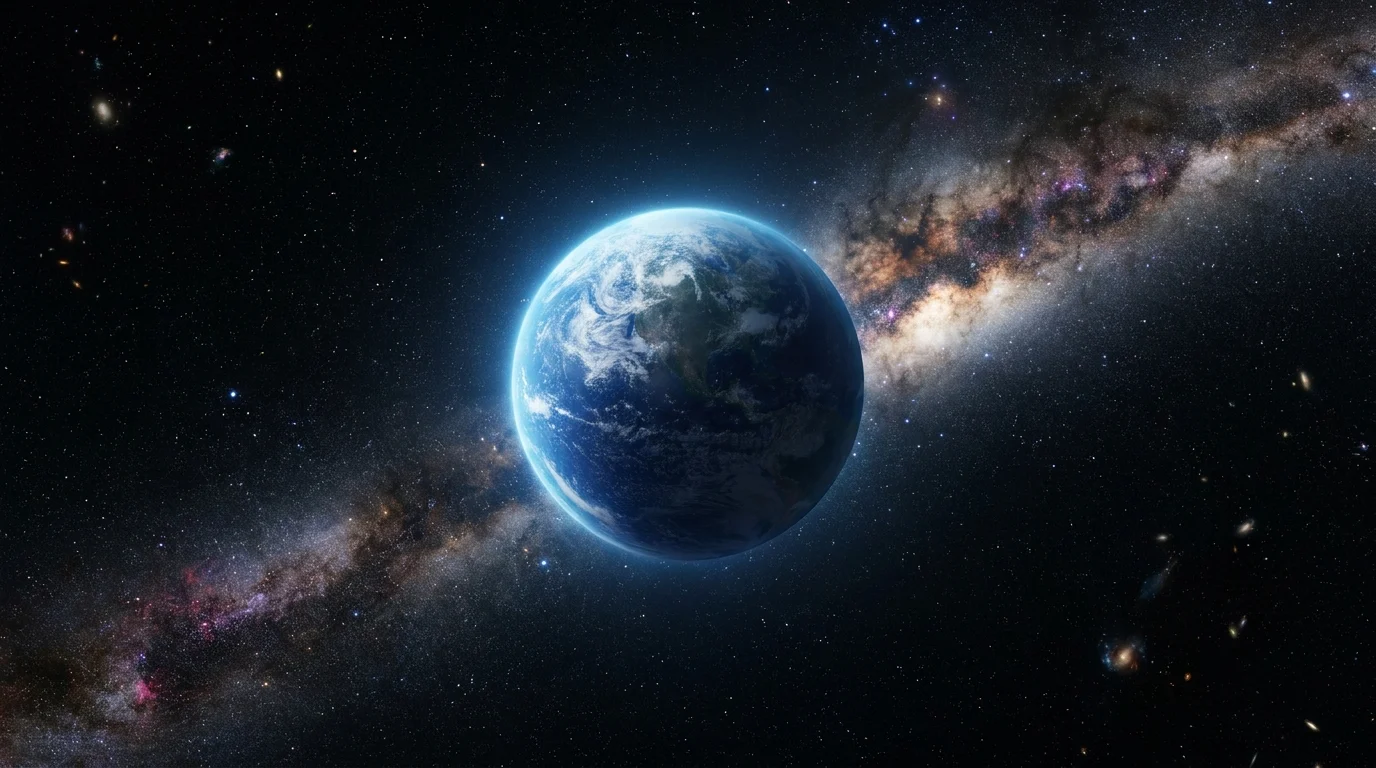
For thousands of years, humanity believed that Earth occupied the most important position in existence. Looking up at the sky, ancient civilizations saw the Sun rise in the east, cross the heavens, and disappear in the west. The Moon, planets, and stars appeared to revolve around our world. To the naked eye, the conclusion seemed obvious: Earth was the center of the Universe.
This idea influenced philosophy, religion, science, and culture for centuries. Entire civilizations built their understanding of reality around the assumption that humanity occupied a privileged cosmic position. But as scientific discoveries accumulated, this comforting worldview was challenged again and again.
Today, modern astronomy provides a dramatically different picture. Earth is not the center of the Solar System, the Milky Way, or the observable Universe. Yet the story is more fascinating than simply replacing one center with another. The question itself reveals how science evolves, how evidence reshapes beliefs, and why our place in the cosmos remains one of humanity’s greatest mysteries.
🔭 The Ancient Geocentric Model
The earliest civilizations naturally assumed that Earth stood still while everything else moved around it.
This perspective became formalized in ancient Greece, particularly through the work of philosophers such as Aristotle and later the astronomer Claudius Ptolemy.
Ptolemy developed an incredibly sophisticated mathematical model known as the geocentric system. According to this theory:
- Earth remained motionless at the center.
- The Sun orbited Earth.
- The Moon orbited Earth.
- The planets moved around Earth using complex circular paths called epicycles.
- The stars were attached to an enormous celestial sphere surrounding everything.
Although incorrect, the model predicted planetary positions surprisingly well for its time. Without telescopes or modern instruments, it represented one of humanity’s greatest intellectual achievements.
For nearly 1,500 years, the geocentric model dominated astronomy.
☀️ The Revolutionary Idea That Changed Everything
In the 16th century, Polish astronomer Nicolaus Copernicus proposed a radical alternative.
Instead of Earth sitting at the center, he suggested that the Sun occupied the central position of the Solar System.
His heliocentric model explained many puzzling astronomical observations much more elegantly.
Initially, the proposal faced skepticism because it contradicted centuries of accepted wisdom and everyday experience. After all, no one could feel Earth moving.
Yet the theory opened the door to a scientific revolution.
🔭 Galileo’s Telescope Changed the Debate
Everything changed when Galileo Galilei turned one of the first astronomical telescopes toward the sky.
His discoveries challenged the geocentric model in profound ways.
He observed:
- Mountains and craters on the Moon.
- Sunspots moving across the Sun.
- Four large moons orbiting Jupiter.
- The complete phases of Venus.
The moons of Jupiter demonstrated that not everything revolved around Earth.
Meanwhile, the phases of Venus matched predictions made by the heliocentric model but could not be fully explained under Ptolemy’s system.
Galileo’s observations became some of the strongest evidence that Earth was not the center of the Solar System.
🪐 Johannes Kepler Improved the Model
German astronomer Johannes Kepler refined Copernicus’ work.
Instead of assuming perfectly circular orbits, Kepler demonstrated that planets travel around the Sun in ellipses.
His three laws of planetary motion dramatically improved the accuracy of astronomical predictions.
These discoveries laid the mathematical foundation for modern celestial mechanics.
🍎 Isaac Newton Explained Why Planets Move
The next breakthrough came with Isaac Newton.
Newton’s theory of universal gravitation explained why planets orbit the Sun.
Gravity was no longer just an observation but a universal force acting between all objects with mass.
For the first time, scientists possessed a physical explanation that unified falling apples and orbiting planets under the same natural law.
The heliocentric model became overwhelmingly convincing.
🌠 Is the Sun the Center Instead?
Not exactly.
Although the Sun occupies the center of our Solar System, it is far from being the center of the Milky Way galaxy.
The Sun resides roughly 26,000 light-years from the galactic center.
Our Solar System takes approximately 225 to 250 million years to complete one orbit around the Milky Way.
That means the dinosaurs lived during an entirely different “galactic year” than modern humans.
🌌 The Milky Way Isn’t the Center Either
For centuries, many astronomers believed our galaxy represented the entire Universe.
That changed dramatically during the early 20th century.
American astronomer Edwin Hubble demonstrated that the fuzzy spiral nebulae seen through telescopes were actually separate galaxies located millions of light-years away.
The observable Universe contains an estimated hundreds of billions, and possibly trillions, of galaxies.
The Milky Way is simply one among an unimaginably vast cosmic population.
🚀 Does the Universe Have a Center?
Here the answer becomes more surprising.
According to modern cosmology, the observable Universe does not have a unique center in the ordinary sense.
This idea often feels counterintuitive because our everyday experience involves explosions expanding outward from a central point.
However, the expansion of space itself works differently.
Imagine dots drawn on the surface of an inflating balloon.
As the balloon expands:
- Every dot moves away from every other dot.
- No dot occupies a privileged central position on the surface.
- Every observer sees other dots moving away.
The expanding Universe behaves in a similar way, except in three dimensions rather than on a balloon’s surface.
This means every galaxy observes distant galaxies receding in all directions.
🌍 Why It Sometimes Feels Like We’re in the Center
Interestingly, every observer anywhere in the observable Universe would see themselves surrounded by expanding galaxies.
This does not mean each observer occupies a special location.
Instead, it reflects the uniform expansion of space.
In cosmology, scientists refer to this as the Cosmological Principle.
The principle states that, on sufficiently large scales, the Universe appears essentially the same regardless of location or direction.
🛰️ What About the Big Bang?
One common misconception is that the Big Bang was an explosion from a specific location into empty space.
Modern cosmology suggests something quite different.
The Big Bang represents the rapid expansion of space itself.
Every region of today’s observable Universe emerged from an extremely hot, dense state.
There was no ordinary point in space where the explosion occurred because space itself was expanding everywhere simultaneously.
Therefore, asking where the center of the Big Bang is resembles asking where the center of Earth’s surface is.
The question misunderstands the geometry involved.
🔬 How Scientists Know Earth Is Moving
Modern science confirms Earth’s motion using numerous independent observations.
These include:
- The apparent shift of nearby stars, known as stellar parallax.
- The Doppler effect in starlight.
- Precision satellite navigation.
- Measurements of Earth’s rotation.
- Observations from interplanetary spacecraft.
- The cosmic microwave background.
Together, these forms of evidence leave virtually no doubt that Earth rotates on its axis while orbiting the Sun, which itself orbits the Milky Way.
🌠 Our Cosmic Address
To appreciate just how far we are from being the center, consider our cosmic “address.”
Earth belongs to:
- The Solar System.
- The Orion Arm of the Milky Way.
- The Milky Way galaxy.
- The Local Group of galaxies.
- The Virgo Supercluster region.
- The larger Laniakea Supercluster.
Each level is only one part of an even larger cosmic structure.
The scale quickly becomes almost impossible to visualize.
🤔 Does Humanity Still Hold a Special Place?
Science separates physical location from philosophical significance.
Astronomy tells us Earth is not located at the center of the cosmos.
However, it says nothing about meaning, purpose, or value.
Some philosophers argue that intelligence capable of understanding the Universe is itself extraordinary.
Others emphasize that our apparent cosmic ordinariness makes the emergence of life even more remarkable.
These questions belong to philosophy, theology, and personal belief rather than observational astronomy.
🔭 The Observable Universe Has Limits
One important distinction is between the entire Universe and the observable Universe.
The observable Universe is the region whose light has had enough time to reach us since the Universe became transparent approximately 13.8 billion years ago.
Beyond that cosmic horizon may exist vastly more space that remains forever inaccessible to observation.
Whether the entire Universe is finite or infinite remains an open scientific question.
If the Universe is infinite, the concept of a geometric center may have no meaning at all.
📚 The Scientific Consensus
Modern astronomy overwhelmingly concludes that Earth is not the center of the Universe.
Instead:
- Earth orbits the Sun.
- The Sun orbits the Milky Way.
- The Milky Way moves among countless other galaxies.
- Space itself is expanding.
- No observational evidence identifies a unique center of the Universe.
Far from diminishing humanity, this realization has expanded our understanding of reality. The journey from the ancient geocentric model to modern cosmology represents one of the greatest intellectual achievements in history. Every generation has looked farther into space, uncovering a Universe that is larger, older, and more complex than anyone previously imagined.
Ironically, learning that Earth is not the cosmic center has not made our planet less important. Instead, it has highlighted just how extraordinary it is. Amid an immense Universe filled with billions of galaxies, Earth remains the only world currently known to harbor life. That fact alone makes our small planet one of the most remarkable places in the cosmos.