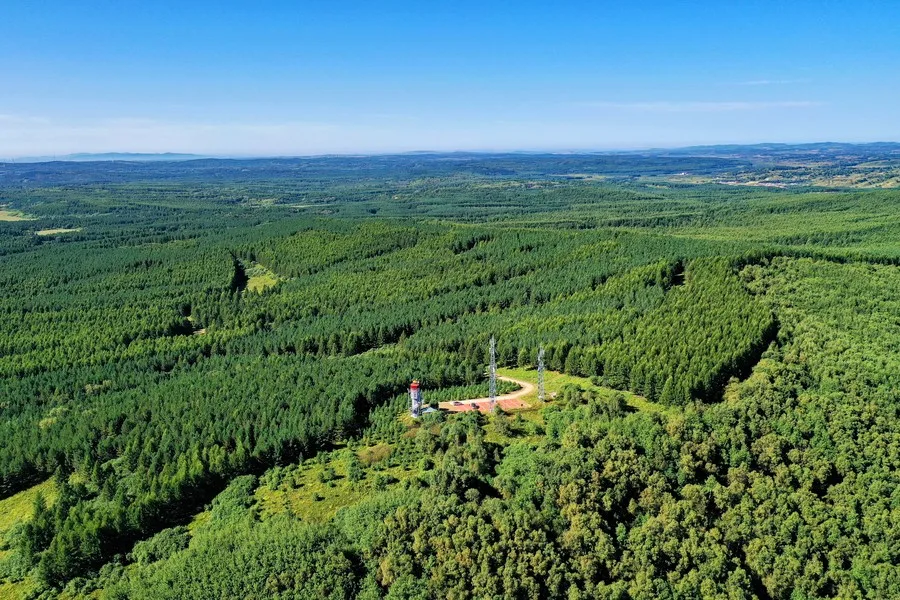
The government of the Communist Party of China presented, on Wednesday (22), a new plan for the forestry and pasture sector, which will guide the country’s environmental policies between 2026 and 2030. The initiative is part of the 15th Chinese Five-Year Plan and seeks to deepen a strategy built over the last few decades, in which the protection of ecosystems began to be incorporated into the country’s economic and social planning.
Released by China’s National Forestry and Grassland Administration and three other government bodies, the document establishes goals to expand forest coverage, strengthen protected areas and develop an economy linked to natural resources.
Among the objectives defined for the next five years are: increasing national forest coverage to 25.8% by 2030, expanding forest reserves to 22.4 billion cubic meters and expanding the value of the forest and pasture industry to 14 trillion yuan, approximately R$10.5 trillion.
The new phase of environmental planning comes at a time when China seeks to combine economic growth, technological innovation and reduction of environmental impacts. For Beijing, this strategy is associated with the concept of “ecological civilization”, incorporated into national planning as a development vision that seeks to integrate environmental protection, economic growth and improving the population’s quality of life.
In addition to nature conservation, the forestry sector began to be seen as a strategic area for generating jobs, regional development and creating new production chains. The plan foresees expanding the sustainable use of natural resources and strengthening the integration between environmental protection and economic activity.
From desertification to the green economy
The new stage of Chinese environmental planning has as one of its main challenges facing a historical problem: the desertification of extensive areas in the north of the country.
For decades, regions in northwestern and northern China have suffered from soil erosion, loss of vegetation and sandstorms that have affected cities, agricultural areas and local communities. The country has around 2.57 million square kilometers of desertified land, mainly in arid and semi-arid regions of the north and west.
One of the main responses was the Northern Three Protection Belt Afforestation Program, known internationally as the “Great Green Wall”. Created in 1978, the project became one of the largest reforestation initiatives in the world, covering areas of more than 4 million square kilometers and involving regions in the north, northeast and northwest of the country.
The objective is to recover degraded areas, contain the spread of deserts and create natural barriers against sandstorms. Over more than four decades, the initiative transformed landscapes previously marked by environmental degradation and became considered one of the symbols of Chinese ecological policy.
China currently has around 220 million hectares of forests, the result of decades of tree-planting programs, soil recovery and ecosystem protection. National forest coverage, which was around 12% in the early 1980s, has exceeded 25% in recent measurements.
According to the Food and Agriculture Organization of the United Nations (FAO), China was the country that most expanded its forest area in recent decades, driven mainly by reforestation programs and recovery of degraded areas.
Environmental restoration began to be integrated with other public policies, including rural development, income generation and adaptation to climate change. In several regions, ecological recovery projects have been combined with new economic opportunities for local communities, such as tourism, sustainable agriculture and food production associated with forest areas.
In the autonomous region of Inner Mongolia, for example, environmental protection initiatives have helped expand green areas and reduce the impacts of sandstorms that historically hit other parts of northern China.
Biodiversity and sustainable development
The new plan for 2026-2030 envisages accelerating ecological recovery projects, strengthening the protected areas system, expanding the construction of national parks and improving the conservation of wetlands.
Biodiversity is another central axis of the strategy. The document establishes protection actions for 165 species of wild animals and plants threatened with extinction.
In 2021, China established its first group of national parks, creating a protection system that brings together areas of great ecological importance and covers around 230,000 square kilometers.
“Build national parks with high standards, implement the integration and optimization of protected areas, carry out emergency protection for 165 species of endangered wild animals and plants, and fully protect wetlands”, were the objectives enumerated by Zou Qinghao, deputy director of the Planning and Finance Department of the National Forestry and Grassland Administration of China.
In addition to conservation, Beijing seeks to transform forest resources into an area of economic development. The plan envisages increasing self-sufficiency in wood, strengthening the forest seed industry and expanding economic activities developed in forest areas.
Among these initiatives is the so-called economy under the forests, which brings together food production, cultivation of medicinal plants, ecological tourism and other activities capable of generating income while maintaining environmental conservation.
The document also establishes measures to strengthen the prevention of forest fires and the control of organisms that threaten ecosystems.
Beijing has also presented its experience in ecological restoration as a contribution to the global fight against climate change, arguing that developing countries can reconcile economic growth and environmental protection.
By setting new goals for 2030, China seeks to consolidate a trajectory in which environmental recovery ceases to be just a conservation policy and becomes part of a broader national development strategy.
Source: www.brasildefato.com.br