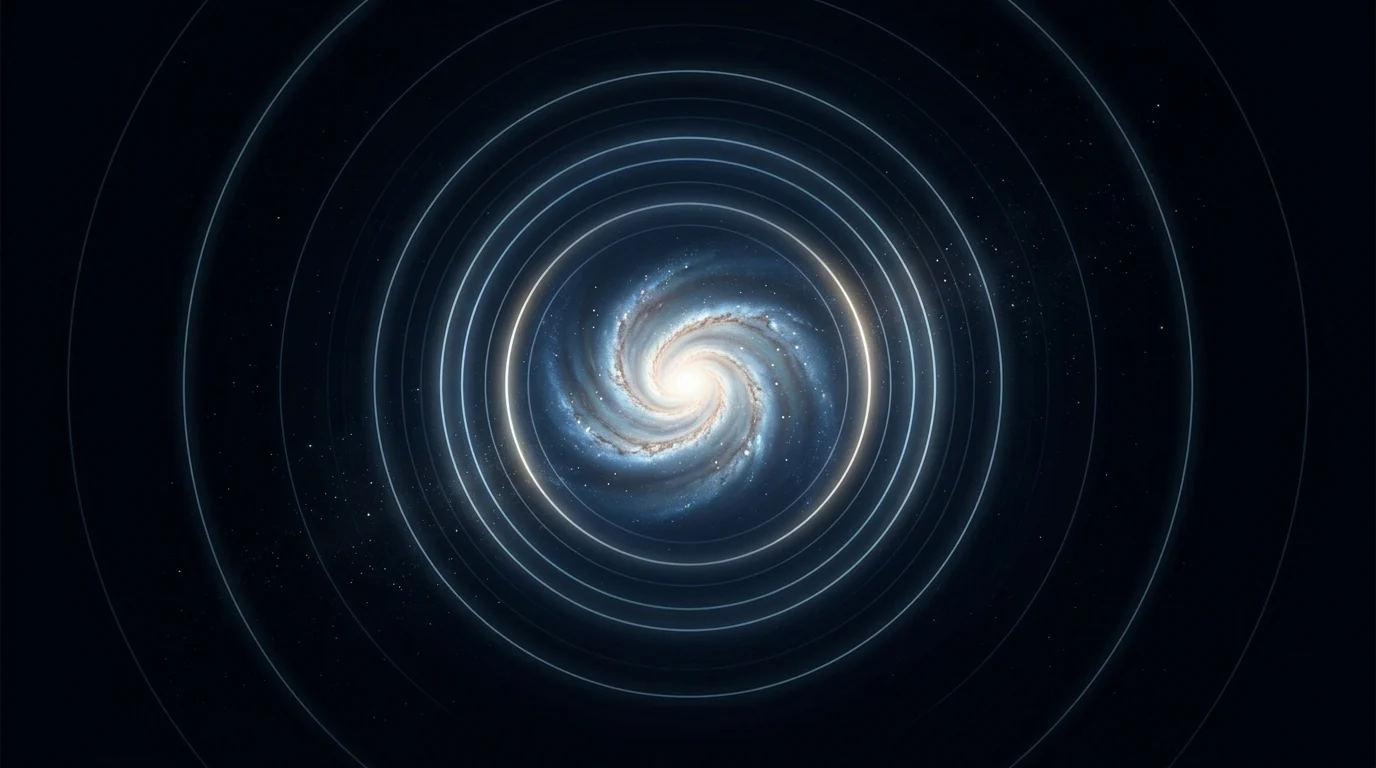
For more than a century, astronomers have known that the universe is expanding. Galaxies are not standing still in a static cosmic landscape. Instead, space itself is stretching, carrying galaxies farther apart as time passes. This revolutionary discovery transformed humanity’s understanding of the cosmos and laid the foundation for modern cosmology.
Yet one of the most important questions in science today is not whether the universe is expanding. It is how fast that expansion is happening.
What should have been a straightforward measurement has become one of the greatest scientific puzzles of the 21st century. Different methods of calculating the universe’s expansion rate continue to produce conflicting results. The discrepancy has persisted despite increasingly precise observations, advanced technology, and years of investigation by some of the world’s leading researchers.
The problem is so significant that it has earned a name of its own: the Hubble Tension.
At its heart lies a simple but profound possibility. Scientists may be missing something fundamental about how the universe works.
The implications extend far beyond astronomy. If the discrepancy cannot be explained by observational errors, it could point to new physics, unknown forms of energy, undiscovered particles, or entirely new insights into the evolution of the cosmos.
The universe, it seems, may be expanding faster than expected.
🔭 The Discovery That Changed Everything
The story begins in the early 20th century.
For centuries, many scientists believed the universe was static and unchanging. Even some of the greatest minds in physics assumed that the cosmos existed in a stable state.
That assumption changed dramatically when astronomers began studying distant galaxies.
In the 1920s, observations revealed that galaxies were moving away from one another. The farther away a galaxy was, the faster it appeared to recede. This relationship became known as Hubble’s Law, named after astronomer Edwin Hubble.
The discovery provided the first strong evidence that the universe was expanding.
Imagine dots drawn on the surface of an inflating balloon. As the balloon grows larger, every dot moves farther away from every other dot. No single dot occupies the center of the expansion. Instead, the surface itself stretches.
Cosmologists often use a similar analogy to describe the universe. Galaxies are not simply flying through empty space. Space itself is expanding.
This realization fundamentally changed humanity’s understanding of reality.
If the universe is expanding today, then it must have been smaller in the past. Following that logic backward leads to the concept of the Big Bang, the idea that the observable universe emerged from an extremely hot and dense state approximately 13.8 billion years ago.
The expansion rate became one of the most important quantities in cosmology.
Scientists call it the Hubble Constant.
📏 Measuring the Expansion of the Cosmos
Determining the universe’s expansion rate is far from easy.
Astronomers cannot stretch a tape measure across billions of light-years. Instead, they must rely on indirect techniques to estimate distances and velocities.
One common approach involves observing special types of stars and exploding stellar remnants known as standard candles.
These objects have predictable brightness levels. By comparing how bright they appear from Earth to how bright they are known to be intrinsically, astronomers can estimate their distance.
Once the distance is known, researchers compare it to the object’s redshift, a stretching of light toward longer wavelengths caused by cosmic expansion.
This method allows scientists to calculate how rapidly the universe is expanding in the present era.
Another approach looks much farther back in time.
Rather than studying nearby galaxies, researchers examine relic radiation left over from the early universe. This ancient light, known as the cosmic microwave background, provides a snapshot of the cosmos when it was only about 380,000 years old.
By analyzing tiny temperature fluctuations within this radiation, scientists can infer conditions in the early universe and predict what the expansion rate should be today.
For years, many researchers expected these methods to converge toward the same answer.
Instead, they did the opposite.
⚡ The Emergence of the Hubble Tension
As measurement techniques improved, a troubling pattern emerged.
Observations of the nearby universe consistently suggested a faster expansion rate.
Measurements based on the early universe consistently suggested a slower expansion rate.
The gap between the two estimates refused to disappear.
At first, scientists suspected systematic errors.
Perhaps telescopes needed calibration.
Perhaps certain stars behaved differently than expected.
Perhaps data analysis methods contained hidden biases.
Researchers carefully examined every stage of the measurement process.
They refined observations.
They launched new missions.
They improved statistical techniques.
Yet the discrepancy remained.
The difference may seem small to non-scientists, but in cosmology it is enormous.
The mismatch exceeds what would be expected from random measurement uncertainty.
In other words, the disagreement appears to be real.
This has transformed the issue from a technical problem into a potentially revolutionary scientific challenge.
🌠 Why a Small Difference Matters So Much
To many people, the debate may seem trivial.
Why does it matter whether the expansion rate is slightly higher or lower?
The answer lies in the extraordinary precision of modern science.
A small discrepancy in cosmological measurements can reveal major flaws in existing theories.
History provides many examples.
Tiny irregularities in planetary motion led to discoveries about gravity.
Unexpected behavior in atomic experiments contributed to the development of quantum mechanics.
Minor discrepancies in astronomical observations have often pointed toward profound new truths.
The current tension could be another example.
If the universe is expanding faster than predicted by standard cosmological models, then one or more assumptions about the cosmos may be incomplete.
Scientists may need to revise their understanding of dark energy, dark matter, neutrinos, gravity, or other fundamental phenomena.
The consequences could reshape physics itself.
🌑 The Role of Dark Energy
One possible explanation involves dark energy.
Dark energy is among the most mysterious concepts in science.
Observations suggest that the expansion of the universe is not merely continuing. It is accelerating.
Something appears to be pushing space apart at an increasing rate.
Scientists call this unknown influence dark energy.
Remarkably, dark energy is believed to account for roughly 68 percent of the total energy content of the universe.
Despite its dominance, researchers still do not know what it actually is.
It cannot be seen directly.
It does not emit light.
Its existence is inferred through its gravitational effects on cosmic expansion.
If dark energy behaves differently than current theories predict, it could help explain the Hubble Tension.
Perhaps dark energy changed over time.
Perhaps it interacts with other cosmic components.
Perhaps it possesses properties not yet incorporated into existing models.
Each possibility could alter the universe’s expansion history.
🕳️ Dark Matter and Hidden Influences
Another possibility involves dark matter.
Dark matter is an invisible substance thought to account for approximately 27 percent of the universe.
Although it cannot be observed directly, astronomers detect its gravitational influence throughout the cosmos.
Galaxies rotate too quickly to be held together by visible matter alone.
Galaxy clusters contain more mass than telescopes can see.
Large-scale cosmic structures appear shaped by an unseen gravitational framework.
Dark matter helps explain these observations.
Yet researchers still do not know what dark matter is made of.
If dark matter possesses previously unknown properties, it could influence expansion measurements in unexpected ways.
Some theories suggest interactions between dark matter and dark energy.
Others propose entirely new particles.
The Hubble Tension has inspired renewed interest in these possibilities.
🚀 New Physics Beyond the Standard Model
Perhaps the most exciting possibility is that the discrepancy signals new physics.
The standard model of cosmology has been extraordinarily successful.
It explains the large-scale structure of the universe, the cosmic microwave background, and many other observations.
Yet it remains incomplete.
Scientists already know that current theories cannot explain everything.
Dark matter remains unidentified.
Dark energy remains mysterious.
Quantum mechanics and general relativity remain difficult to reconcile.
The Hubble Tension may be providing a clue about what comes next.
Some researchers have proposed the existence of previously unknown particles.
Others suggest modifications to gravity itself.
Certain theories explore additional dimensions.
Some examine forms of early dark energy that existed shortly after the Big Bang.
While many ideas remain speculative, they illustrate how seriously scientists are taking the problem.
The discrepancy is no longer viewed as a minor annoyance.
It has become a gateway to potential breakthroughs.
🔬 How Modern Telescopes Are Tackling the Puzzle
Astronomy is entering a new era of precision.
Powerful observatories are gathering unprecedented amounts of data.
Space telescopes and ground-based facilities are measuring cosmic distances with greater accuracy than ever before.
Researchers are studying supernovae, variable stars, gravitational lenses, and galaxy distributions.
Each method offers an independent way to estimate the expansion rate.
The goal is simple.
If multiple techniques continue to produce the same discrepancy, confidence grows that the tension reflects genuine physics rather than measurement errors.
Advanced instruments are already delivering remarkable results.
Improved observations have often strengthened the case that the disagreement is real.
Rather than disappearing, the tension has become more difficult to ignore.
🌍 Humanity’s Place in a Growing Universe
Beyond the scientific implications lies a deeper philosophical dimension.
The expanding universe has transformed humanity’s perspective on existence.
For much of history, people viewed Earth as the center of creation.
Later discoveries revealed that Earth is merely one planet orbiting one star within one galaxy among billions.
The realization that space itself is expanding added another layer to that cosmic story.
The universe is dynamic.
It evolves.
It changes over time.
The Hubble Tension reminds us that even our most sophisticated models remain incomplete.
Despite extraordinary advances, the cosmos continues to surprise us.
Each new discovery reveals additional layers of complexity.
The universe is not merely larger than our ancestors imagined.
It may be stranger than our current theories allow.
📡 The Importance of Independent Measurements
One of the strengths of modern science is its reliance on independent verification.
Researchers do not trust a single method.
They compare multiple approaches and look for agreement.
In the case of cosmic expansion, different techniques provide valuable cross-checks.
Scientists examine supernova explosions.
They analyze gravitational lensing effects.
They study galaxy clustering patterns.
They investigate ancient radiation from the early universe.
Each method contains unique strengths and weaknesses.
When several independent measurements point toward the same conclusion, confidence increases dramatically.
The persistence of the Hubble Tension across multiple methods is one reason it has attracted so much attention.
The discrepancy appears remarkably resilient.
🌟 Could We Be Missing an Entire Chapter of Cosmic History?
Some theoretical models suggest that the universe may have experienced phases that scientists have not yet fully understood.
Perhaps a short-lived form of energy existed shortly after the Big Bang.
Perhaps unknown interactions influenced the early cosmos.
Perhaps key events occurred that left subtle signatures hidden within observational data.
If such phenomena existed, they could affect modern expansion estimates.
This possibility excites many cosmologists because it would open entirely new areas of research.
Rather than merely adjusting existing theories, scientists might uncover a previously unknown chapter in cosmic history.
The idea remains speculative, but it highlights the profound stakes involved.
Resolving the tension could reveal something fundamentally new about reality.
🧠 Scientific Skepticism Remains Essential
Despite growing excitement, researchers remain cautious.
Science advances through evidence, not enthusiasm.
Many apparent mysteries have eventually been explained through improved measurements or better understanding of known phenomena.
Astronomers continue testing instruments, refining calculations, and searching for hidden sources of error.
This skepticism is not a weakness.
It is a strength.
Extraordinary claims require extraordinary evidence.
Before rewriting the laws of physics, scientists must exhaust every conventional explanation.
The ongoing investigation reflects the rigorous standards that define scientific inquiry.
🔭 What Happens Next?
The coming years may prove decisive.
New observatories will provide increasingly precise measurements of the universe.
Future surveys will map millions of galaxies.
Improved instruments will study the cosmic microwave background in greater detail.
Researchers will continue searching for signs of new particles, new forces, or unexpected cosmic behavior.
Several outcomes remain possible.
The tension could eventually disappear through improved analysis.
It could reveal subtle measurement biases.
Or it could survive every challenge and point toward a genuine revolution in physics.
Many scientists believe the final possibility is becoming increasingly plausible.
🌌 A Universe Still Full of Surprises
The story of cosmic expansion began with one of the greatest discoveries in human history.
Astronomers learned that the universe is not static.
Space itself is stretching.
Galaxies are drifting apart.
Time and cosmic evolution are deeply intertwined.
Today, that story has entered a new and fascinating chapter.
The measured expansion rate appears faster than theoretical expectations derived from the early universe.
This disagreement has evolved into one of the most significant scientific mysteries of our era.
Whether the answer involves dark energy, dark matter, new particles, modified gravity, or something entirely unexpected, the stakes are enormous.
The resolution could deepen humanity’s understanding of the cosmos and potentially transform modern physics.
For now, the mystery remains unsolved.
The universe continues expanding.
Astronomers continue measuring.
Theories continue evolving.
And somewhere within the vastness of space and time may lie the clue that explains why the cosmos appears to be growing faster than expected.
Until that answer arrives, the Hubble Tension stands as a powerful reminder that even after centuries of scientific progress, the universe still holds secrets waiting to be discovered.