Lula flirts with the atomic bomb and resurrects the Paraguayan War to justify Brazil’s rearmament; At the embassies, no one read there just an electoral message: the government fears that the USA will use Paraguayan territory as a gateway for military operations on Brazilian soil
On June 26, at the Thyssenkrupp shipyard in Itajaí (SC), President Luiz Inácio Lula da Silva (PT), 80 years old, christened the frigate Cunha Moreira and made, impromptu, what seemed to be another electoral speech about sovereignty, undue interference from external agents and the modernization of weapons as a priority.
The full speech, I found out, was circulated in the embassies in Brasília, with special attention in the United States. Diplomats read what the newspapers didn’t read, and saw something worrying, out of the ordinary.
The excerpt that made them read it twice is this:
“I was a constituent, and I was one of those who voted for the non-proliferation of nuclear weapons, because I was committed that whoever had nuclear weapons would deactivate it. Did anyone deactivate it? Since then, Pakistan has armed itself, North Korea has armed itself, India has armed itself, China has armed itself, Russia and the United States continue to manufacture more and more nuclear weapons. And us?”
Notice how the sentence doesn’t say what it wants to say, but leaves the conclusion up to the listener. Lula says he voted for non-proliferation “why” there was a commitment — and, in the next sentence, he asks: “Did someone deactivate it?”. The answer is no, and everyone knows it. But the listener is the one who gives it, not the president. If the vote depended on the promise, and the promise died, then… The conclusion is not said: the audience is the one who completes it. THE “and us?” works the same way —2nd unanswered question in the same passage. Two loose words, and each listener gives meaning to it on their own: are we still? Do we fulfill the agreement alone? should we have the atomic bomb? Then, in a bar conversation verbiage, he links the bomb to the North American threat:
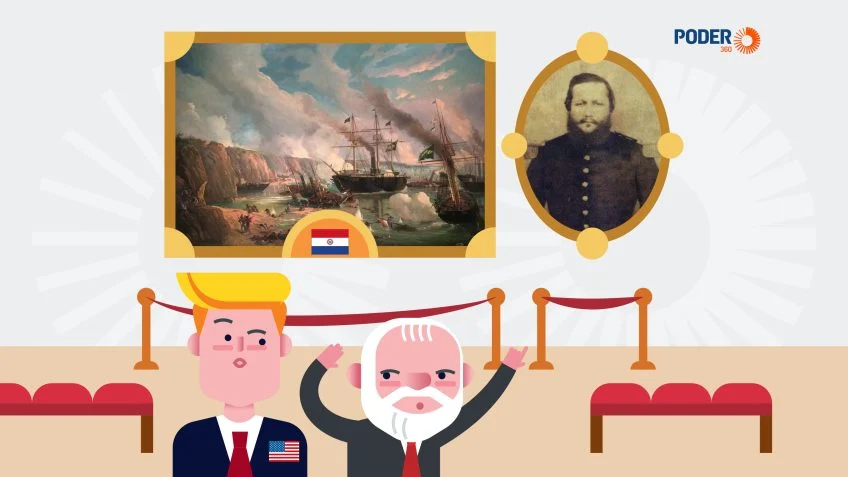
“I don’t want to be caught by surprise […] Then one fine day, when no one expected it, Solano López [1827-1870]president of Paraguay, immediately invaded Brazil, Argentina and Uruguay. Está cheio de nego maluco no mundo. Right now the American president wants to take over Greenland, Canada is going to become his state, he wants to take over the Panama Canal. Where are we?”
No sentence states that Brazil needs the bomb to deter the United States. But the set leads to exactly this conclusion. It is ingeniously formulated to preserve the perpetrator from having suggested it.
No one in their right mind believes that Lula will challenge the United States with the promise of developing the Brazilian atomic bomb.
Firstbecause it would give US President Donald Trump (Republican), 80 years old, reasons to transform Brazil, a historically peaceful country, into a South American Iran.
Afterwards, in 2nd placebecause it is not possible to imagine that a country that was unable to even build a rocket capable of putting a satellite into orbit would develop the bomb by the end of Trump’s 2nd term.
Em 3rd placeseeking the bomb would require amending the Constitution — which admits nuclear activity “for peaceful purposes only”— and tear up the Tlatelolco and Non-Proliferation treaties. The question that remains is: why did a campaigning president decide, in a shipyard in Santa Catarina, to publicly flirt with regretting the vote that helped make Brazil a constitutionally disarmed country?
The answer, heard with the reservation of 3 diplomats, is that Lula’s rhetoric does not only have an electoral function (research shows that the defense of sovereignty brings votes to the president running for re-election). It would be one piece of a more complex issue. And, to understand it, it is necessary to associate Itajaí’s speech with a 2nd speech, which also evokes the Paraguayan War (1864-1870), and a military agreement between our border neighbor and the United States.
The 2nd speech was made 4 weeks later, on Friday (24.Jul.2026), during a visit to the headquarters of the SBPC (Brazilian Society for the Progress of Science), in São Paulo — on the same day, it should be noted, that Lula visited the Avibras defense industry, in Jacareí, and also the date on which Javier Milei disembarked in São Paulo and on which the visas of the 2 North American emissaries were denied.
In his speech to scientists at the SBPC, Lula repeated, almost word for word, Itajaí’s speech: it is necessary to protect the 16,800 km of dry border, the 8,000 km of coastline, the riches that “We don’t know yet” to have; it is necessary “a defense plan for this country, something serious”. And he resorted to the same ghost: “Any day one or the other decides to invade Brazil […] Paraguay one day invaded Brazil, Argentina and Uruguay. To do good things, a guy has to think, but to do crazy things, a guy doesn’t need to think.”.

And, in his speech in São Paulo, Lula ordered an apparently meaningless study: the president asked the person responsible for the SBPC for a study on how much the Paraguayan War cost Brazil —“How many of the country’s budgets did we have to spend to be able to win that war?”
For those diplomats who paid attention to the president’s speeches, the message was given. Lula was not telling stories from the past or eruditionally recalling a war from 1865. He was making indirect reference to the agreement signed on December 15, 2025 by the US Secretary of State, Marco Rubio, and the Paraguayan Foreign Minister, Rubén Lezcano.
This is a military agreement known by the acronym “Sofa” (Status of Forces Agreementor Status of Forces Agreement), ratified by the Paraguayan Congress and sanctioned by President Santiago Peña in March. Here is the full text (in English – PDF – 1 MB). Its terms, which are public, eliminate any doubt:
- military personnel and companies contracted by the Pentagon gain free entry, exit and movement within Paraguayan territory;
- their planes, boats and vehicles are exempt from inspection, including those they carry, including weapons;
- its members receive full immunity from local justice;
- US forces operate their own telecommunications system, with free use of the spectrum;
- Paraguay waives claims for damages.
The State Department describes the agreement as the “gold standard” of the genre. Paraguay borders Brazil, and the Triple Border is just a bridge away from Foz do Iguaçu.
The conviction that has taken root in the Brazilian government, according to the same diplomatic interlocutors, is that the agreement has, among its unwritten objectives, to enable military incursions into Brazilian territory, under the argument of financing Hezbollah in the Triple Border, the activities of the PCC and the Red Command, or the convenient mixture of the two.
In May 2025, Washington placed a US$10 million reward on Hezbollah’s financial networks in the tri-border region, a week after Senator Flávio Bolsonaro reminded a Trump envoy of the PCC’s alleged links to the Lebanese group. In May 2026, the State Department designated Comando Vermelho and the PCC as foreign terrorist organizations, promising to use “all tools available” against them. Three weeks after this designation, Lula took the stage in Itajaí.
Add to this the precedent of Nicolás Maduro. In the early hours of January 3, Delta Force commandos invaded Caracas under bombardment, killed 32 Cuban agents who were part of the dictator’s personal guard —Havana confirmed the deaths and published their names—, captured Maduro and his wife, Cilia Flores, while they slept, and boarded them on the warship USS Iwo Jima, with a stop at Guantánamo, before the final flight to the cells of the Brooklyn Metropolitan Detention Center, in New York.
According to a Venezuelan official interviewed by the newspaper New York Timesat least 80 people died in the offensive. The military face of the Trumpulência —the neologism with which the economist and former diplomat Marcos Troyjo defined, in 2024, the mix of turbulence and opulence of Trumpism. The creator thought about tariffs and markets; the dawn in Caracas expanded the scope of the term.
After Maduro’s capture, Venezuela became a North American colony, administered from Washington to the point where Rubio was nicknamed viceroy. Lula, at the time, said that the operation had been a “very serious affront to Venezuela’s sovereignty” and surpassed a “unacceptable line”. It doesn’t matter what the world thought about Maduro. What has been demonstrated is that, in 2026, a South American head of state can be physically removed from power by United States military force. For a president like Lula, who Washington began to treat as an adversary, the message is not rhetorical. It’s physics.
It is difficult to locate a lower moment in the history of the relationship between the USA and Brazil. And the degradation took less than 1 semester. On May 7, Lula was received by Trump at the White House; after 3 hours of meeting, the North American said that the meeting was “boa” and described him as “the very dynamic president of Brazil” —weeks after, in a phone call reported by the Brazilian press, he told Lula a “I love you”. From there, everything went downhill.
On June 16, at the G7, the two exchanged a brief greeting. Three days later, in an interview with the digital newspaper AxiosTrump called Lula “very volatile”said he doesn’t think about him and classified Brazil as a politically complicated country. Forty-three days separate the “dynamic” do “volatile”. A week later, Itajaí came. Lula, for his part, began to repeatedly criticize Trump in fiery speeches, reaching the point of disrespect: on July 14, he said that the dental prosthetics offered by the SUS are better than the dentures used by Trump. On July 24, a new tariff of 12.5% raised the surcharge on around 1/3 of Brazilian agribusiness exports to 37.5%, under the accusation of forced labor. Lula classified the measure as a political maneuver in favor of his electoral opponent.
On Friday (24.Jul.2026), the Brazilian government denied visas to 2 senior State Department officials, Riley Barnes and Samuel Samson, after identifying that their mission, revealed by the Washington Postwas to cast doubt on the fairness of the Brazilian electoral system. Their itinerary included meetings with ambassadors and candidate Flávio Bolsonaro. Despite the effort to normalize the episode, Brazil sent an unprecedented message to the North American government by denying entry to two authorities, accusing them of wanting to disrupt the October election.
There is also Brazil’s isolation on the South American table. Trump supported candidates in recent elections in the region. They all won —Nasry Asfura in Honduras, Abelardo de la Espriella in Colombia. Javier Milei, his most devoted ally, personally participated, on Saturday (25.Jul.2026), in the launch of Flávio Bolsonaro’s candidacy for President, and used the platform to harshly criticize the Brazilian government.
For experts, the United States National Security Strategy, published in November 2025, was already clear: the Americans will reaffirm and apply the Monroe Doctrine and reposition their global military presence to the Western Hemisphere – here is the full text (PDF – 500 kB) of the document. Before, Brazil’s ideological neighborhood was all left-wing. Today, Lula is surrounded by aligned governments led by Trump, who calls him volatile.
It is in this context that Itajaí’s nuclear discourse makes sense. Read in isolation, it seems like the reverie of a nationalist on campaign. Read within the framework that diplomats describe, it is the desperation of a government that finds itself surrounded. Lula cannot announce the artifact, so he launches a speech with a dubious meaning and a double destination: to Washington, that Brazil will buy the fight; to the voter, that this president does not bend.
The ghost of Solano López was Lula’s find to challenge Washington. The president invokes the dictator who attacked 3 countries out of madness to justify Brazil’s rearmament. The episode, from 1865, is transported to 2026. The madman in the parable is another. The information I started to find out was about a president flirting with the atomic bomb. The one I ended up finding is earlier and bigger: a president convinced that the Paraguayan War could change centuries.
Source: https://www.poder360.com.br/opiniao/o-espectro-de-solano-lopez-ronda-lula-e-brasilia/