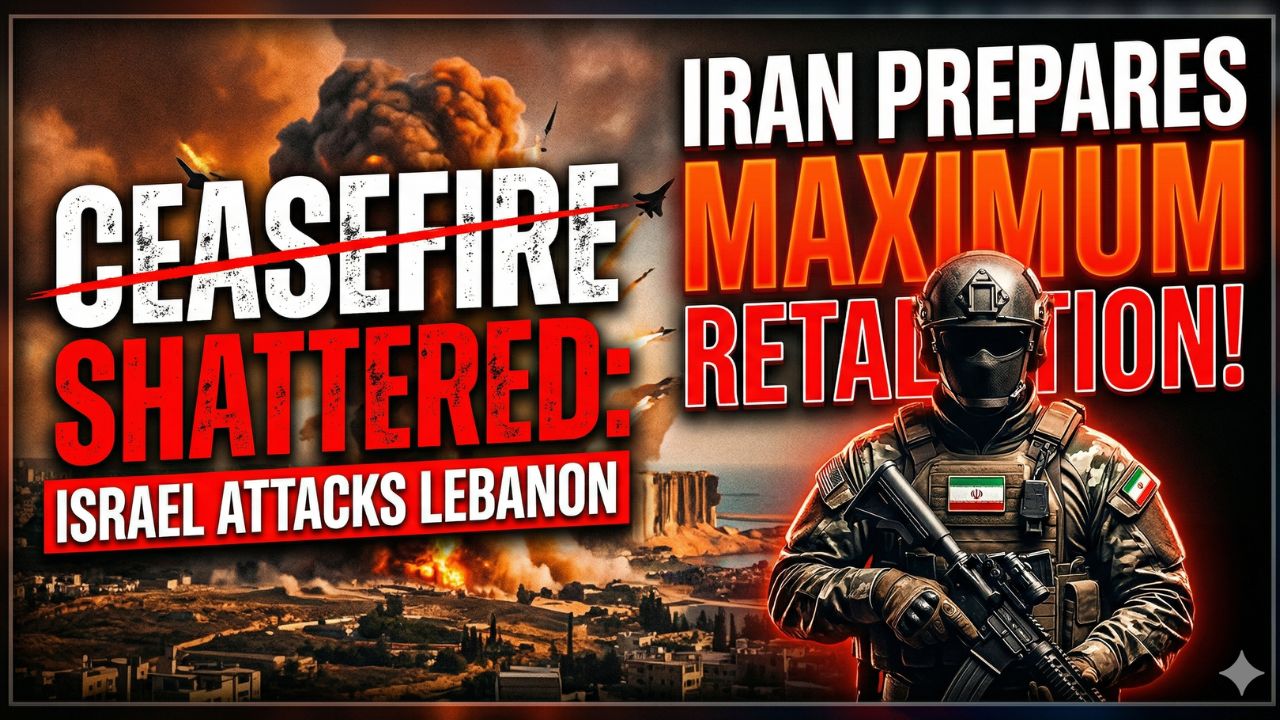
A recently negotiated ceasefire agreement is already falling apart after Israel launched devastating attacks in Lebanon, resulting in the deaths of over 100 people. The comprehensive 25-point ceasefire, which integrated 10 points proposed by Iran and 15 points from the United States, was intended to cover the entire Middle East, including Lebanon and Hezbollah. However, Israel has blatantly ignored the truce, a move that critics argue is a deliberate sabotage aimed at forcing Iran to continue the conflict.
Israel’s Territorial Ambitions According to the statements from Israeli leadership, the attacks are framed as retaliation, with Israeli Defense Minister Israel Katz declaring a personal vendetta against Hezbollah. Despite claims by figures like Benjamin Netanyahu and Donald Trump that Lebanon was not included in the ceasefire terms, Iranian Foreign Minister Abbas Araghchi has firmly stated that the agreement does indeed protect the region.
Observers argue that Israel’s true objective is not merely to defeat Hezbollah, but to achieve territorial conquest. Specifically, Defense Minister Katz has openly discussed a plan to take over and annex southern Lebanon. This strategy mirrors the military campaign in Gaza, where the presence of Hamas was used as a justification to target civilian areas with the ultimate goal of transforming the territory.
International Outcry and War Crimes Accusations The international community has reacted with alarm to Israel’s disregard for the agreement. A coalition of leaders and institutions from the United Kingdom, France, Italy, Germany, Canada, Denmark, the Netherlands, Spain, and the European Union have issued a joint plea demanding that the ceasefire be respected in Lebanon.
Meanwhile, the Lebanese Prime Minister took to social media to denounce Israel’s actions as war crimes. He highlighted that Israel is expanding its strikes into densely populated residential neighborhoods, particularly in Beirut, resulting in the deaths of unarmed civilians and showing a complete disregard for international humanitarian law. The Prime Minister explicitly called upon the international community and friends of Lebanon to intervene and help stop the aggression. It is also noted that it is important to separate Hezbollah from the official Lebanese state and army, as Israel is attacking the nation of Lebanon under the guise of fighting Hezbollah.
Iran’s Retaliation and the Blockade of the Strait of Hormuz The situation threatens to escalate into a broader economic and military crisis. Because the protection of Lebanon was a core component of Iran’s 10-point proposal, the Iranian news agency Tasnim has announced that Iran is threatening to withdraw from the ceasefire entirely if the attacks continue.
Furthermore, the Iranian news agency Fars reported that oil tankers are already being prevented from navigating through the strategic Strait of Hormuz. This blockade is a direct response to what Iran considers a severe violation of the ceasefire by Israel, which could have massive global economic ramifications.
A Broader Colonial Strategy Ultimately, analysts and critics point out that Israel’s actions are part of a broader colonialist plan in the Middle East, driven by a Zionist agenda that relies on continuous warfare. By provoking Iran, Israel allegedly hopes to frame Iran as the violator of the ceasefire, thereby maintaining unwavering support from the United States. The United States is also heavily criticized as being complicit and an aggressor in this ongoing regional instability, with former CIA officials like Joe Kent accusing Israel of pressuring the U.S. into its wars.