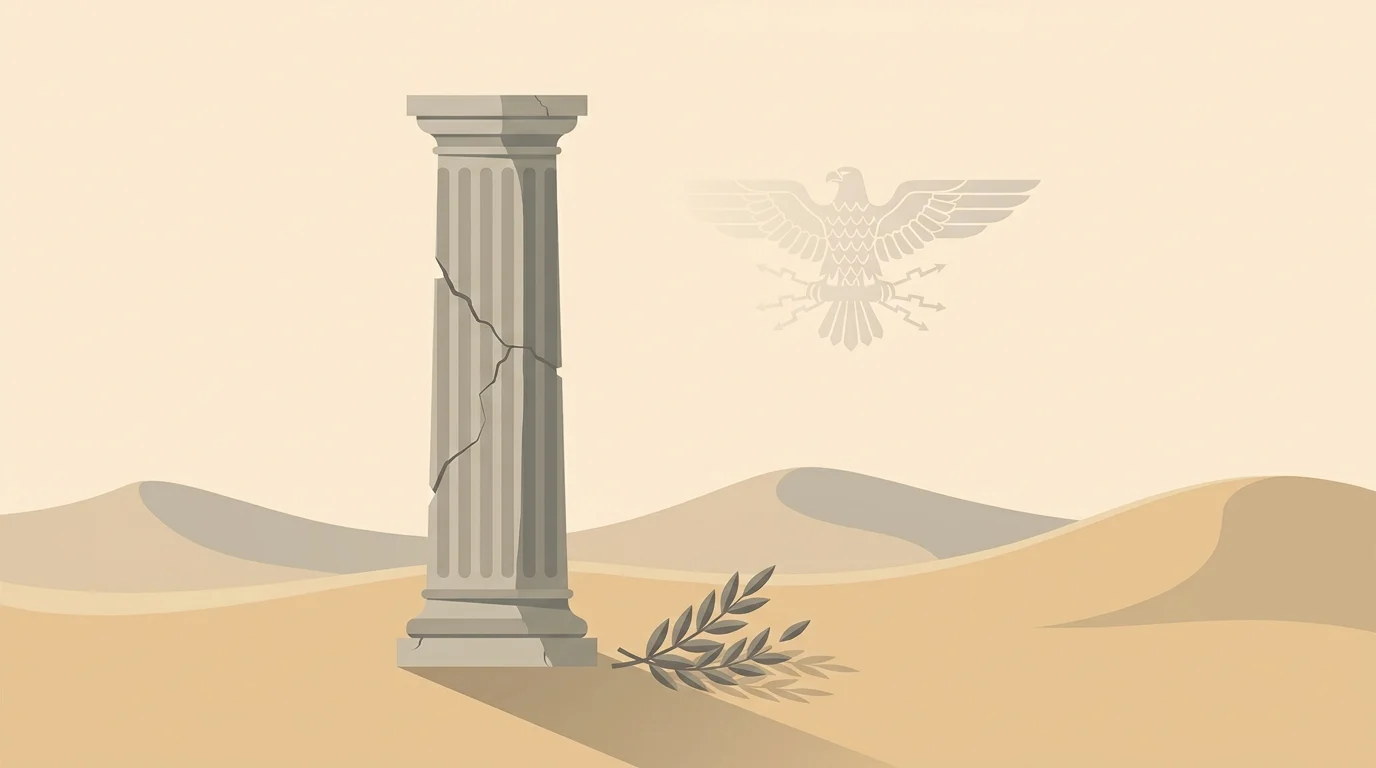
The fall of the Roman Empire remains one of the most fascinating events in human history. For centuries, historians, politicians, military strategists, and economists have debated the reasons why one of the most powerful civilizations ever created ultimately collapsed. The story is often simplified into a dramatic narrative in which barbarian invaders stormed across the borders and brought Rome to its knees. While invasions played a role, the reality was far more complex.
The Roman Empire did not disappear overnight. Its decline unfolded over centuries through a combination of political instability, economic troubles, military challenges, social transformations, environmental pressures, and external threats. By the time the Western Roman Empire officially fell in 476 AD, many of the forces that destroyed it had been at work for generations.
Understanding why Rome fell is more than an exercise in studying ancient history. The Roman experience offers important lessons about power, governance, economics, military strategy, and the fragility of even the strongest institutions. The collapse of Rome reshaped Europe, influenced the development of medieval societies, and left a legacy that continues to shape the modern world.
The real question is not whether Rome was defeated by a single enemy. The real question is how an empire that dominated the Mediterranean for centuries became unable to solve its own internal problems.
⚔️ An Empire Built on Expansion
At its peak, the Roman Empire controlled vast territories stretching from Britain to North Africa and from the Atlantic Ocean to the Middle East. It governed millions of people speaking different languages and practicing different religions.
Rome’s success was built on conquest. Military victories brought wealth, slaves, resources, and prestige. Newly conquered territories paid taxes and supplied soldiers. Expansion fueled economic growth and reinforced the authority of Roman leaders.
However, this system contained a hidden weakness.
As long as Rome continued expanding, new resources flowed into the empire. But by the second century AD, expansion had largely slowed. The empire had reached natural geographic limits. Further conquest became increasingly expensive and difficult.
Without a constant influx of new wealth, Rome had to rely more heavily on taxation and existing economic production. The financial model that had supported centuries of growth began to show signs of strain.
An empire designed for expansion now faced the challenge of managing what it already possessed.
👑 Political Chaos at the Top
One of the most destructive forces in Roman decline was political instability.
In theory, emperors ruled with supreme authority. In practice, the transfer of power was often chaotic and violent. Unlike modern political systems with established succession rules, Rome frequently relied on military support, political alliances, and personal influence.
The result was a recurring cycle of assassinations, civil wars, and power struggles.
The third century AD became particularly disastrous. During a period known as the Crisis of the Third Century, dozens of emperors rose and fell within a relatively short period. Many were overthrown by rivals or killed by their own soldiers.
This constant turmoil weakened the state in several ways:
- Resources were diverted toward internal conflicts.
- Military units fought one another instead of defending borders.
- Economic confidence declined.
- Government institutions became less effective.
- Long-term planning became nearly impossible.
Political instability created a dangerous environment where survival often mattered more than good governance.
💰 The Economic Slowdown
Rome’s economy was vast, but it was not immune to decline.
As military expansion slowed, revenues became harder to maintain. Meanwhile, the costs of governing the empire continued to rise. Roads, fortifications, armies, and administrative systems required enormous financial resources.
To cover expenses, Roman authorities increased taxes. In many regions, heavy taxation placed significant burdens on farmers, merchants, and local communities.
Inflation also became a serious problem.
Some emperors reduced the silver content in Roman coins in an attempt to stretch government finances. Over time, people lost confidence in the currency. Prices rose, trade became more difficult, and economic uncertainty spread throughout the empire.
The gap between rich and poor widened as well.
Large landowners accumulated wealth and influence, while many small farmers struggled to survive. Economic inequality weakened social cohesion and reduced the ability of ordinary citizens to support the state.
The Roman economy did not collapse all at once, but its foundations gradually eroded.
🛡️ The Military Became Harder to Sustain
Rome’s military was one of the most effective fighting forces in history. It conquered territories across three continents and protected the empire for centuries.
Yet maintaining such a massive army became increasingly difficult.
The empire’s borders stretched thousands of miles. Defending these frontiers required enormous numbers of soldiers and substantial financial resources.
Recruitment became a growing challenge.
As population growth slowed and economic pressures increased, fewer citizens were willing or able to serve. Rome increasingly relied on foreign recruits, including soldiers from Germanic tribes beyond its borders.
Many of these troops fought loyally for Rome. However, the growing dependence on non-Roman military personnel created new challenges related to loyalty, integration, and command structures.
Military expenses also consumed a large share of government revenue.
As external threats increased, Rome needed more troops, more fortifications, and more supplies. The burden on the state’s finances became heavier each year.
Eventually, Rome found itself trapped in a cycle where military needs strained the economy while economic weakness reduced military effectiveness.
🌍 Pressure from Migrating Peoples
The traditional image of barbarian hordes destroying Rome contains a grain of truth, but the reality was more nuanced.
Many groups that entered Roman territory were not simply invaders seeking destruction. Some were migrants, refugees, or allies seeking protection and opportunities within the empire.
Germanic tribes such as the Goths, Vandals, Franks, and others interacted with Rome for centuries through trade, diplomacy, military service, and settlement.
A major turning point occurred during the late fourth century.
The arrival of the Huns from Central Asia disrupted existing populations across Europe. Their expansion pushed other groups toward Roman territory. Many sought refuge within the empire’s borders.
Roman authorities often struggled to manage these migrations effectively.
Mistreatment, corruption, and poor administration created tensions. In some cases, groups that initially sought peaceful settlement eventually rebelled.
The Battle of Adrianople in 378 AD demonstrated the growing danger. Roman forces suffered a devastating defeat against Gothic warriors, and Emperor Valens was killed.
The battle exposed weaknesses that would become increasingly difficult to overcome.
🏙️ Urban Decline and Social Transformation
The Roman world was famous for its cities.
Urban centers served as hubs of administration, commerce, culture, and public life. Roads connected communities across vast distances. Markets facilitated trade. Public buildings reflected Roman engineering and organizational capabilities.
Over time, however, many cities experienced decline.
Economic difficulties reduced commercial activity. Political instability disrupted local administration. Some regions became less secure due to military threats.
As urban life weakened, populations shifted toward rural areas. Large estates became more important economically and socially.
Local elites often focused on protecting their own interests rather than supporting broader imperial institutions.
The result was a gradual fragmentation of the social structures that had helped unify the empire.
🌡️ Climate and Environmental Challenges
Recent research suggests that environmental factors may have contributed to Rome’s decline.
Climate conditions appear to have changed during certain periods of Roman history. Variations in temperature and rainfall may have affected agricultural production in some regions.
Agriculture was the backbone of the Roman economy. Reduced harvests could lead to food shortages, higher prices, and social unrest.
Environmental pressures rarely act alone. Instead, they tend to amplify existing weaknesses.
A society already struggling with political instability and economic problems becomes more vulnerable when faced with agricultural disruptions.
Although climate change was not the primary cause of Rome’s fall, it likely added pressure to an already stressed system.
☣️ Disease and Population Loss
Epidemics represented another major challenge.
The Roman Empire’s extensive trade networks connected distant regions. While these connections facilitated commerce, they also allowed diseases to spread more easily.
Several major outbreaks affected the empire, including the Antonine Plague and the Plague of Cyprian.
These epidemics likely killed millions of people.
Population losses had far-reaching consequences:
- Labor shortages reduced economic productivity.
- Tax revenues declined.
- Military recruitment became more difficult.
- Communities struggled to recover.
Repeated outbreaks weakened the empire’s resilience and reduced its ability to respond to other crises.
Disease did not destroy Rome on its own, but it contributed significantly to long-term decline.
✝️ The Rise of Christianity
The rise of Christianity is sometimes presented as a cause of Rome’s fall, but this interpretation remains controversial.
Christianity transformed Roman society in important ways. It changed cultural values, influenced political institutions, and reshaped public life.
Some historians have argued that Christian teachings reduced traditional military values or redirected resources away from state functions.
Others disagree, noting that the Eastern Roman Empire remained deeply Christian while surviving for nearly a thousand years after the fall of the West.
What is clear is that Christianity became an important part of Roman identity during the empire’s later centuries.
Rather than causing the collapse, Christianity was one element within a much broader process of social and cultural transformation.
🏛️ The Division of the Empire
One of the most significant developments in Roman history was the division of the empire into eastern and western regions.
This arrangement was intended to improve administration and security.
In many ways, it succeeded.
The Eastern Roman Empire, centered on Constantinople, possessed several advantages:
- Stronger urban centers.
- Greater economic resources.
- Better defensive geography.
- More stable tax revenues.
The Western Roman Empire faced greater challenges.
Its borders were harder to defend. Economic resources were weaker. Political instability was more severe.
Over time, the differences between East and West became increasingly pronounced.
While the East adapted and survived, the West struggled to maintain cohesion.
🔥 The Sack of Rome
Few events symbolized Roman decline more dramatically than the sack of Rome itself.
In 410 AD, Gothic forces led by Alaric entered and looted the city.
The psychological impact was enormous.
For centuries, Rome had represented power, stability, and civilization. Many people believed the city was virtually invincible.
The sack shattered that illusion.
Although the city recovered to some extent, confidence in imperial authority suffered a major blow.
Another devastating sack occurred in 455 AD when the Vandals entered Rome.
These events highlighted the empire’s inability to protect its own symbolic heart.
👑 The Last Emperor
The traditional date for the fall of the Western Roman Empire is 476 AD.
In that year, a Germanic leader named Odoacer deposed the young emperor Romulus Augustulus.
The event marked the end of imperial rule in the West.
Yet it is important to recognize that many Roman institutions continued to exist.
Roman law survived.
Roman culture survived.
Roman language evolved into the Romance languages.
Roman religious institutions remained influential.
Even after the empire disappeared politically, its legacy endured.
The fall of Rome was not the sudden destruction of a civilization. It was the transformation of one world into another.
📚 What Historians Believe Today
Modern historians generally reject simple explanations for Rome’s fall.
There was no single moment when everything collapsed.
Instead, the empire experienced a long process of decline shaped by multiple interacting factors:
- Political instability.
- Economic difficulties.
- Military pressures.
- Population loss.
- Environmental challenges.
- Administrative problems.
- External invasions and migrations.
- Social and cultural change.
Each factor reinforced the others.
Economic weakness limited military effectiveness.
Military failures increased political instability.
Political instability damaged economic confidence.
Population decline reduced productivity and tax revenue.
The empire became trapped in a cycle of compounding problems.
🌟 The Real Lesson of Rome
The story of Rome is not merely about collapse.
It is also about adaptation, resilience, and transformation.
The Roman Empire survived numerous crises throughout its history. For centuries, it overcame invasions, rebellions, economic difficulties, and political turmoil.
What ultimately made the difference was the accumulation of challenges that exceeded the system’s capacity to respond.
No empire, nation, or institution is guaranteed permanent success.
Strength can create complacency. Expansion can hide structural weaknesses. Wealth can mask underlying problems.
Rome’s fall reminds us that great powers rarely collapse because of a single catastrophe. More often, decline emerges from the interaction of many forces over long periods of time.
The Roman Empire did not fall in a day.
It slowly lost the ability to solve its most important problems.
That is why the Roman Empire really fell.
More than fifteen centuries later, the question continues to captivate historians and the public alike because Rome’s story is not only about the ancient world. It is also a timeless lesson about how civilizations rise, endure, and eventually change.