Published 06/09/2026 10:38 | Edited 06/09/2026 11:03
Chinese President Xi Jinping’s two-day agenda in North Korea marked one of the most relevant diplomatic moves of the year in Asia and reinforced the historical depth of the relationship between Beijing and Pyongyang. Received this Monday (8) by President Kim Jong-un and First Lady Ri Sol Ju, Xi arrived in the North Korean capital amid strong public demonstrations of friendship and strategic cooperation.
On his first official visit to the country since 2019, the Chinese leader was accompanied by his wife, Peng Liyuan, and a high-level delegation that included Foreign Minister Wang Yi and the director of the General Office of the Central Committee of the CCP (Communist Party of China), Cai Qi. The choice of Pyongyang as the first international destination of the year is, in itself, a political statement.
According to the Chinese state agency Xinhua, crowds occupied the streets to welcome the Chinese delegation, while flags from both countries decorated avenues and public buildings. The gesture made clear the willingness of the two socialist nations to deepen a partnership shaped by decades of political, economic and military solidarity.
In an international scenario marked by the expansion of the US military presence in East Asia, the visit shows that Beijing will not abandon Pyongyang in the face of pressure led by Washington. Statements made during the welcome banquet hosted by Kim confirm this perception.
Xi said that over the 65 years of the China-Korea Treaty of Friendship, Cooperation and Mutual Assistance, relations between the two countries have reached a new historical starting point. According to a statement from Xinhua, this friendship, tested by changes in the international scenario, only strengthened over time.
Kim, in turn, stressed that the visit fully demonstrated the great importance that Xi attaches to the development of bilateral relations. The North Korean leader classified the Chinese leader’s presence as the most valuable support for the socialist cause of People’s Korea.
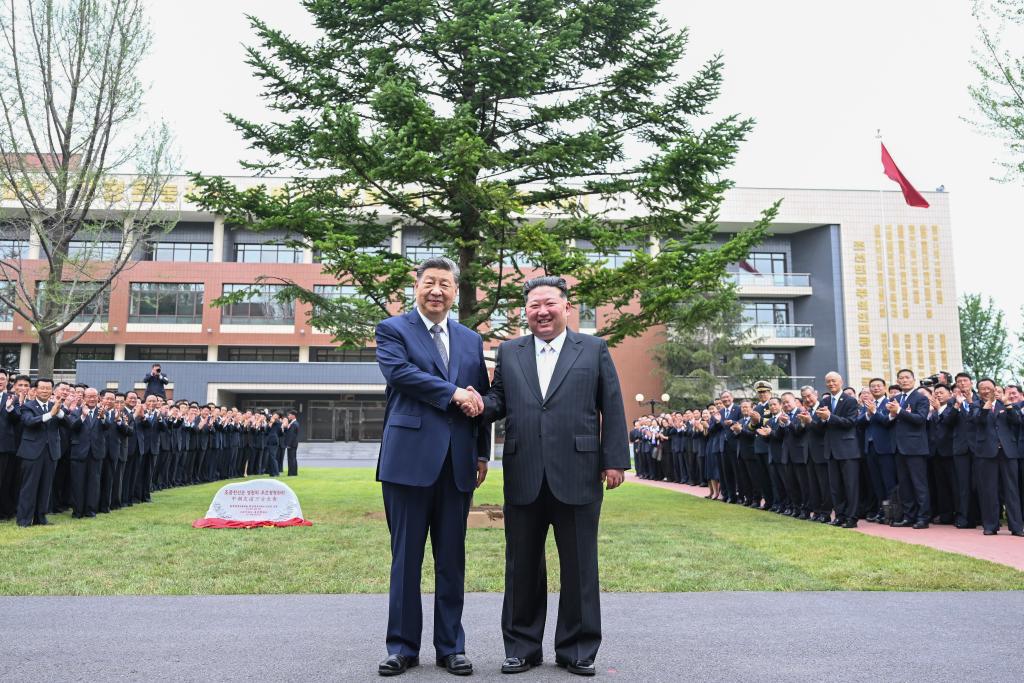
On the 9th, Xi and Kim visited the China-Korea Friendship Tower together and paid tribute to those who laid the foundations of this historic relationship. At the Central Cadre Training School of the Workers’ Party of Korea (WPK), the two leaders jointly planted a fir tree – a tree that remains green throughout the year and was chosen, according to Xinhua, to symbolize the lasting and always renewed friendship between the two countries.
In an article published the day before the visit in the newspaper Rodong Sinmun (official organ of the WPK Central Committee), Xi stated that China and Korea must “move forward together through trials, inheriting the past and opening up the future.” The Chinese leader highlighted that Sino-Korean friendship was built “in blood” during the anti-imperialist struggles of the 20th century and remains “an unshakable strategic choice” of the two peoples.
Strategic coordination
The Western press itself recognized the strategic importance of the agenda. In a BBC report, analysts point out that the meeting takes place amid the increase in the North American military presence in the region and the strengthening of alliances between the USA, Japan and South Korea. In the view of these analysts, the Sino-Korean rapprochement is a geopolitical response to the attempted siege promoted by the Western bloc.
Xi stated that Beijing wants to deepen strategic coordination with Pyongyang in various areas, such as economic development, political exchanges and international cooperation. He called on both sides to take advantage of the opportunity to fully reopen border crossings, as well as the resumption of civil aviation flights and international passenger trains, to intensify exchanges between people.
For Kim Jong-un, who is also secretary general of the WPK, relations with China are a priority. The North Korean president praised Beijing’s role in defending regional stability, emphasizing the defense of multilateralism and national sovereignty. Furthermore, Kim reaffirmed that Korea will unswervingly uphold the one-China principle and support Beijing’s positions in safeguarding its core interests.
In one of the Xinhua reports, Xi criticized practices of “hegemonism” and “politics of force”, in an indirect reference to US foreign policy. The position converges with the historical narrative of Popular Korea, which for decades has denounced economic sanctions, military threats and attempts at international isolation promoted by Washington.
Another important aspect of the visit was the reaffirmation of the historical ties between the communist parties of the two countries. Chinese diplomacy highlighted that friendship between Beijing and Pyongyang is anchored in a shared revolutionary tradition since the Korean War.
This symbolic element appeared both in official speeches and at the reception organized by North Korean authorities. At the same time, People’s Korea partially breaks the media isolation imposed by the West by receiving one of the world’s main leaders in a visit widely publicized by the international media.
On Tuesday afternoon (local time), Xi left Pyongyang. Kim and Ri Sol Ju personally went to the airport for a grand farewell ceremony. Kim called the visit a complete success and a positive message to the world of further strengthened friendly cooperation. Amid worsening tensions in East Asia, Xi Jinping’s visit to Pyongyang signals that China and People’s Korea intend to deepen their political and strategic coordination in the face of transformations in the international order.
Source: vermelho.org.br