Published 10/21/2025 16:07 | Edited 10/21/2025 18:08
The signing of a US$20 billion currency swap agreement between the Central Bank of Argentina (BCRA) and the United States Treasury Department, announced less than a week before the midterm elections in the South American country, goes far beyond a financial gesture. This is, first and foremost, a political intervention disguised as monetary cooperation — an effort by Donald Trump to keep afloat his far-right ally, Javier Milei, whose popularity and economic stability are rapidly deteriorating.
The pact is presented as a “bridge to stability”, but in practice it consolidates Argentina’s structural dependence on both speculative capital and multilateral organizations, especially the International Monetary Fund (IMF) — an institution that Trump himself has already criticized for “wasting American money” on bailouts for unstable countries.
Milei: austerity, submission and social collapse
Since taking office in 2023, Milei has led Argentina down a path of savage fiscal adjustment, reduction of ministries and cuts in social policies. The result was predictable: falling consumption, rising unemployment and economic stagnation. Even though inflation has receded, the achievement came at the cost of a deep recession and a deterioration of the social fabric, with almost half of the population living below the poverty line.
The Milei government, which proclaims itself “libertarian” and “anti-system”, ended up reproducing the old formula of subordination to the IMF — the same one that historically plunged the country into cycles of debt and external dependence. The new agreement with the USA only reinforces this bond, turning the White House into a political guarantor of the neoliberal shock program applied in Buenos Aires.
Trump: ideology above sovereignty
Donald Trump’s direct involvement in the negotiation exposes a glaring paradox: a president who preaches “America First” is channeling US strategic resources to support a foreign government — and still does so out of ideological affinity.
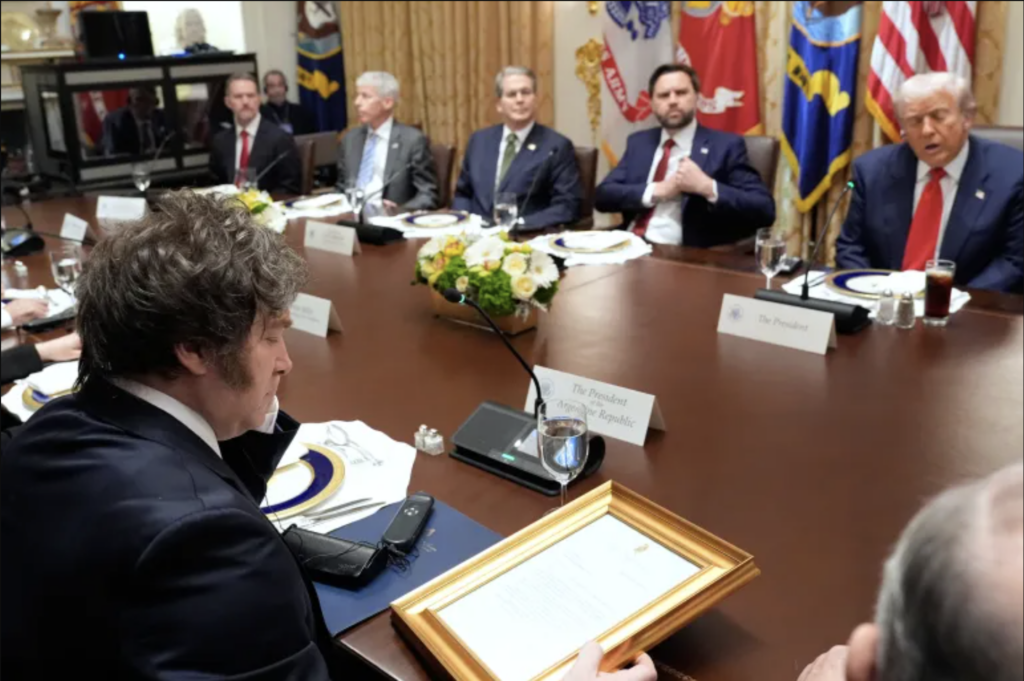
Trump explicitly conditioned the release of the package on the electoral victory of Milei’s party, La Libertad Avanza, on October 26. “If he loses, we won’t waste time with Argentina,” he said. The speech lays bare the interventionist and electoral nature of the operation, converting American foreign policy into a campaign instrument for an ultra-rightist ally.
Read more: Press freedom suffers serious deterioration in the USA and Argentina, warns SIP
The gesture contrasts with Washington’s hostile stance towards progressive governments in the region — such as that of Luiz Inácio Lula da Silva, in Brazil, who recently faced new tariffs imposed by Trump. Selectivity reveals that the so-called “support for democracy” in the US is nothing more than support for governments ideologically aligned with the White House.
A rescue without sovereignty
The billion-dollar aid — which still faces resistance from banks like JP Morgan and Goldman Sachs, concerned about payment guarantees — does not solve Argentina’s structural problems. On the contrary, it postpones the crisis and reinforces external control over the country’s exchange rate and fiscal policy.
The American Treasury Secretary, Scott Bessent, himself admitted that support depends on the continuity of the austerity program and pro-market reforms. In other words, money comes with obedience.
Analysts point out that the package may only postpone the inevitable devaluation of the peso and the renegotiation of the debt of almost US$60 billion with the IMF — the largest debt of a country to the fund among all countries.
The political and moral account
Trump’s operation with Milei is not just a financial deal: it is a political investment in an ultra-liberal and anti-social agenda that threatens to deepen inequality and weaken Latin American sovereignty.
By conditioning aid on electoral results, Washington openly violates the principle of non-interference, transforming Argentina into the stage for a geopolitical dispute disguised as economic cooperation.
Trump, who promised to prioritize American workers and reduce spending abroad, today mobilizes billions of dollars to save a foreign government, not in the name of solidarity, but of ideological affinity.
American aid to Argentina is less a gesture of economic support and more a political maneuver to sustain Milei’s neoliberal experiment and reinforce Washington’s influence over the South American economy. If Milei loses autonomy, Trump loses coherence — and those who pay the price, once again, are the Argentine people.
Source: vermelho.org.br