Published 11/06/2025 15:17 | Edited 11/06/2025 15:22
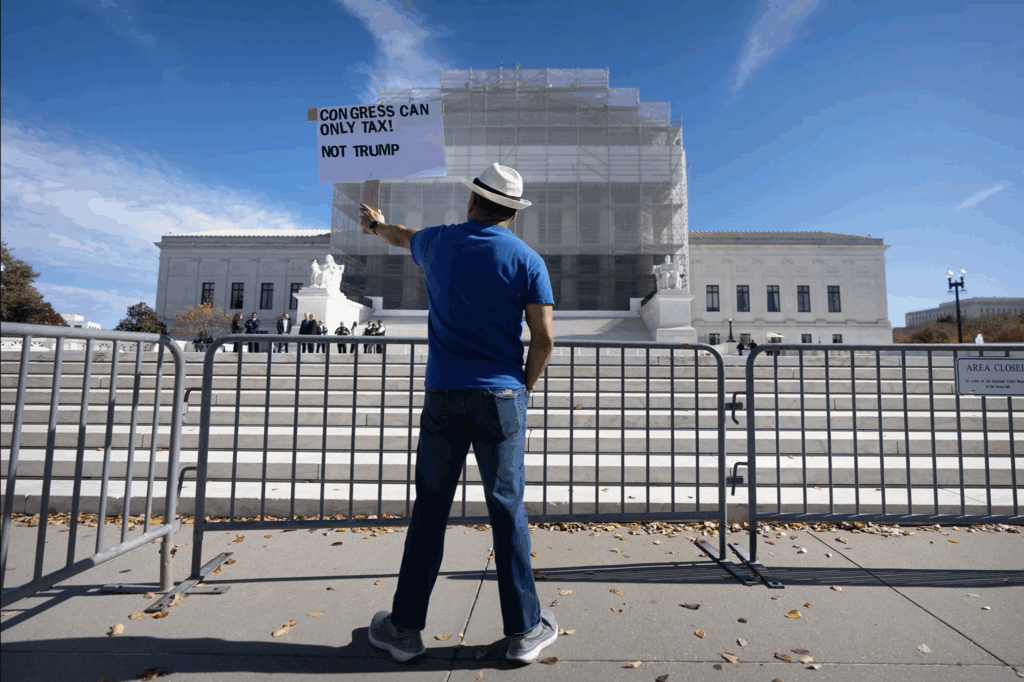
This Wednesday (5), the Supreme Court of the United States plunged into a debate that could redefine the limits of presidential power. During more than two and a half hours of hearing, judges from different ideological wings expressed skepticism about the legality of the tariffs imposed by Donald Trump, who relied on the 1977 International Emergency Economic Powers Act (IEEPA) to justify a global tariff offensive.
The discussion revealed a central impasse: how far does the Executive’s power go to act without the approval of Congress? The Supreme Court’s response could change the institutional balance between powers and directly influence the world economy.
Debate exposes internal divisions in the Court
The session reflects an institutional and political impasse. The Supreme Court’s response will have profound implications — both for the balance of powers in the U.S. and for the global economy.
Although the court has a 6-3 conservative majority, questions asked during the hearing indicated widespread doubts about the legal basis used by Trump. Chief Judge John Roberts, also conservative, recalled that the imposition of tariffs and taxes is a constitutional prerogative of Congress, not the Executive.
Other judges, however, argued that the case involves the president’s “inherent power” in foreign affairs — which could lead to a fragmented and unpredictable decision. The debate also brought to light the so-called “main issues doctrine”, which determines that measures with great political or economic impact can only be adopted with explicit authorization from the Legislature.
Domino effect can affect agreements and commercial partners
The decision threatens not only measures against geopolitical adversaries, such as China, but also against strategic allies, including Brazil, Mexico and Canada. According to experts, if maintained, the sentence could force Washington to compensate countries and companies affected by the tariffs, with a billion-dollar impact.
Even before the decision, the Trump administration had argued that canceling the tariffs could lead to a “financial collapse comparable to that of 1929”. For the White House, tariffs were an instrument of “economic defense”, a way of pressuring countries to review trade practices considered unfair.
US Attorney General John Sauer tried to maintain that Trump acted within the law by invoking the International Emergency Economic Powers Act (IEEPA). According to him, trade deficits brought the country “to the brink of an economic and national security catastrophe”, and the tariffs would have strengthened the American position in global negotiations.
The argument, however, met resistance. Several judges observed that, by increasing revenue, tariffs assumed a tax function — and, therefore, invaded the exclusive competence of Congress.
Trump reacts and bets on confrontation with the Supreme Court
True to his personalist style, Trump reacted on social media, calling the court “highly partisan” and stating that the decision “would literally destroy the United States.” The Republican promised to appeal to the Supreme Court — where three of the six conservative judges were appointed by himself.
The case places the high court once again at the center of the clash over the limits of presidential power. The Supreme Court has been increasingly cautious with measures that expand the Executive’s authority, as seen when restricting Joe Biden’s actions on environmental and educational issues.
A test for the balance between economics and politics
Trump was the first president to use IEEPA to impose tariffs, a move that represents part of his strategy to expand the power of the Executive on multiple fronts, from immigration to trade. The Supreme Court’s decision on the case could define the limits of presidential authority in areas that go far beyond tariff policy.
If the court validates Trump’s thesis, future presidents — Republican or Democrat — could use the notion of “national emergency” as an open door for unilateral economic interventions. Otherwise, the trial could mark a historic brake on presidential expansionism and reaffirm Congress’s role as guardian of United States fiscal and trade policy.
The dispute over tariffs is more than a trade dispute: it is an institutional test of the extent of a president’s power to use trade as a political weapon.
If confirmed by the Supreme Court, the decision weakens the argument that the Executive can act unilaterally in the name of national economic security. If reversed, it would set a precedent for future presidents—of any party—to use emergencies as justification for redesigning U.S. global trade policy.
Source: vermelho.org.br