Published 07/01/2026 18:55 | Edited 07/01/2026 18:56
In the United States, the calendar was rewritten. January 6th was no longer the day when a mob, encouraged by a defeated president, invaded the heart of the legislative branch. Now it is ‘Peaceful Demonstration Day’ which, interestingly enough, required tear gas, rubber bullets, deaths, injuries and more than a hundred hospitalized police officers to prove its peaceful nature. The logic is simple, almost didactic: if it was patriotic, it could not have been violent; if it was violent, it certainly wasn’t patriotic — therefore, it wasn’t violent.
Five years after the invasion of the United States Capitol, on January 6, 2021, Donald Trump’s government promotes an official reinterpretation of the facts. A new White House website presents the president’s version of the episode, denies the insurrectionary nature of the action and justifies the presidential pardon granted to those involved after his return to power in 2025.
It’s Orwell’s doublethink in its purest form. The White House explains that “insurrectionists” never existed, just misunderstood patriots. The 2020 election was rigged because it was not won by those who should have won. And Congress was not attacked; was visited, even though the doors were broken down with the delicacy typical of the most excited tourists. Five deaths are a statistical detail, and democracy, this demanding lady, must learn to be more flexible with those who try to overthrow her in her name.
The page classifies the participants as “patriotic protesters” and attributes responsibility for the chaos and legal consequences of the episode to Democrats — especially former Speaker of the House Nancy Pelosi —. The text also reaffirms, without evidence, the allegation of fraud in the 2020 election, won by Joe Biden.
Real attack, violence and deaths
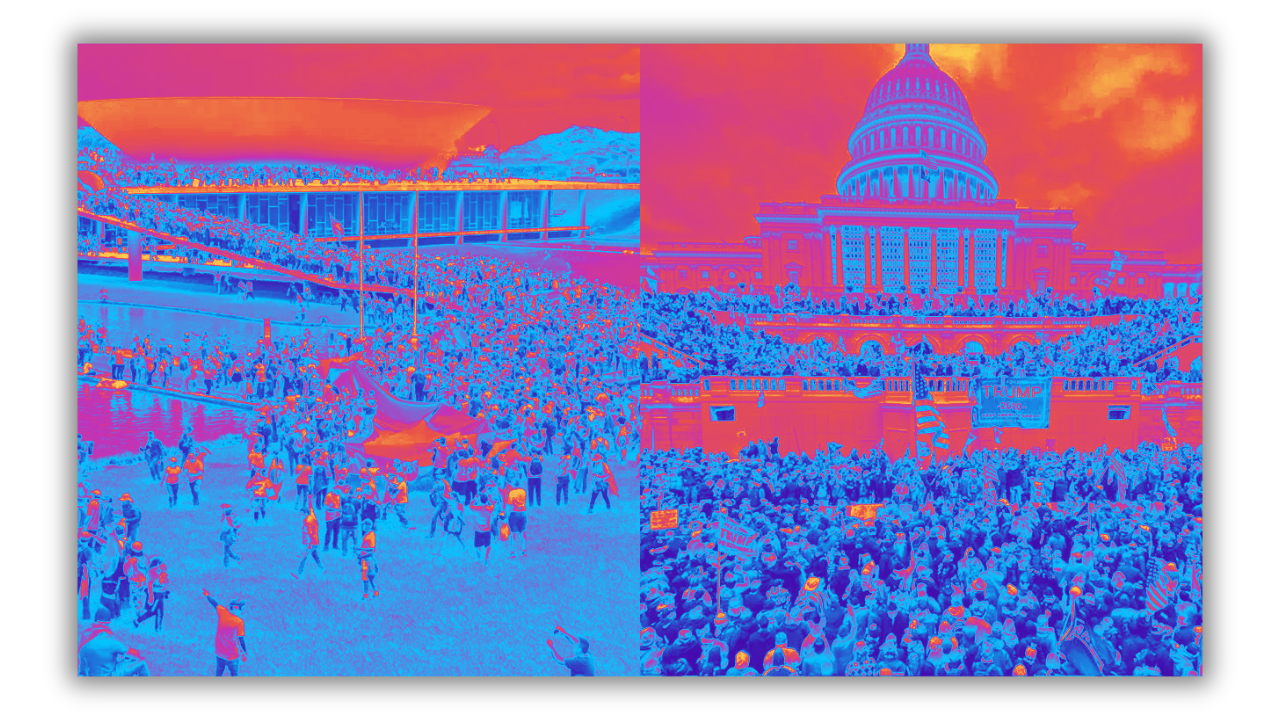
The official narrative contrasts with the widely documented facts. On January 6, 2021, Trump supporters stormed Congress to prevent the certification of the election result. The attack resulted in clashes with the police, left more than 140 officers injured and caused five deaths, including that of a police officer, a lethality even more serious than that which occurred in Brazil.
Hundreds of participants were arrested, tried and convicted of crimes ranging from invasion and obstruction of official proceedings to attacks against State agents. Still, Trump granted pardons to around 1,500 people involved, treating the convictions as political persecution.
Brazil takes the opposite path after January 8th
In Brazil, the institutional response to the attacks of January 8, 2023 followed the opposite direction. After the invasion and depredation of the headquarters of the Three Powers, in Brasília, the country reaffirmed its commitment to criminal and political accountability for those involved, including financiers, executors and organizers.
The investigations conducted by the Federal Supreme Court and the Federal Police resulted in arrests, convictions and liability agreements, consolidating the understanding that attacks against the democratic order are not subject to political amnesty or historical relativization.
Read more: Movements call for acts for democracy and against amnesty this January 8
What Brazil did, in the world of doublethink, sounds almost subversive. Here, January 8th did not become a civic holiday for the “orderly invasion”. An official portal was not created to explain that the destruction was, in fact, an artistic performance, and that the attacks on institutions were just misinterpreted hugs. We opted for an old-fashioned attitude: calling a coup a coup, a crime a crime, and a scammer a defendant.
Memory, justice and democracy
While the Trump administration seeks to rewrite January 6th as a legitimate protest and minimizes violence, Brazil transformed January 8th into a symbol of defense of democracy and the supremacy of the Constitution. Punishing those responsible began to be treated as a necessary condition to avoid repeating attacks on institutions.
Brazilian experts and authorities have highlighted that preserving the memory of facts and ensuring justice are pillars for democratic stability, especially in contexts of political polarization and the spread of misinformation.
While Trump acquits to accuse the law of being unfair, Brazil punishes to affirm that the law exists. In the US, forgiving has become an act of political courage; In Brazil, condemning has become a democratic commitment. There, rewriting history serves to cleanse the past; here, preserving memory serves to protect the future. In Washington, truth is what suits power. In Brasília, at least for now, the authorities still insist on respecting the truth.
Two models in dispute
The comparison between the two countries highlights divergent paths. In the United States, the official narrative of Trumpism relies on role reversal, the delegitimization of the electoral system and the weakening of control institutions. In Brazil, the post-January 8th period has been marked by the reaffirmation of the Democratic Rule of Law and the understanding that democracy is not defended with oblivion, but with truth and accountability.
Thus, while Washington relives the past to absolve its tormentors, Brasília projects the future based on exemplary punishment and the celebration of democracy as a non-negotiable value.
North American doublethink teaches that democracy can be defended by destroying it, as long as the speech is sufficiently eloquent. Brazil, on the other hand, insists on an almost naive thesis: that attacked institutions need to be defended, not renamed. Maybe we’re late. After all, it is much more modern to say that the invasion never happened than to explain why it cannot be repeated.
In the end, there are two dates and two pedagogies. The North American 6th of January, where lies are promoted as state policy and the past is remodeled to fit the narrative of the winner who lost. And the Brazilian 8th of January, where democracy, imperfect and noisy, decided that remembering hurts less than forgetting — and that punishing is still the most honest way of saying that reality exists.
Source: vermelho.org.br