Published 01/10/2025 09:53 | Edited 01/10/2025 12:34
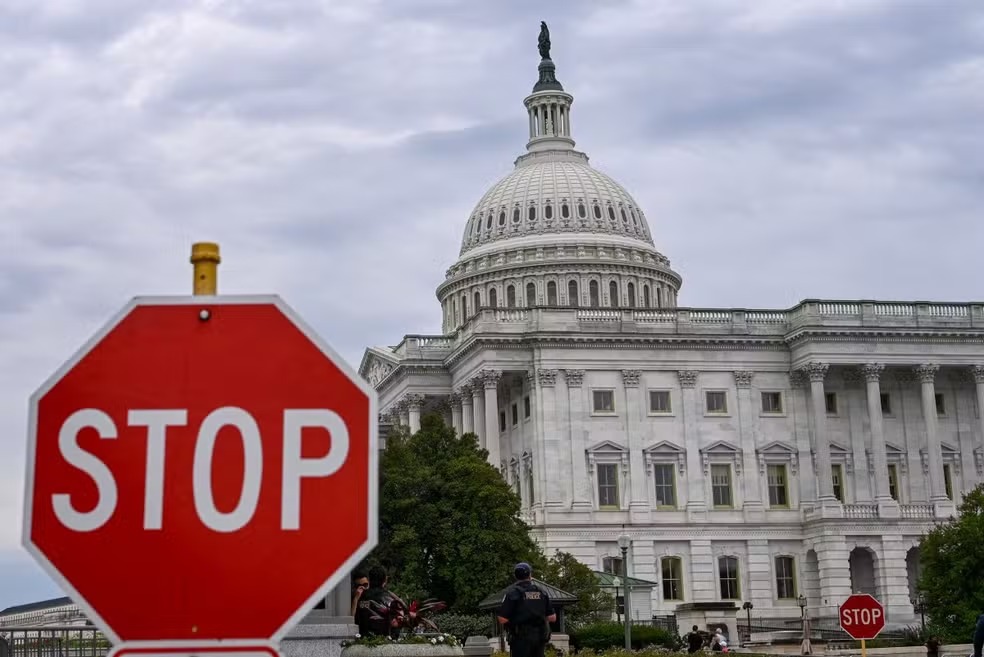
The United States Government went into shutdown At 0:01 am on Wednesday (1st) after Donald Trump and the majority republican in Congress bar the release of resources for health and social programs.
The stoppage, caused by the refusal to extend health subsidies and reverse cuts in Medicaid, reaches hundreds of thousands of servers and interrupts public services across the country. About 750,000 employees were removed, most of them without remuneration, while only essential activities remain in operation.
Democratic opposition required the extension of Obamacare subsidies, which guarantee accessible health plans for millions of families, and the reversal of cuts in Medicaid, approved in July in the Donald Trump tax package known as One Big Beautiful Bill.
Without renewal, it is estimated that 4 million people lose their coverage by 2026, while another 10 million may be uninstated by 2034. For those who continue in the system, insurance awards will have an average increase of 75% next year, according to a survey by Kaiser Family Foundation.
O shutdown It happens whenever Congress cannot approve a budget or temporary financing extension project.
Since 1981, there were 15 such stoppages, the longest of them between 2018 and 2019, when the government was 35 days stood amid Trump’s demand for resources for the Mexico border wall.
In these situations, federal agencies are prohibited from spending additional resources and suspend not essential activities, affecting services ranging from libraries to scientific research programs.
The current stoppage is the fourth under Trump and differs from the previous ones because the White House uses it as a deliberate political instrument.
Budget director Russell Voght has determined that public agencies prepare permanent layoffs plans, not just temporary licenses. Trump himself said he intends to take advantage of the moment to “do irreversible, bad things”, alluding to job cuts and social programs linked to his opponents.
According to the Associated Press, it is expected that the deportation schedule will advance as areas such as education and the environment remain paralyzed.
Public health at the center of the impasse
Democrats claim that they would only accept to vote on the budget if there were extension of Obamacare subsidies and reversal of cuts in Medicaid. The measures are at the center of the dispute because they directly affect millions of workers and low -income families.
Republicans advocate what they call ‘clean resolution’ – a seven -week project that extends funding at the current level, without including the extension of Obamacare subsidies or the reversal of cuts in Medicaid.
The vote in the Senate, the eve of the deadline, made clear the impasse. The Republican plan, which would extend the financing until November 21, obtained 55 votes, but was below the 60 necessary.
The Democratic project, which kept the subsidies and provided more than $ 1 trillion in health spending, was rejected by 53 senators.
There were dissent on both sides: Catherine Cortez Masto, John Fetterman and Angus King (independent) voted with the Republicans, while Rand Paul was the only Republican to reject their own party.
Trump radicalizes and transforms the crisis into a political weapon
Instead of negotiating, Trump raised his confrontation tone. “We can do things during the irreversible stoppage, which are bad for them and irreversible for them, such as cutting a large number of people, cutting things they like, cutting programs they like,” he said shortly before the official start of the shutdown.
Later, in the Oval Hall, he said that “a lot of good things can come from shutdowns”Including dismissing federal democratic servers and weakening opposition social initiatives.
The threat is not rhetorical. The OMB (Office of Management and Budget) has already advised agencies to adopt the budget prepared by Trump – a document without force of law – instead of Congress approvals.
The measure consolidates the strategy of removing from the legislature the constitutional power over public spending.
Experts point out that the White House has been systematically using instruments such as Impoundment and the Pocket Rescissions to retain approved resources, a practice already considered illegal by the Government Responsibility Office, an independent agency linked to Congress.
Social and economic impacts
In practice, closure affects workers across the country. The 750,000 removed represent families without immediate income, while those considered essential – such as flight controllers and security agents – follow in their posts, but without payment until the end of the crisis.
The scenario repeats scenes seen in 2019, when delays and queues multiplied at airports. National parks, federal museums and zoos are closed or operate in a limited way. The Statue of Freedom in New York and the National Mall in Washington suspended visits.
O shutdown It also compromises the dissemination of crucial economic data, such as the September Employment Report, and paralyzes small business services.
Scientific research programs are suspended, as well as environmental inspections and part of the activities of the National Health Institutes and the Center for Disease Control and Prevention. Even the veterans department was affected, with the interruption of support lines and the suspension of military-civil transitional transition programs and chowcase installation in cemeteries.
Political War and Fake News
The dispute in Congress was intensified by the exchange of accusations. Democratic leader in the Senate, Chuck Schumer, warned that Americans will pay up to $ 600 more a month in their health plans and held Trump for the crisis.
John Thune, a republican leader, said the Democrats bowed to the “far left” and that negotiation could only happen “with the open government.”
Trump, in turn, released a rude video generated by artificial intelligence mocking Schumer and the House Democratic leader Hakeem Jeffries.
In the material, Jeffries appears with a Sombrero and Schumer was voiced with insults to the party, the Democrat.
In response to the fake video of artificial intelligence released by the White House, Hakeem Jeffries headed directly to Trump in a public act on the capitol staircases.
“Mr President, let me re-present me. I am the Democratic leader in the House. We do not work for you. We work for the American people,” he said, to the applause of about 150 democratic parliamentarians gathered.
Hours later, in a press conference, Jeffries further elevated the tone and challenged Trump not to hide behind digital montages.
“The next time I have something to say about me, don’t hide behind a fake and racist video. When I’m back to the Oval Hall, say it in my face,” he said.
On social networks, the Democrat reinforced the criticism of publishing a photo of Trump alongside financier Jeffrey Epstein, killed in prison in 2019 while waiting for trial for sex trafficking.
The former Republican president was close to Epstein in the 1990s and 2000s, and there are records of meetings between the two.
A state against the poor
Current shutdown It is not just a legislative accident for lack of agreement between Capitol senators. It reflects a deliberate Trump government policy to use crises to advance the reduction of the state and social cuts.
While the military machine and deportations follow untouched, vital areas such as health, education, environment and veterans support programs are sacrificed.
At the same time as it threatens jobs of 750,000 servers, Trump insists on dismantling health subsidies that guarantee coverage to millions of poor workers.
The stoppage exhibits, once again, the logic of its administration to transform social rights into the target of political blackmail, weakening state protection and deepening inequality in the name of an authoritarian agenda.
Source: vermelho.org.br