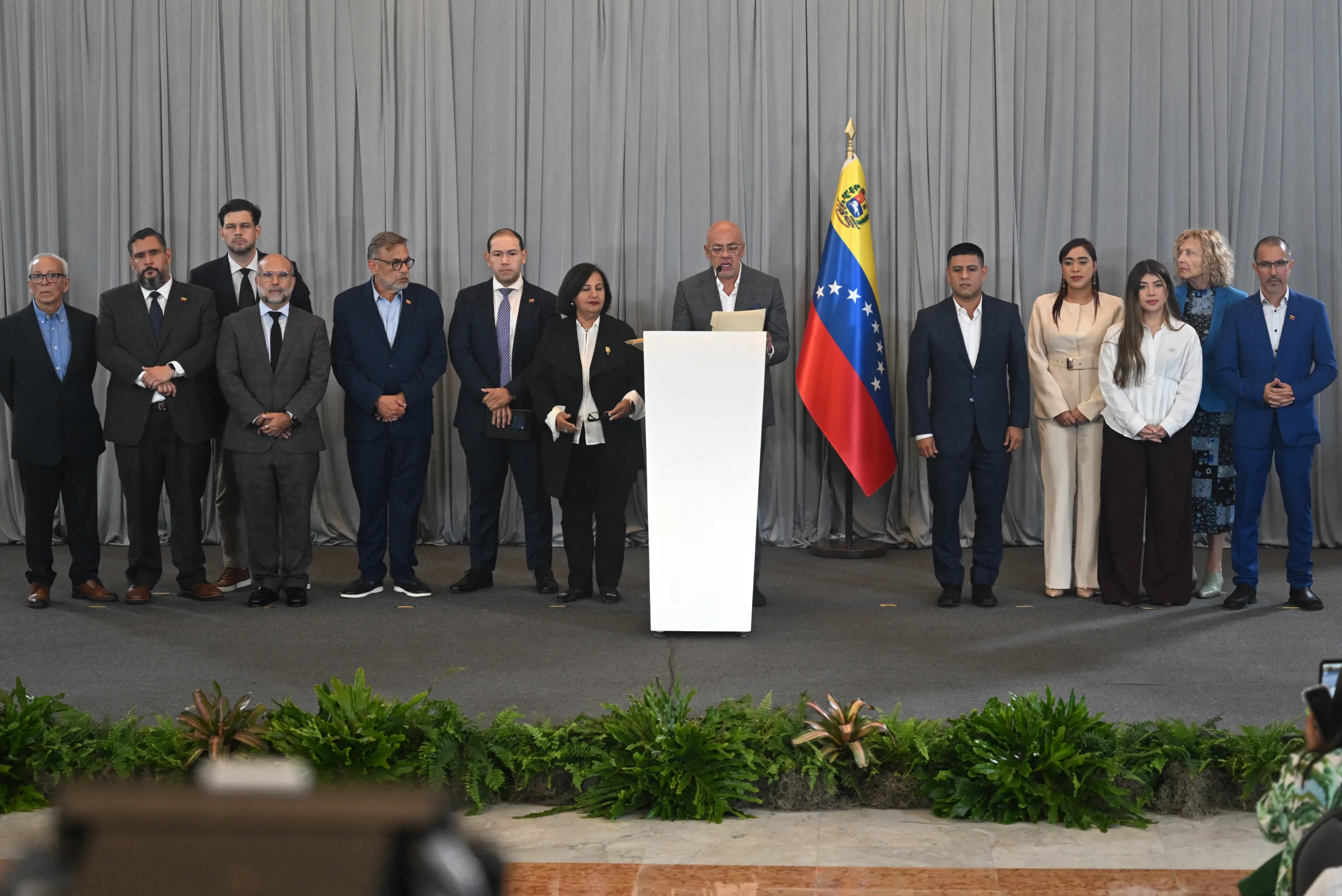
Chavistas and opponents concluded the first cycle of conversations within the framework of the National Program for Democratic Coexistence. There were five face-to-face meetings behind closed doors, in which the operating methodology and the installation of technical work tables were approved, informs the government spokesman, the president of the National Assembly of Venezuela, Jorge Rodríguez.
“For this cycle, two technical tables were installed: emergency response due to the double earthquake and strengthening of democracy, judiciary and electoral power”, declared Rodríguez.
As a result of the first round of dialogue, it was agreed to give priority to actions that seek to strengthen the country’s reconstruction work after the double earthquake on June 24, which left more than 6,000 people dead. In this sense, one of the central points is the attempt to recover the 31 tons of Venezuelan gold held in England. The resource is considered fundamental for the reconstruction of the affected areas, as detailed by the president of the Venezuelan Legislature.
“In view of the magnitude of the tragedy caused by the double earthquake of June 24, and in order to continue providing assistance to the victims of these earthquakes, it is agreed to work on strengthening assistance programs for housing, electricity, health and debris removal. In this sense, both parties will focus their efforts on promoting the recovery of Venezuela’s international reserves held at the Bank of England, establishing transparency, traceability and audit mechanisms to guarantee their efficient use and the well-being of all those affected”, said the deputy, head of the delegation government.
In addition to the humanitarian agenda, the dialogue advances the renewal of institutions. Reforms are planned in the organic law of the Supreme Court of Justice and a new process for choosing magistrates for the highest court and the National Electoral Council. The measures, according to the opposition representative, former deputy Dinorah Figueira, will be known in the coming days and weeks.
“The agreement execution schedule will begin this August with official announcements and concrete actions under a continuous work mechanism that ensures strict compliance with each commitment”, informed the former parliamentarian.
Analysis
For Venezuelan political analyst and specialist in international geopolitics, Miguel Jaimes, it is positive that the dialogues sought to prioritize the emergency, which demonstrates the spirit of national unity around political negotiations.
“We have already begun to observe that, instead of presenting some differences, there are agreements and synergy in them, such as being able to share what a resolution on the issue of sanctions means, especially with the issue of the 31 tons of gold from Venezuela that rest in England, to which there has been no type of response. The Venezuelan government hopes that, through this dialogue table, the best and greatest opportunity will be presented for these funds to be disbursed, because also, in this bipartisan commission, there is a coincidence that it is necessary start solving the issue of La Guaira. One of them is the cleaning of the city that was severely affected by the earthquake and the removal of materials has to take place so that the fields and areas can be evaluated in a better way and way to start building new homes, and the government needs money for this”, analyzes Jaimes.
According to him, the first announcements follow an agenda that was already being debated by the country’s political class, as a way of improving the democratic system and overcoming divisions that only harmed the population.
“The issue of justice for Venezuela, for us and for any part of the world, undoubtedly comes from the existence of revisions. There are no principles that are sacred in legal frameworks, as is the theme of our national Constitution, but there are also many formulas in which many of these principles can be revised”, he states.
“Even in previous years, as was the reform of the Constitution, Venezuela has already tried on previous occasions under its constitutional spirit and the way in which Venezuela presents each of its political formulas. Let’s have a dialogue, conversations and we will surely reach agreements”, recalls the international geopolitics analyst.
Elections
For the Venezuelan opposition, the main point of negotiation is the creation of an electoral calendar at the different levels of government. Which, for Jaimes, should not be an obstacle to continuing the dialogues.
“Without a doubt, for many, the electoral issue could be something thorny and uncomfortable, but it will be accepted and it will happen through a path and through a dialogue stance. Here there is no coup d’état, here there is no fragmented decision or imposition. Here there is simply an agenda and it will be discussed. This will take a few days and even a few months, as was pointed out, until the end of this year”, points out the expert.
“For Venezuela, it is fruitful and interesting that there is the appointment of a new composition of the National Electoral Council. This rejuvenates, it is profound. If it guarantees the participation of all sectors and if it is recognized by all of them, I believe that we are going to make a very interesting political advance”, he argues.
For the expert, although it generates deep debates within the political base of both camps, the process reflects a political maturity that avoids violent conflict and prioritizes national sovereignty.
“The United States says it wants to go through several phases, several principles and several stages with Venezuela. That is the concept. One of them is to recover the issue of monetization of the economic factor, wages, salaries and workers’ rights. We agree because the Venezuelan government is also working towards this. That the matter should be addressed and that it should occur under some processes of change, exchange, negotiations and agreement. Let it happen, but that all sectors be involved, because we cannot continue playing with the salary of the population and its recovery must be one of the main objectives”, assesses Jaimes.
“Stability and stabilization we also want because many sectors in Venezuela have been demanding that resources that are held back in other countries be unlocked. In this case, we do it with one sector so that we go together, hand in hand, to demand this. It is positive for the country. This is a democratic and respectful act, that it is done in this way and that this voice reaches the main decision-makers in the United States directly. It touches this political scenario”, he adds.
Source: www.brasildefato.com.br