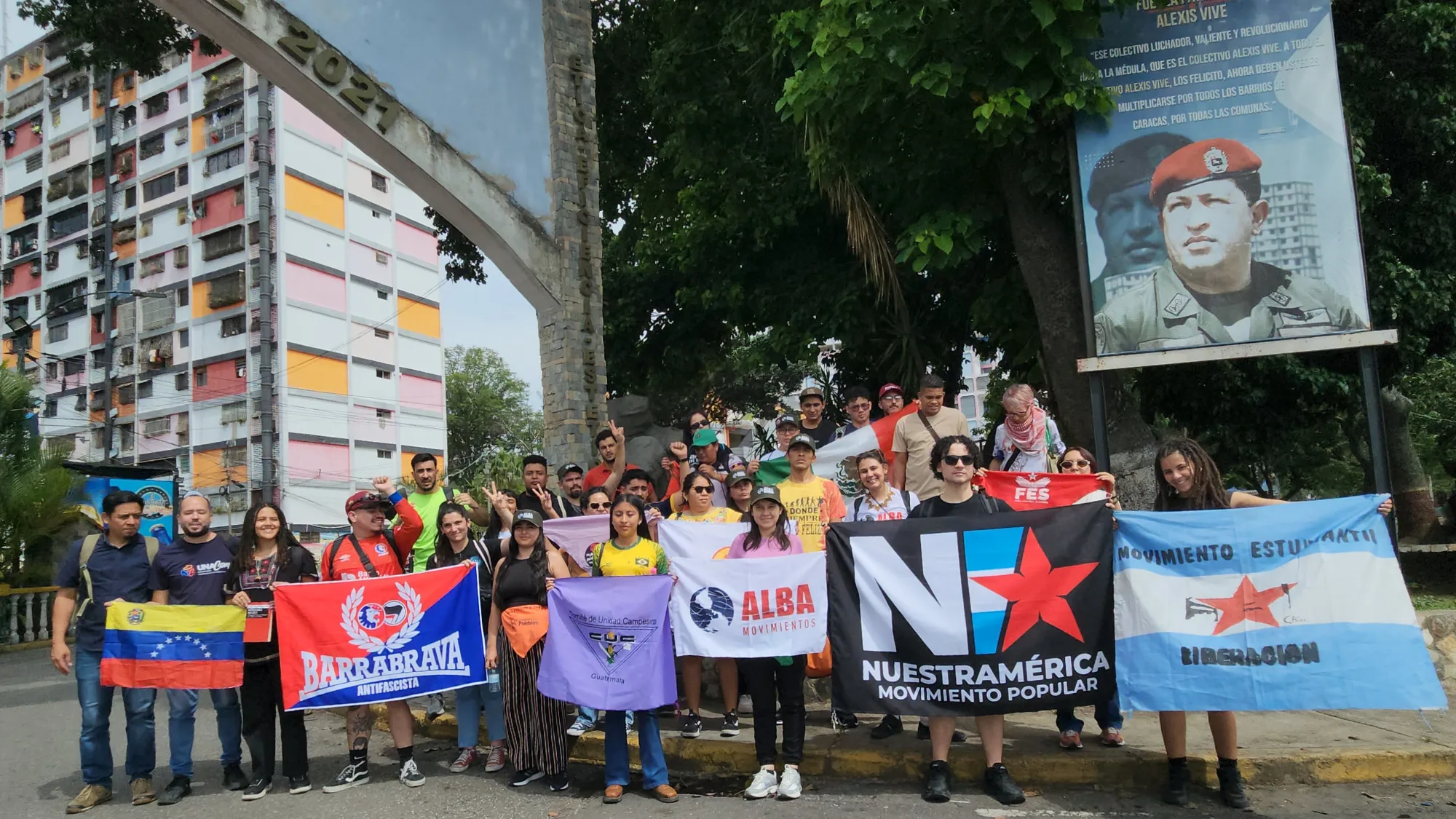
Brazil, Argentina, Colombia, Mexico, Guatemala, El Salvador, Honduras, Chile and Panama are represented in the Fidel Castro solidarity brigade, organized by Alba Movimentos, which arrived in Venezuela to learn about the reality, share experiences and provide support to the Bolivarian Revolution, which is going through one of its most difficult moments.
Marco Moreno, member of the Unified Union of Construction Industry Workers, came from Panama. He says that, on the day of the bombing of Venezuela and the kidnapping of President Nicolás Maduro and Cília Flores, the Panamanian government celebrated the aggression, in a context similar to the US military intervention in the Central American country in 1989.
The population, however, has a different stance. “The Panamanian people are in solidarity with the Venezuelan people, with President Nicolás Maduro and with what happened with the earthquake. The Alba brigade is here precisely so that we can return to our countries, to Panama, and tell things really as we see them here in Venezuela”, says the union leader.
Sinia Rápalo, from the Lorenzo Zelaya Revolutionary Student Movement of Honduras, also highlights the disinformation campaign by the hegemonic media in relation to the reality of the Venezuelan people. Without hesitation, she points out what she would most like to know about this reality:
“Mainly the topic of how communes work. We have great expectations of learning how their organization works, how it benefits the Venezuelan people and being able to replicate this methodology among our people as well”, says the young Honduran. And there they went.
Communes: the seed of Bolivarian socialism
The first communal experience on the group’s agenda was at the Panal 2021 commune, in the heart of Caracas. A territory that became a model of organization by transforming the reality of more than 10 thousand families in the Venezuelan capital.
With almost two decades of territorial work, the commune has productive projects, educational centers and a community organization methodology that caught the attention of Aura Galeas, a member of the Socialist Women movement in Honduras.
“We, left-wing activists, have some idea of how collective power is built, leaving hierarchical logics. So, coming to a commune in fact — because both Cuba and Venezuela have been references for the left and the construction of this entire process — is to understand it as a process. Coming to the commune brings all this reflection that we belong to a capitalist system, but, as it is a process, even if it is slow, we are finding ways, getting to know its dynamics and replanning, based on collective construction”, says Galeas.
“We know that the ideals of Fidel and Chávez were so visionary that, even after their deaths, they sowed this seed of revolution. So, seeing the commune is like seeing part of that vision they had at that time and realizing that it remains”, he adds.
“It remains”, despite the difficulties, whether those imposed by imperialism or by the force of nature itself. For the hosts, in addition to overcoming specific difficulties, this is the time to reaffirm the banner of socialism and strengthen the unity of popular organizations around the world, as proposed by the representative of the Venezuelan nucleus of Alba Movimentos, Hernán Vargas.
“It is essential to build the unity of peoples in a great front against imperialism, because, otherwise, imperialism will impose on us a logic that is completely contrary to our lives. And, at the same time, we believe that it is fundamental to raise the flags of socialism. This society can no longer take it. We have to build an alternative society, but no longer from imagination, but from concrete references built in Cuba, built in Venezuela”, proposes Vargas.
“The path to socialism starting from the commune, starting from the people who self-organize, who self-govern their territory and who redistribute resources according to the things they need most, is the same path that built the community cafeterias in Argentina, that built the MST camps in Brazil. It is learning from this that allowed us to live better, to live well”, he adds.
Source: www.brasildefato.com.br