Published 10/10/2025 11:10 | Edited 10/10/2025 11:26
The Peruvian Congress dismissed President Dina Boluarte in the early hours of Friday (10), after declaring her “permanent moral incapacity” to face the escalation of violence and organized crime.
The vote, which had 122 votes in favor and no votes against, easily exceeded the 87 necessary and led to the immediate inauguration of the president of Congress, José Jerí, who assumes the interim leadership of the State.
The first woman to hold the position, Boluarte did not appear in the plenary to defend herself, alleging a violation of due process.
The vacancy process was conducted at an accelerated pace. On Thursday night, Congress admitted the motion and, a few hours later, unanimously approved its dismissal.
The official justification was the president’s inability to contain the increase in crime, which, according to parliamentarians, would demonstrate the government’s bankruptcy. The country is going through weeks of tension with protests by transport drivers and demonstrations by young people against worsening insecurity.
In his last statement before leaving office, Boluarte said he believed there were irregularities in the process and refused to participate in the impeachment session.
“We will not validate the motion, and for this reason, we will not go to the National Parliament”, stated his lawyer, Juan Carlos Portugal, in a message published on the X network.
Already dismissed, Boluarte made a statement at the Presidency headquarters accompanied by ministers, without the presidential sash, and tried to present a government balance sheet. The speech, broadcast live on television channels, was abruptly interrupted when she began to list numbers and achievements of her administration.
Boluarte’s mandate, which began in December 2022 after the fall of Pedro Castillo, ended with a balance of political isolation and social wear and tear. The former president faces at least eleven investigations opened by the Public Prosecutor’s Office for alleged corruption, illicit enrichment and serious human rights violations.
Among the accusations are the repression of protests that resulted in more than 50 deaths, the receipt of undeclared Rolex watches and the cover-up of the escape of a leader of the Peru Libre party, the party for which he was elected vice-president on Castillo’s ticket.
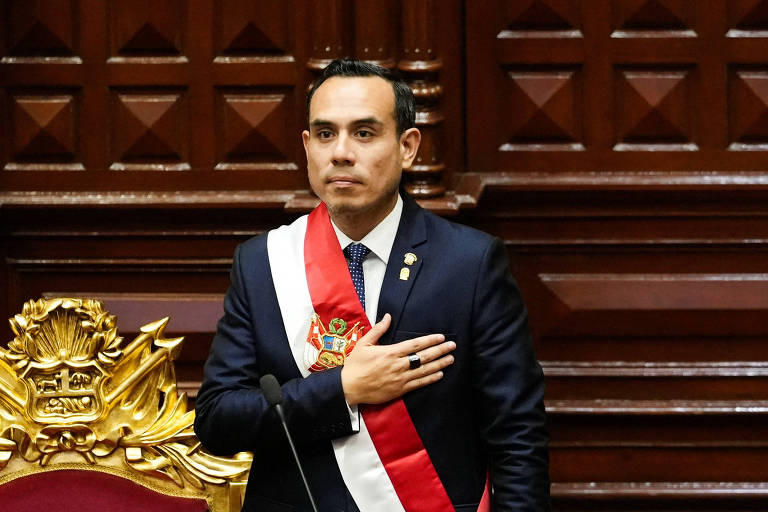
Minutes after the vote, the plenary held the inauguration ceremony for José Jerí, deputy from the right-wing Somos Perú party.
With his right hand raised, the new president swore allegiance to the Constitution and promised to call general elections in April 2026, with the winner inaugurated in July of the same year.
“It is time to ask forgiveness for the mistakes we may have made. To all Peruvians, the case’s apologies and a promise: the promise to start building and laying the foundations of a country that, based on empathy, allows reconciliation between all”, he stated in his first speech.
With Jerí’s ascension, Peru has had seven presidents in less than ten years, a record that symbolizes the political collapse of the Andean country.
Since 2016, Pedro Pablo Kuczynski, Martín Vizcarra, Manuel Merino, Francisco Sagasti, Pedro Castillo, Dina Boluarte and now José Jerí have held the position.
The succession of presidential falls, always supported by the legal figure of “permanent moral incapacity”, consolidated Congress as the center of power and further weakened Peruvian democracy.
From prison, Pedro Castillo spoke out again, asking for the reinstatement of his mandate and accusing Parliament of maintaining a “de facto government” since his dismissal in 2022.
“On December 7, 2022, I was illegally removed without reaching the 104 votes required by law. Today, with more than 104 votes, four motions were approved to remove the usurper Boluarte,” he wrote.
The acting attorney general, Tomás Gálvez, announced that he will ask the court to prevent Boluarte from leaving the country.
She left the Government Palace shortly after the speech, in an official car, and until early this Friday morning her whereabouts were unknown. Jerí’s new administration begins in the midst of a profound crisis of legitimacy, with the economy stagnating and the institutions being widely discredited.
The promise of elections in 2026 attempts to contain popular pressure, but does not dispel the feeling that the country is experiencing an endless cycle of political ruptures and social distrust.
Source: vermelho.org.br