Published 11/17/2025 17:22 | Edited 11/17/2025 17:38
The trial of six members of Palestine Action — a pro-Palestine direct action group banned by the British government in July — began this Monday (17) at Woolwich Crown Court, in London. They are accused of aggravated burglary, criminal damage and violent disorder for actions against Israeli company Elbit Systems, in Filton, Bristol, in August 2024.
The defendants, identified by supporters as Zoe Rogers, Fatema Zainab (Ray) Rajwani, Jordan Devlin, Samuel Corner, Charlotte “Lottie” Head and an activist known only as Ellie, were detained at the scene and have been detained for more than a year — exceeding the British legal limit of six months of pre-trial detention.
The case is the first in a series of cases involving the so-called “Filton24”, a broader group of 24 activists detained in various phases of police operations.
What is Palestine Action
Created in 2020 by Huda Ammori and Richard Barnard, Palestine Action uses non-armed direct actions to disrupt the operations of companies involved in the arms chain linked to Israel. The group claims it seeks to prevent British participation in war crimes and accuses the government of complicity with Israeli policy in the Gaza Strip.
Its members have already spray-painted buildings with red paint — a trademark of their actions — blocked factory entrances, occupied roofs and damaged military equipment. With Israel’s war in Gaza, which began in October 2023, the pace of interventions increased, including paint attacks on BBC headquarters, in protest against what they consider the broadcaster’s pro-Israel bias.
The attack on Elbit in Filton and the wave of arrests
In the central episode of the trial, on August 6, 2024, activists entered the Elbit Systems unit in Bristol and destroyed quadcopter drones allegedly used in Israeli operations in Gaza. The damage was estimated at over £1 million.
Six people were arrested on the spot. Another four were detained in national operations in the following days; in November, new raids brought the total number of detainees to 18. Finally, in June 2025, a final operation brought the number to 24 prisoners.
Although initially accused of terrorism, the crimes were later reclassified to common charges, but the majority were still denied provisional release. The situation sparked protests and led to the start of hunger strikes in November 2025, with activists denouncing abuses in prisons, such as restrictions on visits and the confiscation of kefiyyehs (Palestinian scarves) from visitors.
Why the group was classified as “terrorist”
In July 2025, shortly after an action in which activists invaded the Brize Norton air base and painted the engines of two Airbus Voyagers with red paint, the British Parliament voted to proscribe Palestine Action as a terrorist organization.
The measure made it a crime to join, support or promote the group — punishable by up to 14 years in prison — and equated the organization with armed groups such as al-Qaeda and ISIS. The government said it was acting for reasons of national security and described the actions as “aggressive” and “intimidating”.
On the same day, two far-right entities — Maniacs Murder Cult (MMC) and Russian Imperial Movement (RIM) — were also added to the list of terrorist organizations.
Criticism of the proscription and treatment of detainees
The decision to classify Palestine Action as a terrorist group provoked a strong reaction:
- The UN, through High Commissioner Volker Türk, warned of the “misuse” of anti-terror laws, as the group is not armed and has never caused deaths.
- Amnesty International called the move “disturbing” and accused the government of stifling legitimate protests.
- Civil rights experts say the ban sets a dangerous precedent, expanding the reach of laws designed to address violent attacks rather than actions of civil disobedience.
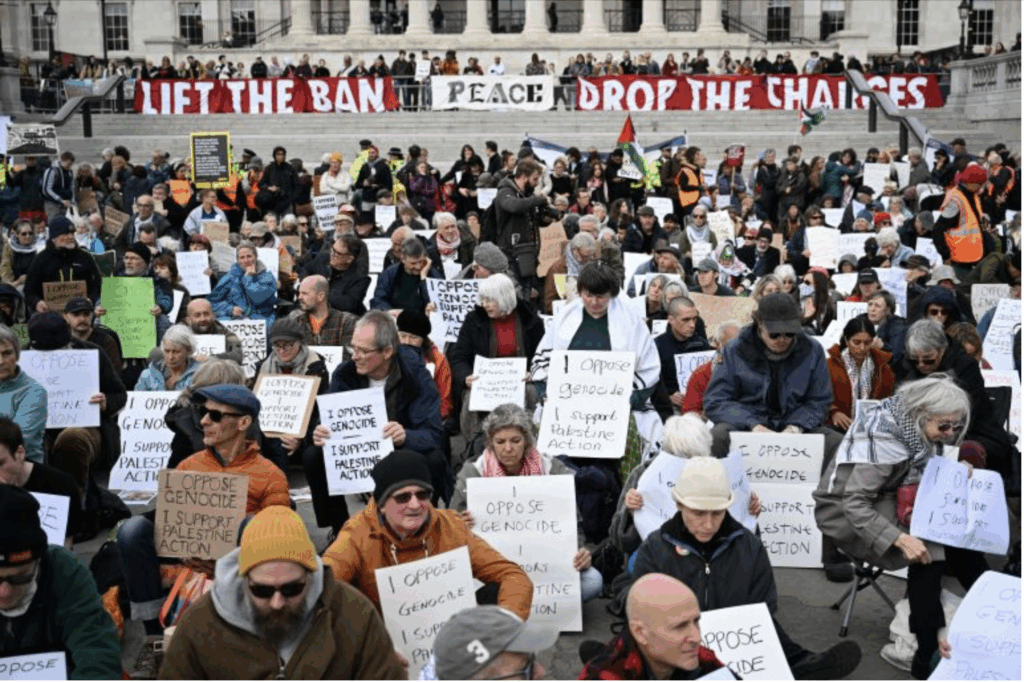
The criminal persecution also became a showcase for the Starmer government’s stance in the face of the growing pro-Palestine movement. On October 4th alone, 500 people were arrested in London for allegedly “supporting a proscribed organization”.
Co-founder Huda Ammori obtained court authorization to challenge the ban, with a hearing scheduled for November 25th to 27th.
Other group actions and political impact
Palestine Action has a history of interventions in installations linked to the military sector, including:
- raids on Elbit’s Ferranti complex in Oldham (2020–2022);
- occupation of drone factory in Leicester, in 2021;
- action with smoke bombs at the Thales factory in Glasgow (2022);
- occupation of an Elbit building in New Hampshire (USA), in 2023.
Although none of the actions caused injuries, the material cost — in some cases, millions of pounds — and the political repercussion have increased pressure on the British government, which seeks to balance protecting legal protests with toughening up against property damage and interference with military installations.
What to expect from the trial
The proceedings at Woolwich Crown Court will be a landmark for the relationship between political protest and anti-terror legislation in the UK. The defense must argue that the defendants acted for reasons of conscience and that their prolonged detention is illegal; The prosecution maintains that the damages were serious, planned and motivated by political objectives.
If the accused are convicted, the case could reinforce the use of harsh laws against political activism. If acquitted, it would tend to strengthen the argument that the proscription of Palestine Action was excessive and incompatible with the right to demonstrate.
The trial, therefore, transcends the six activists in the dock: it calls into question the boundary between civil disobedience, sabotage and terrorism — and the direction of British policies towards the Israel-Palestine conflict.
Source: vermelho.org.br