Published 09/30/2025 16:54
Mexico has achieved the lowest level of poverty of the last four decades, according to official data from the National Institute of Statistics and Geography (INEGI). More than 13.4 million people stopped living in poverty between 2018 and 2024, in a process that authorities and analysts classify as a historical turn.
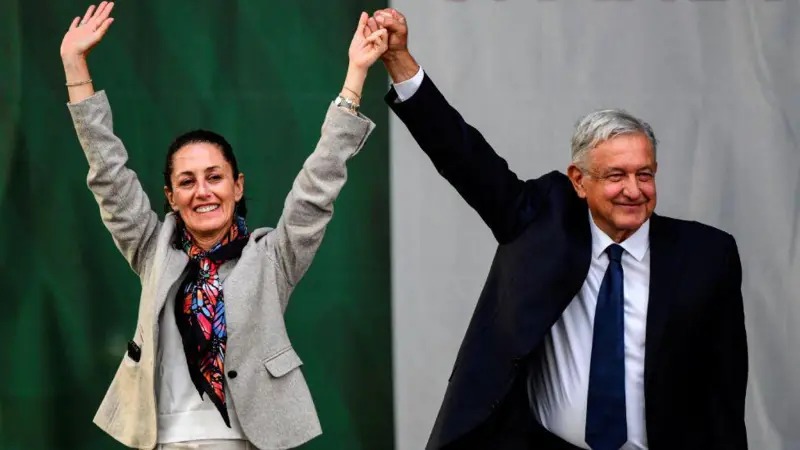
The feat is presented by the government as a direct result of the so-called fourth transformation, a project started by former President Andrés Manuel López Obrador and deepened by the current president, Claudia Sheinbaum, with the maxim “for the good of all, first the poor.”
In recent speeches, Sheinbaum described the poverty reduction as a “feat” and said it should be a source of national pride.
She stressed that for 40 years, poverty in the country had not consistently diminished and, in some periods, has grown. Between 2006 and 2018, for example, Mexico gained more than 15 million poor, a scenario described by the agent as a “poor factory”.
The contrast, according to the president, is in the new development model, which directs public resources to the most needy sectors and promotes a more balanced redistribution of national wealth.
The drop in poverty was accompanied by a significant reduction in inequality. According to the National Family Income and Expense Survey, in 2012 the richest earned 38 times more than the poorest.
Today, this difference has fallen to 14 times. “That is, wealth was distributed,” Sheinbaum summed up, stressing that this transformation was only possible because the state resumed responsibilities that had been relegated to the private sector in the years of neoliberalism.
The historical increase in the minimum wage is pointed out as the first reason for change.
The salary floor has doubled in value in six years, without causing inflation, and the Government’s goal is that it reaches the equivalent of two baskets and a half of basic goods – currently covers 1.8. In 2025 alone, the salary was readjusted by 12.5%. This policy, according to Sheinbaum, also raised other salaries and reinforced domestic consumption.
Another central axis was the well-being programs, which were no longer focused actions and became recognized as universal rights.
Among the examples are the universal pension to the elderly, which today benefits 13 million people; Scholarships for public high school students; pensions for people with disabilities; Support for small farmers with up to two hectares of land; and the Sembando Vida program, which serves half a million rural workers.
Added, the programs reach more than 30 million Mexican families.
“Pension is a right of the people of Mexico,” said the president to reaffirm that the fight against poverty is also the formal recognition of rights.
Public investment in major works was another pillar of strategy. Projects such as Tren Maya, Tehuantepec’s intercetus corridor and the mouth refinery, as well as expand national infrastructure, attracted foreign capital and boosted formal employment.
Sheinbaum pointed out that the end of the outsourcing model known as outsourcing It also contributed to generating more stable jobs.
Health appeared as a symbolic dimension of this change. At events in the state of Mexico and Jalisco, the president inaugurated and reopened hospital units that had been abandoned or destroyed, such as the 93 Family Medicine Unit in Ecatepec and the Tlajomulco Regional Hospital.
“Health, access to health is a right of the people of Mexico established in the Constitution, and the state should provide this access in the best way. IMS is national heritage,” said Sheinbaum, along with local authorities and the Institute’s director, Zoé Robledo.
The president also took advantage of these occasions to announce new measures: the expansion of the universal pension to women aged 60 to 62 years, the construction of an Ecatepec Child Education and Care Center and the goal of raising the minimum wage gradually until reaching 2.5 basic baskets.
The mark of four decades without a consistent reduction of poverty sets the tone of how the government seeks to present the results of the fourth transformation. The expression is used in Mexico to designate the political project started by Andrés Manuel López Obrador in 2018 and continued by Claudia Sheinbaum.
Inspired by three foundational moments of national history – independence, reform and the Mexican Revolution – the term refers to a “fourth major change”, focused on breaking neoliberalism, strengthening the role of the state, expanding social rights and placing the poorest in the center of public policy.
For Sheinbaum, contrast to neoliberalism is evident. “This model stated that it was much better than everything was private and that the public sector practically disappeared, that the government was no capacity to offer services for the benefit of the population. It just no longer advanced because it was not allowed,” he said.
On the contrary, its management reinforces the role of the state to guarantee constitutional rights such as health, education and social security.
The feat is treated as historical achievement, but also as an open process.
While the government celebrates the hallmark of 13 million people who have come out of poverty, it reinforces that the continuity of social policies and public investments will be decisive so that advances are not interrupted.
Mexico, after four decades of stagnation, shows that it is possible to reverse trends of misery and inequality, provided that the center of economic policy is, in fact, in those in need.
Source: vermelho.org.br