Published 9/11/2025 09:19 | Edited 11/09/2025 09:23
Defense Minister Sébastien Leconnu, 39, assumed on Wednesday as the new Prime Minister of France in the midst of a national wave of protests against the government’s economic policy.
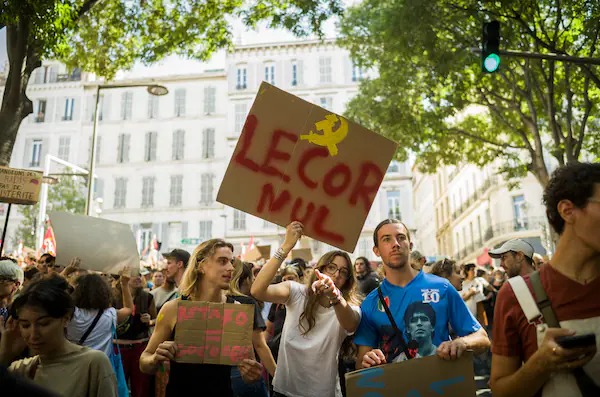
Appointed by President Emmanuel Macron to replace François Bayrou, who fell after a defeat in a vote of confidence in the National Assembly, the military begins the position surrounded by criticism and street mobilizations that broke out this Wednesday in the baptized movement as “blocked everything.”
According to the Interior Ministry, 473 people were arrested and 80,000 police officers were mobilized across the country, including 6,000 in Paris.
About 200 thousand protesters participated in the acts, according to estimates from the French press. The Ministry of Education reported that one hundred schools were affected, 27 of them fully blocked, train stations were paralyzed and bars and restaurants remained closed in the country.
The protests spread throughout cities such as Paris, Nantes, Rennes and Montpellier. There were blockages of highways, burned buses and barrels in flames. In Paris, students and workers raised barriers near Gare du Nord station, the country’s main and center of Châtelet. A restaurant in the 1st arrondissement was hit by fire.
The streets exposed dissatisfaction with the continuity of austerity policy. “The 2026 budget is a social destruction budget. Even with Bayrou out, the poor are still targeted,” said Elodie, 34, a preschool teacher, in an interview with CNN.
“We want another type of government,” Emma, 17, a student of Sorbonne, told Reuters. “The problem is Macron, not the ministers. He has to leave,” said Fred, CGT leader at RATP.
Improly France classified Leconnu’s appointment as a provocation. Movement coordinator Manuel Bompard announced that he will present a motion of censorship if the new Prime Minister does not ask for a vote of confidence to the Assembly. Jean-Luc Mélenchon also called the choice of “sad comedy of contempt for parliament.”
Leconnu, an ally close to the president, is the only minister present in all Macron governments since 2017. He began at the conservative party Les Républicates and projected as the face of French rearmament, conducting the law that provides € 413 billion in defense spending by 2030 by 2023.
He is also close to figures such as Marine Le Pen, with whom he kept controversial dinners, which reinforced criticism of his appointment.
The new prime minister will be immediately challenged to negotiate the 2026 budget in a divided parliament, where the two predecessors have already been overthrown because of this agenda.
Macron pressures for an agreement with socialists and republicans, but both resist sustaining the government. Socialist Party leader Olivier Faure signaled openness to discuss less drastic cuts, but warned: “If we are being wrapped, we will bring the government.”
The PS broke with Melenchon and Bompard’s Insubmissa France, and runs the risk of being left out of Parliament in the next elections, according to recent surveys. Therefore, the socialists try an approximation with the right -wing right as a form of political survival, even if they betray their principles.
The demonstrations resemble the 2018 and 2019 yellow vest movement, but with another social base.
The press points out that current protests have a strong participation of young students, with speeches focused on social justice and fighting inequalities. A new national journey of strikes and stoppages was summoned to September 18, with the adhesion of trade union centrals.
In article published in Libérationcolumnist Jonathan Bouchet-Petersen said the government was going to measure mobilization only by the number of protesters. For him, the choice of Leconnu is “oil in social fire” and highlights the mismatch between calm in mattignon and the noise of the streets. According to cited research, two thirds of the French want Macron to leave, and 25% say they feel “disgust” by the president.
Source: vermelho.org.br