Published 05/01/2026 16:03 | Edited 05/01/2026 16:25
In the occupied West Bank, water — a historical source of life and sustenance — has become an instrument of domination. In Al-Auja, one of the oldest river basins in Palestine, Palestinian families report that Israeli settlements have surrounded springs, installed pumps and dried up the canals that have supplied the community for generations, deepening a structural crisis described by experts as “water apartheid”.
Inequality in access is measurable. Jad Isaac, director of the Jerusalem Institute for Applied Research (ARIJ), says that an Israeli settler consumes about seven times more water than a Palestinian. While the Palestinian quota does not exceed 80 liters per person/day, in marginalized communities it drops to less than 15 liters — far below the global minimum recommendation of 100 liters.
Fenced spring, dry pipes
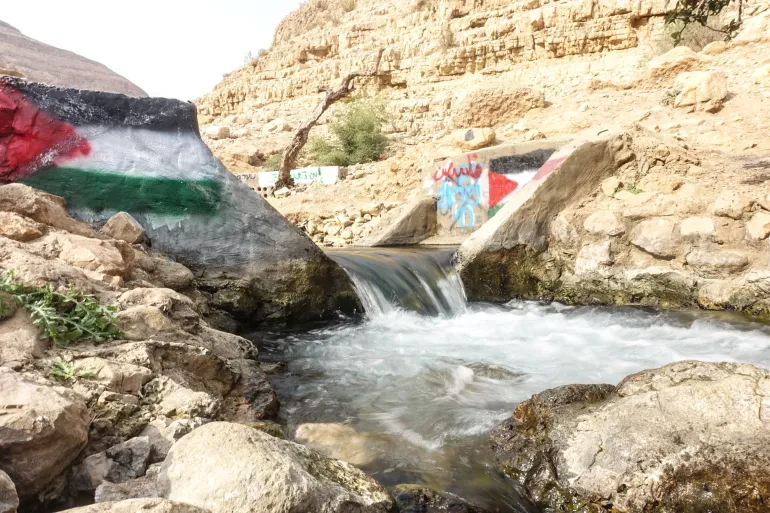
The Al-Auja spring has gushed for centuries in the Jordan Valley. Today, an Israeli settlement stands between residents and the water. According to local reports, settlers surrounded the area and began extracting directly from the aquifer, even hundreds of meters below the spring.
From above, the asymmetry is visible: aerial images show withered Palestinian greenhouses next to green, irrigated agricultural settlements, supplied by confiscated water.
The “Oslo trap”
With sources blocked or taken over, Palestinians have been pushed into structural dependency. Isaac describes the Oslo Accords as a “trap”: Israel refused to negotiate water rights and mandated that Palestinian needs be submitted for Israeli approval — which then sells the water back.
The Palestinian Authority buys more than 100 million cubic meters a year from Israeli companies, effectively buying back its own resources. Military orders have consolidated total control of the sources, and new barriers — such as the so-called “crimson wall” in the north of the Jordan Valley — widen the separation between communities and agricultural lands.
Human rights organizations warn that induced shortages act as pressure for silent expulsion. ARIJ data indicates that more than 56 springs in the West Bank have suffered attacks or occupations by settlers.
“The seizure of the springs indicates the shift from control of resources to direct coercion on the population,” says Isaac. The result is forced migration and the dismantling of rural communities — “slow displacement.”
Government endorsement and dismantling of infrastructure
Water appropriation has political support. In a video circulating online, Israeli Finance Minister Bezalel Smotrich praises settlers for regaining “control” of wells and areas. Meanwhile, Palestinian works are blocked: rain catchment dams are prohibited, cisterns are demolished and, with the separation wall, at least 31 artesian wells are isolated.
Studies indicate that water control is central to colonization. The 1959 Water Law declared all resources as public property of the Israeli state, consolidating centralized management that prioritizes settlements, especially in arid regions, and excludes Palestinians — including Bedouin communities. The rhetoric of “making the desert flourish” supported diversion megaprojects, not for sustainability, but for settling settlers and reinforcing borders.
Manufactured scarcity, food and health crisis
Water restrictions compromise food sovereignty and health. Without irrigation and pasture, families depend on ultra-processed foods; Among urbanized Bedouins, the incidence of diabetes soared, a rare phenomenon until the mid-20th century. Scarcity, often presented as natural, is produced by unequal appropriation.
Researchers conclude that the crisis does not arise from “habits”, but from the expropriation of land and water. Water justice is inseparable from decolonization: without equitable access to natural resources, there is no public health, food security or human rights. The West Bank experience serves as a global warning: when water becomes a commodity and an instrument of power, local populations pay the highest price.
With information from Aljazira
Source: vermelho.org.br