Published 21/11/2025 15:03 | Edited 11/21/2025 15:19
Life in southern Syria has entered a new stage of instability since December 2024, when Israel expanded its military presence following the ouster of President Bashar al-Assad. In Quneitra, a region historically marked by the dispute over the Golan Heights, Israeli incursions have become more frequent, bolder and more violent, according to residents and local authorities.
Tanks, checkpoints, watchtowers and gates embedded in Syrian territory have become part of everyday life. The border that, for decades, was managed by a delicate disengagement agreement signed in 1974 — and considered “null” by Israel after the fall of Assad — is now the scene of arrests, disappearances and repeated attacks on civilian infrastructure.
The estimate by elders in the region is that 688 hectares of land have been taken since then, including centuries-old orchards and pasture areas.
Arbitrary arrests create a climate of terror: “They take whoever they want”
Khadija Arnous lives this drama directly. In July, her husband and brother-in-law were taken from their home by Israeli soldiers at dawn, blindfolded and taken to an unknown destination.
“We haven’t had any news since then. The Red Cross can’t get an answer,” he said, covering his face for fear of reprisals.
Residents and human rights groups classify the cases as kidnappings. Israel, in turn, describes them as “security operations”. Local reports indicate that at least 40 people have been detained in recent weeks.
Other cases reinforce the pattern: Hussain Bakr’s son and brother disappeared five months ago. “We complained to the UN and the Red Cross. Nothing”, he says.
The military advance: watchtowers, trenches and nine new Israeli camps
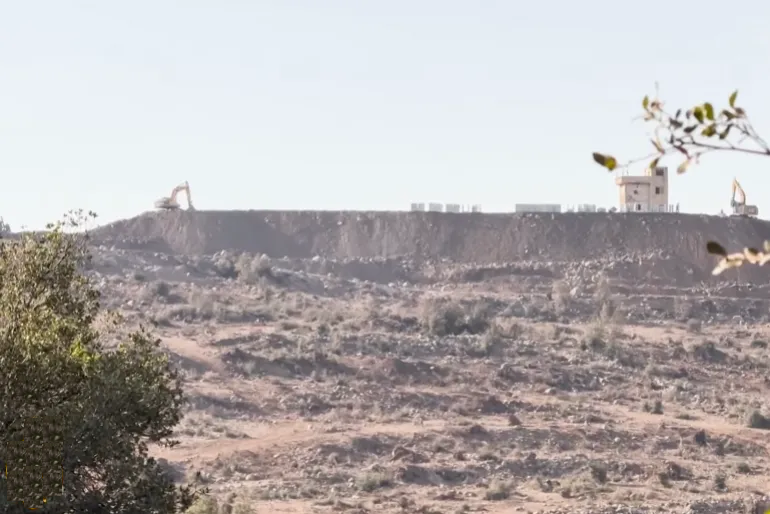
In addition to the detentions, Israel has reinforced its presence with landfills, fortified positions and surveillance towers. Aljazira’s Sanad agency confirmed the installation of nine new military camps since December 2024.
Shepherds report that Israeli troops have razed entire areas, uprooting trees they believe are centuries old, reconfiguring the territory and making agricultural activities unfeasible.
Mohammad Makkiyah experienced the risk up close. When he got too close to a military post, he was targeted by a sniper.
“The first shot went close to my head. The second hit my leg.”
Attacks on infrastructure and hospital destroyed
Al Jawalan Hospital in Quneitra has suffered repeated attacks in recent years. Satellite images show the destruction of the unit, a symbol of the direct impact of the occupation on the region’s already precarious health infrastructure.
Paralyzed communities: fear, exodus and unproductive land
For many residents, like Mohammad Mazen Mriwed of Jubata al-Khashab village, fear has taken over basic activities.
“Since the fall of the regime, many have stopped building or farming. The occupation will only end when the occupation ends.”
The speech exposes the governance vacuum left by Assad’s ouster, which opened space for an Israeli movement unprecedented since 1967.
Interim government under pressure: insufficient diplomacy in the face of the disappeared
Syria’s interim president, Ahmed al-Sharaa — himself a descendant of displaced people from the Golan Heights — faces increasing scrutiny. Local authorities say the government is seeking “diplomatic solutions”, but recognize limits.
Jamal Numairi, member of the People’s Assembly of Quneitra, admits: “I consider them kidnapped, not prisoners. The situation is painful for the families and for us.”
As residents await answers, the feeling is growing that post-Assad Syria does not have the means to control the territory or prevent Israeli expansion.
A reconfigured conflict and a region on the brink of collapse
What we see today in southern Syria is an explosive combination of:
- reconfiguration of the post-Assad military balance;
- Israeli territorial advance without effective international mediation;
- economic and social collapse of rural communities;
- and a cycle of arrests and disappearances that recalls the worst moments of the Syrian conflict.
Without accountability mechanisms and with weakened diplomacy, fears are growing that the occupation will advance into new areas — and that the disappeared, like Khadija Arnous’s husband, will never return.
With information from Aljazira
Source: vermelho.org.br