Published 02/10/2025 12:30 | Edited 02/10/2025 12:52
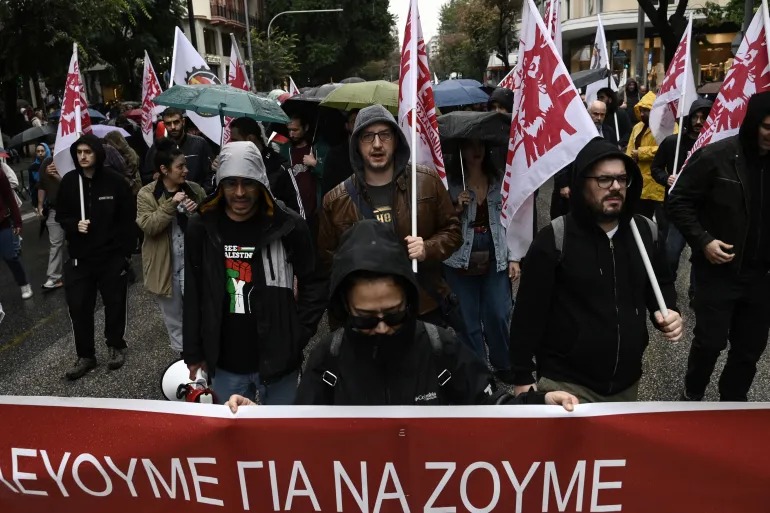
Greece lived on Wednesday (1st) a 24-hour general strike that paralyzed transport, public services and schools in protest against the labor reform presented by the conservative government of Kyriakos Mitsotakis.
The project, which is due to be voted on in October, authorizes hours of up to 13 hours a day in a country that is already among those who work the most in Europe.
In Athens and Thessaloniki, the second largest city, trains and taxis were suspended, while bus, subway, tram and trolleybus worked reducedly. The ferries remained attracted in the ports, leaving the sea around the capital without boats.
Hospitals, schools, courts and public offices also interrupted the activities, in a mobilization that brought together thousands of public and private sector workers on the streets.
Many protesters took Palestinian flags and shouted in solidarity with Gaza, in a demonstration of internationalism of the working struggle.
The proposal defended by Mitsotakis provides that, on certain days, workers can extend their hours within five hours, reaching 13 hours per day. The weekly workload, including overtime, would be limited to 48 hours, with a ceiling of 150 overtime per year.
The government justifies the measure as a way to “flex” the job market and allow young people to focus hours in a single job, promising an additional 40% for those who exceed the journey.
Labor Minister Niki Kerameus said the rule would only be applied to “exceptional circumstances.”
For unions, the reform represents a historical setback. “We say no to the 13 hour shift. Exhaustion is not development, human tolerance has limits,” said the General Confederation of Greece Workers (GSEE).
The entity added that change “endangers the health and safety of workers and destroys the balance between professional and personal life.” Pame, a central connected to the Communist Party, compared the measure to a form of “modern slavery”.
Workers reinforced the criticism of the project on the streets. “Greeks are already forced to survive with some of Europe’s lowest salaries and are now asking us to work most of the day. People cannot be pushed like this; at some point there will be an explosion,” said Makis Kontogiorgos, a technology company.
For Katerina Andritsopoulou, a 55 -year -old employee from a private factory, the change aggravates inequality. “While the rest of Europe talks about a shorter work week in Greece in the 21st century, everything revolves around longer hours and salaries that do not reflect the cost of living,” said the worker.
Although the Greek economy has a 2.3% growth in 2024 and unemployment is falling, wages remain among the lowest of the European Union.
The minimum, currently at € 880 (R $ 5,100), does not cover the increase in the cost of living. The country, which lost more than 25% of GDP during the debt crisis, is still marked by austerity policies imposed in exchange for international rescues.
Since taking office in 2019, Mitsotakis has reduced union power and wholesale collective agreements in the name of the “modernization” of the economy.
Last year, his government had already introduced the six -day work week, a qualified measure as “Barbara” by the centrals. This Wednesday’s general strike, however, reaffirms the disposition of resistance of Greek workers, who face on the streets an offensive that threatens rights conquered for decades.
Source: vermelho.org.br