Published 03/11/2025 19:08 | Edited 03/11/2025 19:15
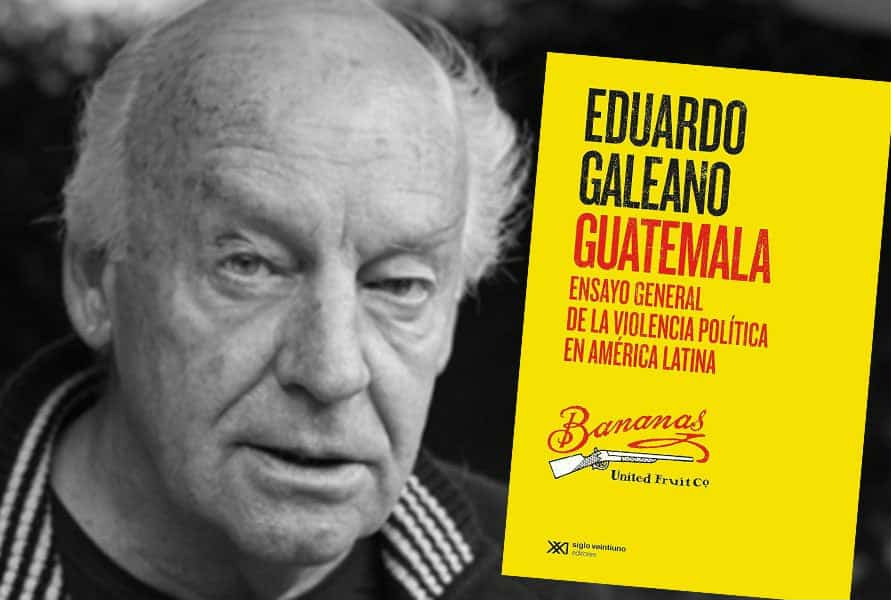
Eduardo Galeano released in 1967, four years before his classic “The open veins of Latin America”, the book “Guatemala – General essay on political violence in America”, in which he focuses on the meaning of the “active, massive and massive American military presence in this country” to defend at all costs the interests of the United Fruit Company (UFC) – the multinational banana company that enslaved rural workers.
In the work, the then young Uruguayan writer describes how “this small country of illiterate and starving Indians stood on its feet” and the risks this represented for imperialism, since “the colony wanted to become a homeland”.
“Until 1944, the country had been a witness and a victim, but not a protagonist of its history. For a long time, the fate of Guatemala had been thrown into the hands of foreign currencies, on Wall Street or in Washington or in the Pentagon’s general headquarters”, he summarized. “Guatemala was the first Latin American laboratory for the application of dirty war on a large scale”, he pointed out.
Since the October Revolution of 1944, which deposed the dictatorship of Jorge Ubico and brought to power – with a large majority at the polls – two popular presidents: Juan José Arévalo (1945-1951) and Jacobo Árbenz (1951-1954), nationalist and developmentalist policies were consolidated, which gave rise to indigenous participation, a majority previously excluded by elites serving foreigners.
Árbenz deepened transformations, mainly with the Agrarian Reform Law, which made it possible to expropriate uncultivated land, completely affecting the UFC’s greedy interests, in a country where 2% of landowners controlled more than 70% of the rural area.
“United Fruit: a State within the State”
“The UFC, a State within the State, owner of the land, railway and port, exempt from taxes and free from controls, is no longer omnipotent in its vast properties. The new labor and social security laws made possible the development of the internal market, the increase in purchasing power and the standard of living of workers. With the construction of highways and the creation of the port of São José, in the Pacific, the monopoly that United Fruit exercised over transport and commerce was broken. ambitious economic development projects, such as the country’s electrification works, driven by with national capital”. With this guideline, in the first months of 1954, more than 100 thousand families had benefited – in a country of three million inhabitants.
With a wealth of detail, Galeano exposes “the leading role that the USA played in this conflict”, as well as its “concealment after the coup against Árbenz on June 18, 1954”.
In Brazil, President Getúlio Vargas committed suicide on August 24 of the same year, a gesture that took the people to the streets and postponed the coup for a decade.
“Guatemala is the victim, like Latin America, of a conspiracy of silence and lies”, echoes a recording from 1967, reporting how “the owners of the media, who manufacture public opinion, hide and distort facts with arbitrariness and efficiency: the news shrinks until it disappears or swells until it bursts, as suits”.
The barbarity had not yet reached the level of psychopathy of the 1970s, when the Israelis came to replace the Americans and went further with their manuals in Hebrew. In practice, they taught how to open the wombs of pregnant women, roast and eat children, rape in lines of up to 20 soldiers, introducing syphilis and gonorrhea, “Palestinizing” communities kept in concentration camps to try to erase Mayan resistance once and for all.
Galeano reveals the role played in the coup by John Foster Dulles, secretary of the State Department from 1953 to 1959 during the Eisenhower administration, and his brother, Allen Dulles, the sadly famous founder and director of the CIA for more than 20 years.
To understand the extent of the barbarity, officially, between 1960 and 1996, the Guatemalan dictatorship murdered 200,000 people and disappeared another 45,000, five thousand of them children, always with capital, training and approval from the American and Israeli governments.
“victims of state terrorism”
“Statistics: in the last fifteen years, a political murder has occurred in Guatemala every five hours. In most cases, the dead are dead without bodies, ‘disappeared’, poor peasants without a face or name, victims of State terrorism. Heads on stakes often appear on the side of the roads. The crime then becomes a public spectacle, as in the times of the Inquisition, to serve as a warning to the living. The peasants then lost their land and their voice”, he described.
Serving as “president,” Castillo Armas “accomplished his mission.” “He returned the idle land expropriated to UFC and other landowners and handed over the subsoil of 4,600,000 hectares, almost half of the country, to the international oil cartel. The Petroleum Code was written in English and reached Congress in English: it was translated into Spanish at the request of a deputy who still had a trace of shame.”
With pain, Galeano remembers Rogelia Cruz Martínez, a companion without whom the work could not have been written, as she was the one who allowed him to reach resistance. “Rogelia, kidnapped, raped, outraged and brutally murdered by a death squad with the intention of silencing her ideas and avenging her revolutionary activism, three months pregnant. Her body appeared under a highway bridge between Siquinalá and Santa Lucía Cotzumalguapa. She had studied architecture at the University of San Carlos. In 1958 she was elected Miss Guatemala and in 1959 she represented the country in the contest for Miss Universe”, he denounced.
Due to the strength of what he saw and reported, from this book onwards there will be no other work in which Galeano does not make reference to Guatemala until his posthumous work, “The History Hunter”.
Source: vermelho.org.br