Published 09/09/2025 08:32 | Edited 02/09/2025 08:53
China, flanked by Russia and India, used the Summit of the Shanghai Cooperation Organization (OCX) held on Sunday (31) and this Monday (1) in Tianjin, to launch a call by a new multipolar world order, as opposed to the United States hegemony and the Donald Trump tariff war.
The meeting, which brought together more than 20 leaders from Global South Countries, served as a stage for Beijing to present itself as a stable alternative to Western unilateralism, with Xi Jinping defending “true multilateralism” and condemning the “policy of power.”
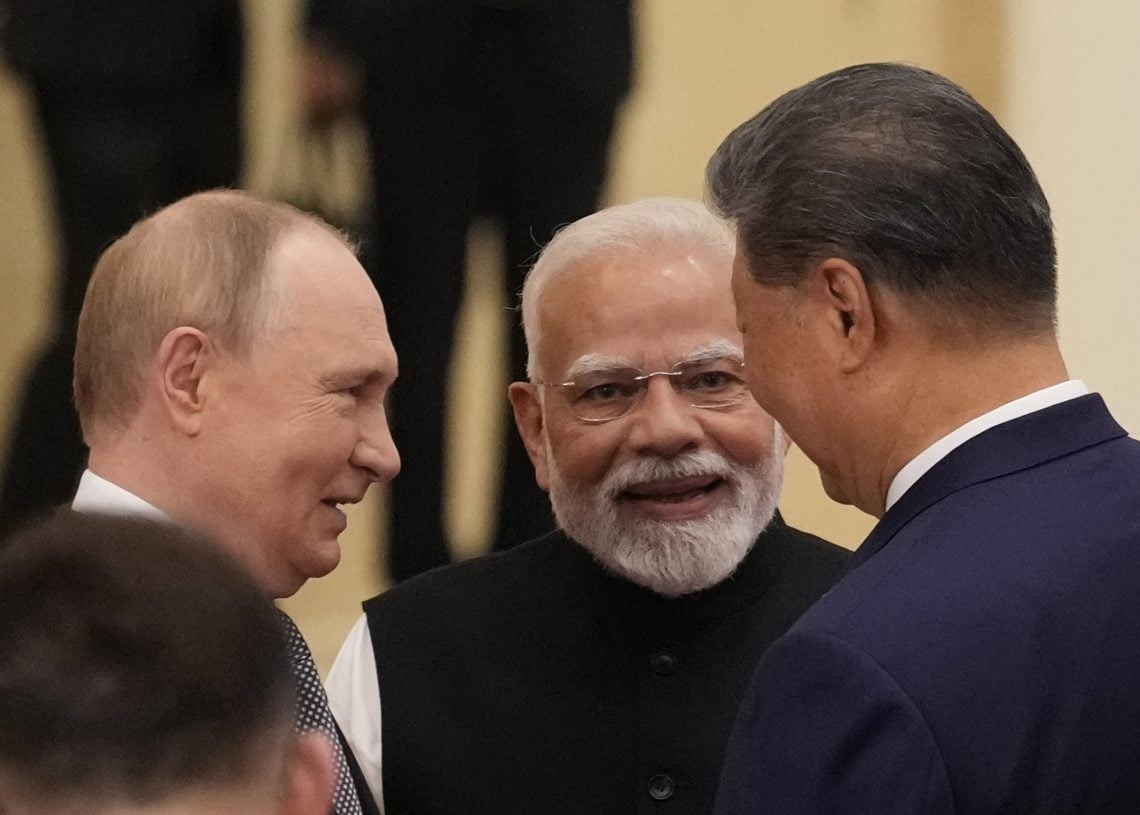
The most emblematic scene of the meeting was starred by India Prime Minister Narendra Modi, Russian President Vladimir Putin, and Xi Jinping.
The Indian Prime Minister and the Russian President came hand in hand to the Chinese leader, and the three formed a smiling circle surrounded by translators and cameras. At another point, Modi joined hands with Putin and Xi, in a gesture that was interpreted as a direct political message to Washington.
The episode, which repercussions on social networks and international press, reinforced the summit’s symbolism: India, Russia and China displaying proximity in a moment of strong contestation to the role of the US.
For analysts, the images carried a clear message component. “Optics is a fundamental part of this summit, and the White House should understand that its policies will lead other countries to look for alternatives to meet their interests,” said Manoj Kewalramani, a Sino-Indian relations expert of Takshashila Institution. The statement was given to The New York Times.
Eric Olander, editor of China-Global South Project, was more incisive in playing the meeting: “If the US President and his acolytes thought they could use rates to press China, India or Russia to submission, this meeting shows the opposite.”
China and India carry a long geopolitical rivalry, marked by border disputes since the 1950s and aggravated by military clashes in Himalayan, such as the 2020 clash that left dozens of dead soldiers and led to the militarization of the 3,800 kilometers border.
In addition to diplomatic choreography, Modi also shared a photo alongside Putin inside the Russian President Aurus Aurus Aurus, in another approach gesture that signaled India’s disposition to affirm his ties with Moscow and Beijing amid commercial dispute with Trump. Recently, the White House has taxed Nova Delhi with 50%tariffs.
OCX consolidates itself as a stage of contestation to western unilateralism
In addition to the symbolic scene among the three leaders, the summit reinforced the weight of the Shanghai cooperation organization as a space for contestation to Western hegemony.
Founded in 2001 by China and Russia and expanded in 2017 with the entry of India and Pakistan, OCX today brings together 27 countries, which total about 40% of the world’s population. The final statement condemned “unilateral coercive measures” and economic sanctions that violate the UN letter and the WTO rules, as a reference implicit in Donald Trump’s tariffs.
In his opening speech, Xi Jinping asked the member countries to unite against the “Cold War mentality, block confrontations and intimidation” in a veiled criticism of US policies.
The Chinese leader also defended the creation of an OCX development bank, greater economic integration and a new global governance system capable of “overcoming the monopoly” of Western powers.
Putin, in turn, stated that the organization revives “true multilateralism” and can serve as the basis for “new stability and safety in Eurasia”, differentiated from Eurocentric models.
He repeated accusations that the West is responsible for war in Ukraine and highlighted the expansion of trade and energy relations with Beijing.
The meeting also functioned as a demonstration of China’s ability to capitalize on Trump’s fissures.
Analysts heard by the international press stressed that the Summit in Tianjin projected an alternative narrative of global leadership, in which India, Russia, and China appear as stability poles in the face of US unpredictability.
For Beijing, this position seeks to consolidate the idea that the integration of the global south can serve as a counterweight to western unilateralism.
One calling for a new multipolar order
In official speeches, the leaders reinforced the political axis of the summit. Xi Jinping presented his “global governance initiative,” stating that “global governance has reached a new crossroads” and that southern countries should “oppose hegemonism and power policy” to build a fairer system.
The Chinese president insisted that the Shanghai Cooperation Organization should serve as a “pillar of a multipolar order”, driven by trade, alternative banks and economic integration that dispenses the dependence of the dollar.
Vladimir Putin echoed the same vision by praising the resumption of what he called “genuine multilateralism”, noting that the agreements in national currencies among OCX members create the foundations of “a new system of stability and safety in Eurasia”.
According to him, this arrangement differs from Eurocentric models because “it does not allow a country to guarantee its safety at the expense of others.”
Narendra Modi, in turn, pointed out that India and China should be seen as “non -rivals development partners,” and stressed that peace and stability on the Himalayan border made room for a new phase of cooperation. At the same time, he took the opportunity to demonstrate that New Delhi is not isolated: he recalled that 50% rates imposed by Donald Trump do not compromise his ability to cultivate strategic alliances within the scope of OCX.
With this convergence of speeches, Tianjin’s meeting has become a platform of explicit contestation to the United States led international system, projecting China alongside Russia and India as an articulating axis of a new world order.
New economic mechanisms and promise of technological integration
In addition to political rhetoric, the summit also resulted in concrete advertisements for cooperation. Xi Jinping defended the creation of an OCX development bank, presented as a fundamental step in consolidating an alternative financial system that reduces dollar dependence and vulnerability to the sanctions imposed by the United States.
The plan is articulated with the goal of expanding the use of national currencies in transactions between the member countries, a practice that Moscow has already intensified in response to Western block.
Beijing has also announced 2 billion yuans (about $ 280 million) in free help to the organization’s countries this year and 10 billion Yuans on loans to an OCX bank consortium in the next three years.
The measure, according to analysts, signals that China is willing to assume the financial costs of regional leadership, strengthening the integration of the bloc.
Another front opened by Xi was the technological. He proposed the creation of an artificial intelligence cooperation center for OCX countries, as well as inviting partners to participate in the Chinese lunar station.
The emphasis on innovation projects shows that China aims to design its development model as a reference for the global south, opposing the instability of US commercial policies.
These ads reinforce the narrative that OCX is not just a security forum, but a space for the construction of economic, energetic and scientific alternatives in the face of western unilateralism.
With the active presence of Russia and India, the Chinese strategy seeks to consolidate Tianjin as a showcase of an integration capable of rivaling the Washington-Bruxelas axis.
Source: vermelho.org.br