Published 10/12/2025 14:11 | Edited 12/10/2025 14:39
The Chinese government presented, this Wednesday (10), the 3rd Document on China’s Policy for Latin America and the Caribbean, a broad guideline that updates political, economic, cultural and security priorities for the region. The initiative, far from being just diplomatic, works as a direct response to the resurgence of the Donald Trump administration’s foreign policy, which, by relaunching the National Security Strategy, attempted to resurrect the Cold War logic of the Monroe Doctrine in the hemisphere.
When announcing the document, Assistant Minister of Foreign Affairs, Cai Wei, sent a clear message to Washington: China does not accept coercion or the imposition of alignments. The phrase, directed at Latin American and Caribbean countries, echoes the perception that the US is once again putting pressure on the continent to “choose sides” amid global competition between great powers.
New policy comes with billion-dollar credit and structural cooperation network
The text consolidates agreements signed at the China–Celac Forum, expanding cooperation in 40 areas and opening a credit line of US$9.3 billion (66 billion yuan) for projects in infrastructure, energy, technological innovation, finance, agriculture, culture and security.
Among the main axes, the following stand out:
- Finance: expansion of the use of local currencies and compensation via yuan;
- Infrastructure: active participation of Chinese companies in strategic works;
- Culture and media: exchanges, co-productions and communication agreements;
- Security: police, military, cyber and humanitarian cooperation;
- Social governance: policies to combat poverty, health and integration between peoples.
The move reinforces Beijing’s ambition to consolidate Latin America as a long-term strategic partner, not just as a supplier of commodities.
Document functions as a political gesture in response to Washington
The presentation of the document has been calculated. The announcement came just days after the US released its new National Security Strategy, the text of which explicitly revives the spirit of the Monroe Doctrine, arguing that the Western Hemisphere must remain under North American predominance.
Trump, in recent interviews, even stated that Latin American countries “may need to choose” between the US and China — a speech received with strong criticism by diplomats from the region in Beijing.
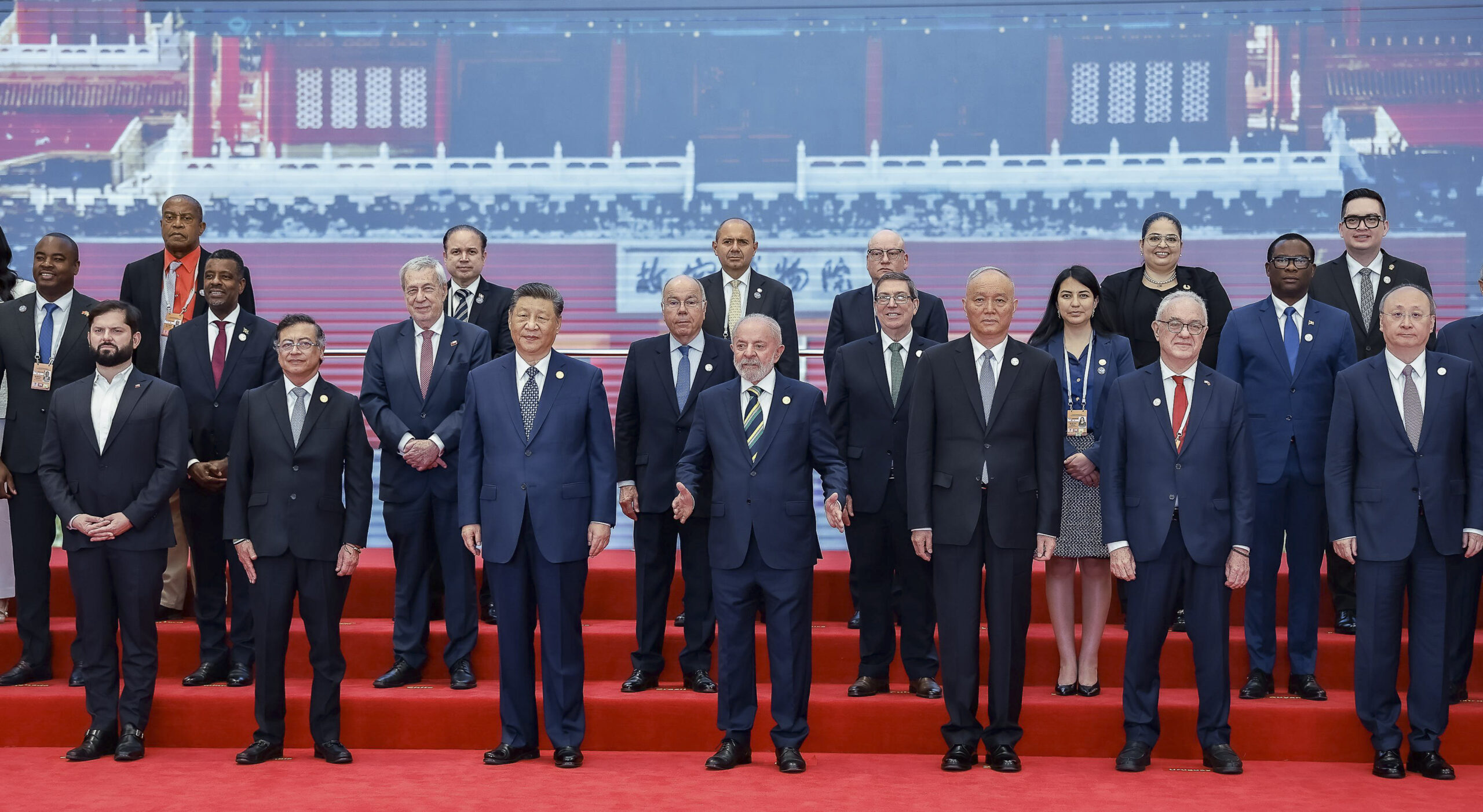
The presence of 24 of Celac’s 33 countries at the ceremony — including Brazil — reinforced the idea that the event was intended as a counterweight to the ruptures caused by North American foreign policy. Ambassadors who participated in the meeting privately stated that the launch was “a direct message to Washington”.
Beijing offers stability where Trump offers uncertainty
China exploits a political contrast: while Trump promises pressure, sanctions and compulsory alignment, Beijing presents itself as a partner of cooperation, investment and predictability. Cai Wei summarized the message: “mutual benefits, shared gains and no geopolitical calculations”.
The statement needs to be read in the context of the global dispute: by explicitly denying the existence of geopolitical interests, Beijing seeks to disarm Trump’s narrative that China represents a threat to the hemisphere.
The gesture had an impact among Latin American diplomats present, many of them uncomfortable with US aggressiveness. One of them summarized: “No one accepts the Donroe Doctrine”, an ironic reference to the Trumpist mutation of the old Monroe Doctrine.
China bets on multipolarity and Latin American autonomy
Beijing places Latin America as an ally of the Global South in the construction of a multipolar world, with a greater balance of international power. By highlighting the tradition of Latin American autonomy, the document directly dialogues with regional dissatisfaction in the face of pressure from Washington, reinforcing the need for representation, productive diversification and digital sovereignty.
At the same time, China expects counterparts:
- explicit support for the “one China” principle;
- cooperation in multilateral forums;
- favorable environment for investments.
Brazil gains space, but needs to transform guidelines into concrete policy
Brazil actively participated in updating the policy — Lula was personally at the ministerial meeting in May — and is seen by Beijing as a central actor in articulating the region. The new policy expands opportunities for infrastructure, digitalization, energy transition and innovation, but also requires Brasília to maintain a balance between China and the US, now under increased tension by Trump’s geopolitical offensive.
The document, in itself, does not resolve contradictions or guarantee automatic investments. But it changes the strategic terrain, signaling that China is willing to compete for influence in Latin America with more strength, more credit and more planning — exactly at the moment when Washington is trying to regain political control of the continent.
The future of the relationship will depend on how the region — and especially Brazil — will transform this new map of cooperation into policies, projects and concrete opportunities for its population.
Source: vermelho.org.br