Published 03/09/2025 22:41
China aired on Wednesday (3) in Beijing, its largest military parade in six years to celebrate the 80th anniversary of victory over Japan in World War II. President Xi Jinping chaired the ceremony alongside Russian President Vladimir Putin and North Korean leader Kim Jong-un in an unprecedented scene that evoked the twentieth-century anti-fascist unity and designed a direct message to Washington: China will not accept to be intimidated.
The ceremony brought together about 50,000 spectators in Tiananmen Square and was attended by more than two dozen foreign leaders, including heads of state of Indonesia, Malaysia, Iran and Kazakhstan.
The absence of high -ranking representatives of the United States and the European Union highlighted the international division around the Ukraine War and Donald Trump’s offensive against Beijing.
Xi spoke at the top of Tiananmen’s gate, under the portrait of Mao Tsé-Tung, stating that “the Chinese nation is a great nation that does not fear tyranny and remain firm over its own feet.”
He stated that humanity again faces a decisive choice between “peace or war, dialogue, or confrontation, won or zero sum”, adding that the Chinese revitalization is “irreversible.”
The parade began with 80 cannon saves in honor of the end of the war, followed by raising the national flag. Soldiers marched on a red carpet while the crowd stirred flags and greeting the scene.
At the apex of the show, 80,000 pigeons and 80,000 balloons were released, symbolizing the victory of peace.
The central image of the event was the joint walk of Xi, Putin and Kim by the red carpet. It was the first time since 1959 that leaders from the three countries appeared together in public at a parade in Beijing.
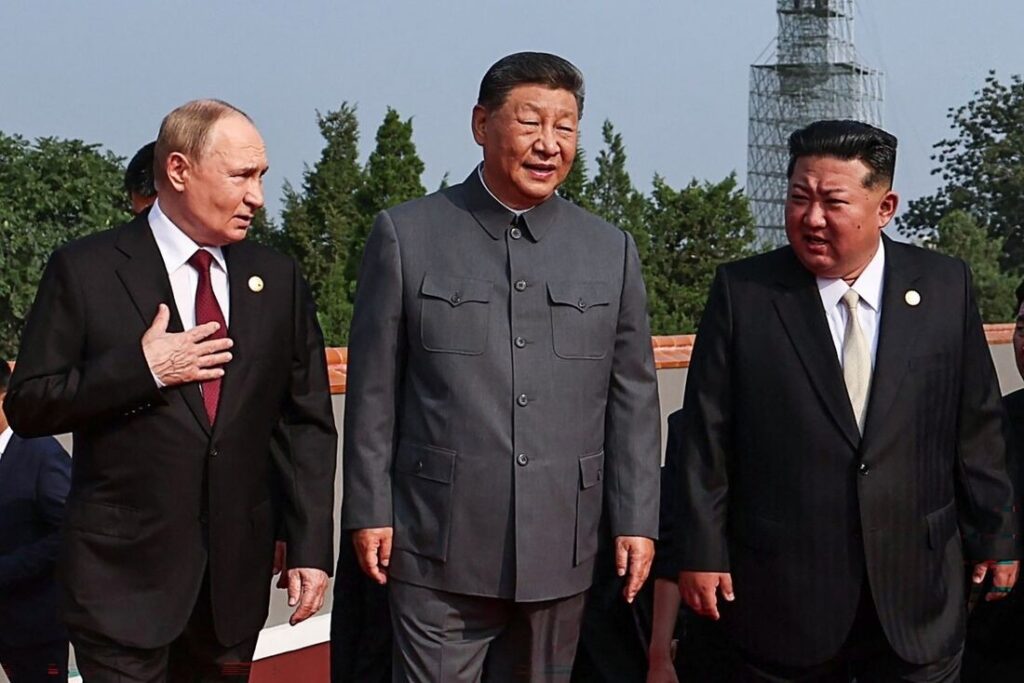
At the time, Mao Tsé-Tung, Kim Il-Sung and Nikita Khruschov shared the podium to celebrate the victory over fascism.
In opening the celebration, XI directly linked the past and the present. “When in the past it was confronted with a struggle of life or death between justice and evil, light and darkness, progress and reaction, the Chinese people came together in hatred of the enemy and rose in resistance,” he said, suggesting that current challenges, imposed by tariffs, military siections and external pressures, are part of the same historical dispute.
Military Power in Evidence
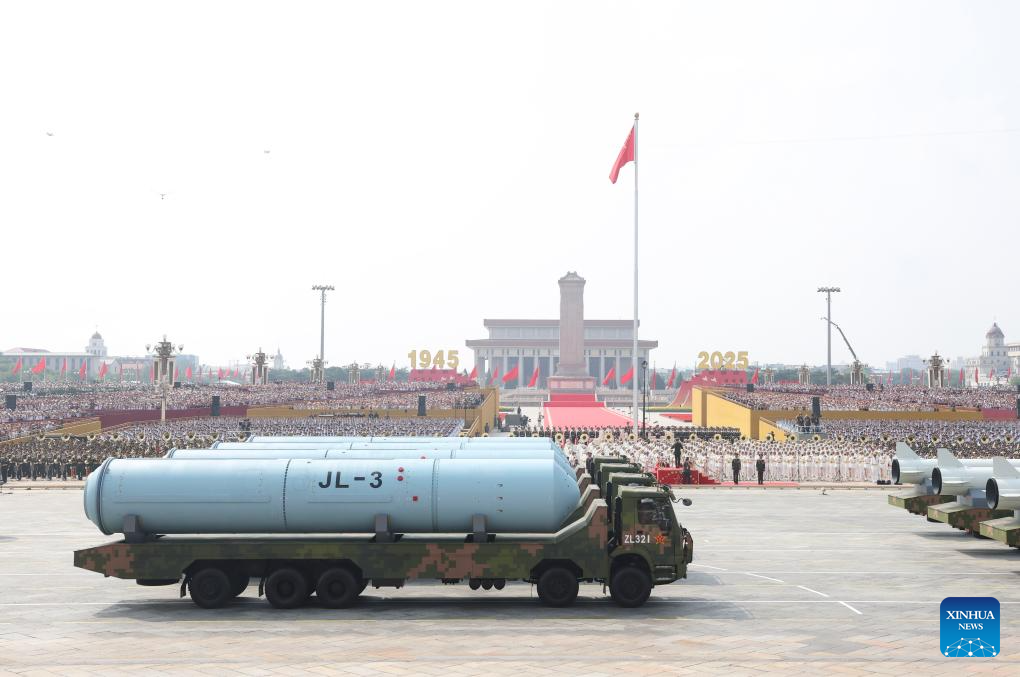
The parade has been the largest showcase in the popular liberation army since 2019, displaying thousands of soldiers and state -of -the -art weapon systems. For the first time, China publicly presented the complete nuclear triad – weapons thrown from land, sea and air.
Among the highlights were the Intercontinental DF-61, mobile release missile; The DF-5C, a larger modernized version; JL-3, designed for nuclear submarines; and the H-6N strategic bomber, rebuilt to transport nuclear weapons.
The H-6N scene flying over Tiananmen Square alongside Fighters and Helicopters’ formations sought to reinforce that Chinese aviation is not only defensive but prepared for long-range operations. The intercontinental missiles were dragged by armored vehicles before the podium, in the sign of readiness and dissuasion against rival powers.
In addition to the nuclear triad, Beijing featured anti-viking hypersonic missiles of the YJ series, capable of reaching large targets, such as aircraft carrier. The YJ-15, YJ-17, YJ-19, and YJ-20 models were displayed, all designed for quick attack missions in Pacific conflict scenarios.
According to analysts, these weapons are a direct message to the United States, whose naval fleet routinely patrol the region.
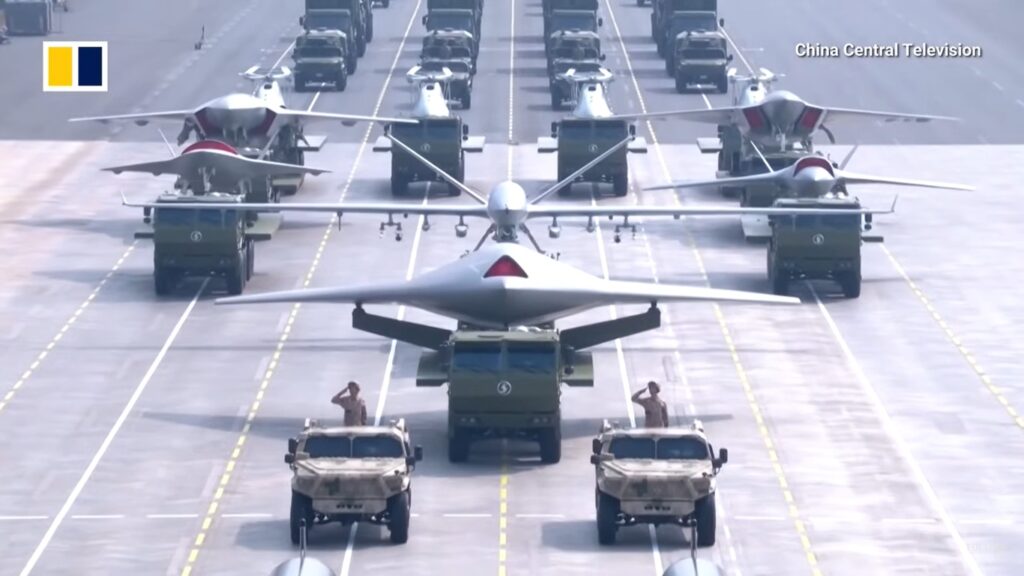
Another prominent point were the latest drones. The presentation included unmanned combat aircraft, known as “SHIRT LOADS”, designed to fly together with manned fighters.
These drones act as strength multipliers: detect enemies, absorb shooting, and reduce risks to human pilots. China is the only country to declare that it already has this system in operation.
The parade also showed a torpedo underwater drones, designated AJX002. On a large scale, these equipment could complicate the naval balance in the region and challenge rivals in the seas of Asia.
Military analysts pointed out that the emergence of these drones surprised by the size and possibility of use in future wars.
To reinforce the message of technological superiority, China presented anti -air systems described by state media as an “iron triangle”. The set includes artillery, high-energy laser weapons and microwave devices.
This integration seeks to demonstrate that Beijing is prepared not only to launch drones, but also to neutralize the use of unmanned vehicles by opponents.
Xi evokes the Second War to talk about the present
The parade had a strong historical dimension, anchored in the memory of the Chinese resistance against the Japanese occupation. The first military formation crossed Tiananmen Square carrying flags of the Communist Brigades that fought in the 1930s and 1940s.
Veterans of war, many in their 90 years, were invited to watch, including a former Kuomintang combatant, in a symbolic gesture of national unity against fascism.
In the speech, Xi reinforced the role of the communist party as savior of the homeland. “The Chinese people resisted the Japanese invasion under a united front defended by the Communist Party of China, saving human civilization and defending world peace,” he said.
The phrase reaffirmed the centrality of the CCP in the official war narrative, as opposed to historical interpretations that attribute greater protagonism to Chiang Kai-Shek nationalists.
Russian President Vladimir Putin took the opportunity to associate the Soviet experience with the Chinese.
He described the victory in World War II as proof of the “willingness to defend historical truth and justice.”
“We were together then, we stayed together now.” Putin called Xi a “dear friend,” he added, thanking Kim Jong-un for sending North Korean soldiers to fight alongside Russia in the Ukraine war.
The evocation of World War II memory was not just retrospective. Xi made it clear that he sees parallels between yesterday’s external aggressions and today’s pressures.
Speaking of the choice between “peace or war, dialogue or confrontation,” he did not directly mention the United States, but the interpretation was immediate: it was a message to the White House, which expanded tariffs against Chinese products and reinforced its military presence in Indo-Pacific.
The contrast with the West was even more evident when Donald Trump, by the social Truth, accused Xi of ignoring the American role in World War II. Trump stated that the “big question” was whether Xi would “mention the blood and massive support that the United States gave China to secure its freedom against a very hostile foreign invader.”
He ended by mocking, “Please send my warm greetings to Vladimir Putin and Kim Jong-un while you conspire against the United States of America.”
Kremlin spokesman Dmitri Peskov replied by saying that “no one is plotting conspiracies” and that Trump would have spoken in “figurative sense.”
Still, the exchange of accusations reinforced the parade’s ideological background: while China and Russia seek to consolidate legitimacy in the present through the memory of anti -fascist victory, the US try to reaffirm its indispensable role in the 1945 war.
Alignment with Putin and Kim reinforces front against Western
The joint presence of Xi, Putin and Kim was interpreted as a political and diplomatic milestone. It was the first time Kim Jong-un participated in a military parade of the popular liberation army.
The North Korean leader arrived accompanied by his daughter, Kim Ju-AE, considered a political heiress, although she did not appear at the event. At the bilateral meeting with Putin, Kim stated that he was willing to “do everything he can” to support Russia.
For Chinese diplomacy, the gesture of gathering in the same podium the most attacked leaders by the West symbolized the construction of a new geopolitical axis. The image of the three walking side by side by the red carpet was carefully planned to be read as a demonstration of unity in the face of sanctions and blocks imposed by Washington and Brussels.
This approach does not eliminate practical differences. Gazprom, a Russian state -owned energy company, has announced that it has closed a “legally binding” agreement to build a new pipeline to China. But the Chinese Foreign Ministry said it had nothing to announce, indicating that Beijing does not intend to immediately expand its dependence on Russian gas.
Still, Xi announced exemption from visas for Russian tourists until 2026, in gesture of concrete approach.
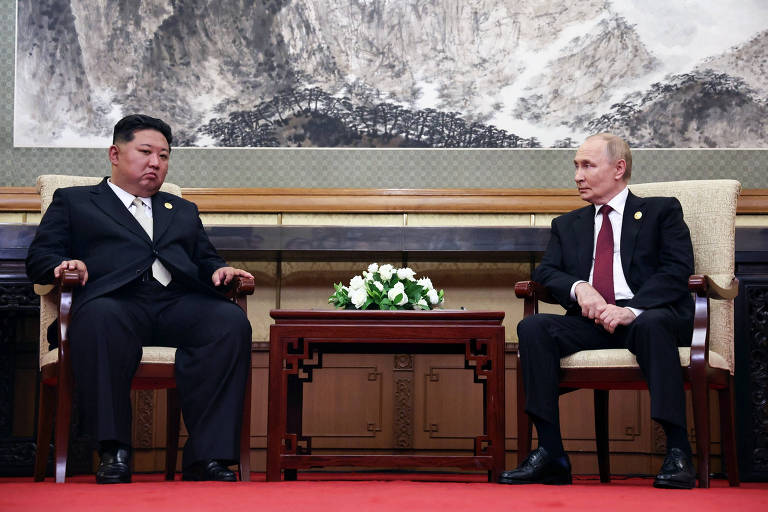
Rhetoric, however, is of convergence. Putin stated that Xi’s vision for a new global governance is “urgently necessary in a moment of leadership deficit.” In echoing this position, Xi reaffirmed that China and Russia were “the main winners” of World War II and have the responsibility to defend the results of this triumph.
The Tribuna scene also revealed the Chinese strategy of consolidating itself as the center of an alternative block to the West.
In addition to Russia and North Korea, leaders of Iran, Belarus and Central Asia nations attended, reinforcing the design of a multipolar network. Absent were the United States, the European Union and Japan, countries that Xi accuses of trying to contain and suppress the Chinese rise.
This division became even clearer at the reception that Xi offered in the Great Hall of the People after the parade. There, the Chinese president stated that humanity should not return to the “jungle law” and reiterated that China will remain “firmly on the right side of history.” The message was clear: Beijing is seen as a pillar of global stability in contrast to western unilateralism.
Internal symbolisms and patriotic mobilization
The parade was also conceived as an internal mobilization act. Xi dressed in the hand -style costume and toured the square in a limo Hongqi, a vehicle symbol of Chinese industrial self -sufficiency.
The presence of former members of the Permanent Politburo Committee, such as Wen Jiabao and Wang Qishan, reinforced the message of continuity and unity at the top. Alongside Nonagenaries, the ceremony sought to convey that the Communist Party has been guardian of national sovereignty since the fight against Japan to the present day.
The display of the new forces created in 2024 – aerospace force, cyberspace strength and information support force – has shown that the country is preparing for multidiness wars, which include space, network and artificial intelligence.
XI stated that the EPL “has always been a heroic force in which the party and the people can trust totally,” reaffirming the bond between politics, society and defense.
Source: vermelho.org.br