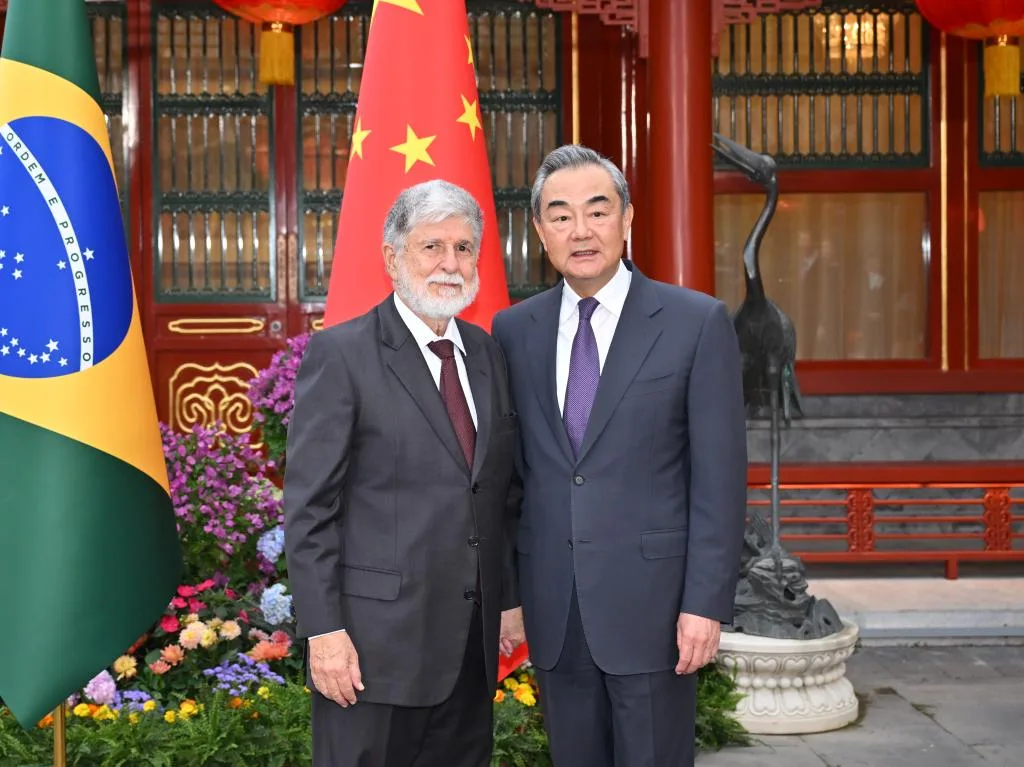
This Wednesday (16), the chief advisor of the Special Advisory to the President of the Republic, Celso Amorim, and the Chinese Foreign Minister, Wang Yi, met in Beijing, capital of China. The main objective of Amorim’s trip to the Chinese capital was to deliver a letter from President Lula to Xi Jinping, Chinese president.
In the letter, Lula reinforced the convergence between the two countries and the strategic importance of bilateral cooperation. The last contact between the Brazilian leader and the Chinese was in July this year, when, in a phone call, Xi “rejected external interference” in the Brazilian electoral process and said he was ready to support the Lula government.
At the meeting between Amorim and Wang, the subject came back to the table. Both condemned attempts to interfere in the internal affairs of other countries and highlighted the importance of defending peace, dialogue and strengthening multilateralism.
Such rejections and condemnations occur amid the offensive of United States foreign policy on the Latin American continent. Since the update of the US National Security Strategy in 2025, a series of actions have been taken by Washington on Latin countries. This was the case with the kidnapping of the president of Venezuela, Nicolás Maduro, and Cília Flores, the questioning of Peruvian sovereignty over its ports and the deepening of the blockade of Cuba.
In Brazil, tariffs on exports to the United States and the inclusion of criminal organizations on the list of terrorist organizations are considered movements of the same nature. And with the explosion of the Master Case on the Federal Supreme Court, the possibility of new US sanctions against ministers of the court was raised. The threat is seen as an attempt to destabilize the Brazilian elections in favor of Flávio Bolsonaro.
Flávio already declared, in March this year, that “Brazil is the solution so that the USA no longer depends on China in rare earths and critical minerals”. This, in fact, was another topic discussed at the meeting between Amorim and Wang.
Both highlighted the need to develop productive and technological capabilities to add value in terms of critical minerals and rare earths. These minerals are strategic for the development of new technologies, including artificial intelligence. For Amorim and Wang, AI must be developed with open source and in an ethical and inclusive way.
Amorim also welcomed the declaration of the BRICS Summit and wished success to the Chinese presidency of the group. The chief advisor’s trip to China ends on Thursday (17).
Source: www.brasildefato.com.br