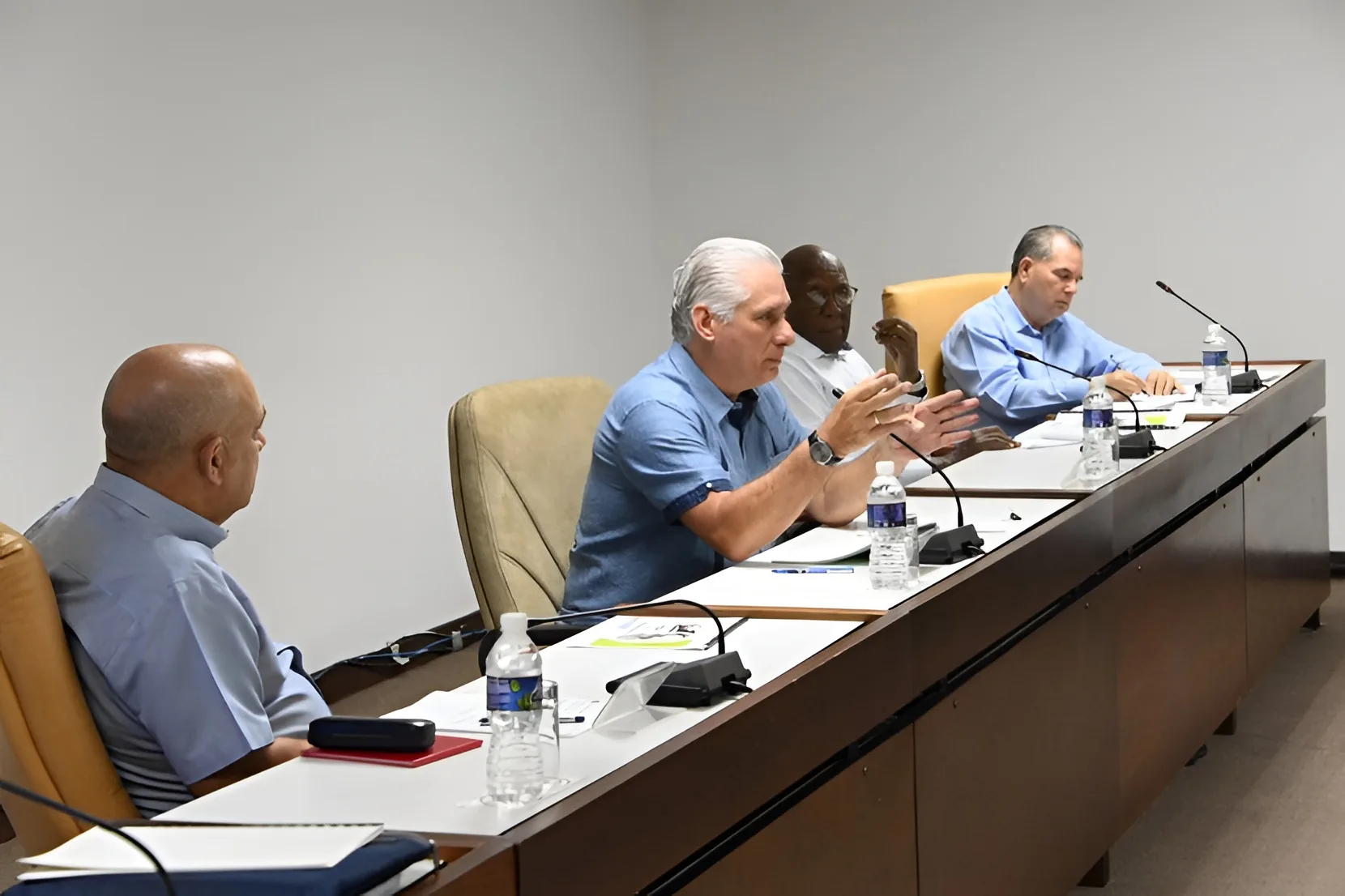
“We have to produce, produce efficiently, use the land well”, stated Cuban President Miguel Díaz-Canel, during a meeting with more than 60 representatives of the agricultural sector, in which he defended the application, with “agility, depth and coherence”, of the 176 economic and social reforms recently approved by the government.
The meeting, held this Monday (14), at the Convention Palace in Havana, focused on the implementation of transformations in agriculture and livestock. “If there is a sector that needs to present results in a more immediate period, it is the agricultural production sector”, stated the president.
Díaz-Canel highlighted that the objective is to achieve “an adequate relationship between expenses, costs and prices of our products”, at the same time that he defended the search for solutions to increase production. “It is time to look for solutions, alliances and leave behind the mentality of asking for inputs, as existed some time ago”, he stated.
Thus, the president highlighted that the new measures give farmers “the right to decide what to produce, how to produce, in what quantities to produce and how to sell”. In this sense, he advocated that, in the short term, “a substantial increase in food production” be achieved and that “the people be allowed to have access to the food they need at better prices”.
‘Cuba is built from the groove’
During the meeting, Díaz-Canel stated that the transformations approved in June do not constitute “a simple change in norms”, but “a change in logic”. As he explained, the objective is to go “from executors of plans to managers of the productive destination of food for the country”.
“The country is built from the furrow, not from an office”, he stated, considering that the contribution of the agricultural sector “is decisive in moments like this”.
The president also acknowledged that the progress presented during the meeting does not yet represent the general situation in the country. “There are many things that are not moving forward, there are many things that are still stuck,” he said. In this sense, he highlighted that, in some of the rural properties and state-owned companies visited, better results were obtained, even in more complex moments.
“This conversation is not just about thinking about the present, but also about projecting ourselves into the future,” he added.
The transformations are being implemented in a context of strong deterioration in food production in Cuba. The agricultural and livestock sector is experiencing a widespread decline associated with the lack of foreign exchange, shortages of basic inputs, fuel shortages and the deterioration of machinery, among other factors.
According to the most recent data from the National Office of Statistics and Information (ONEI), several essential products recorded significant drops. Rice production, for example, went from covering around half of national consumption to representing just 11% of demand. In the case of legumes, production fell by approximately 60%.
162 of the 176 reforms have an impact on the agricultural sector
The deputy minister of Agriculture, Telce González Morera, informed during the meeting that 162 of the 176 reforms approved by the government have a direct impact on the agricultural sector.
“We are facing a comprehensive legal package, which covers all components related to agricultural production: land, genetics, plant and animal health, technology, production, marketing, inputs and others”, he explained.
Among the transformations is the possibility for private companies to receive state-owned land on a usufruct basis, a prerogative that until now was reserved for individuals and agricultural production cooperatives.
The reforms also allow those who carry out agricultural activities to directly import inputs, without the need for state intermediation, a function that was previously performed by companies and public entities. Furthermore, maximum prices will be eliminated, and their regulation will be the responsibility of the market.
Source: www.brasildefato.com.br