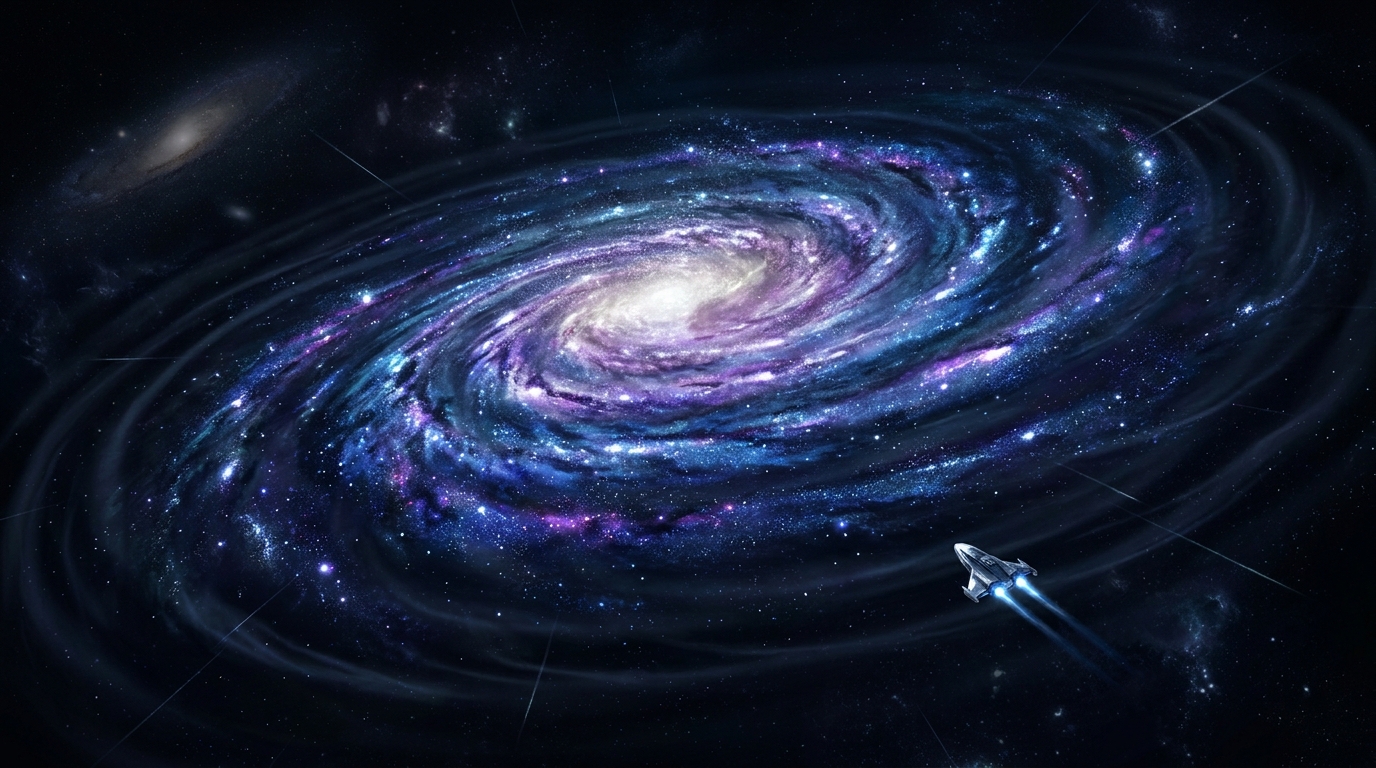
The night sky has always inspired wonder, fear, and curiosity in equal measure. For millennia, humans have gazed upward at the countless stars scattered across the darkness, dreaming of journeys to distant worlds. Science fiction has fueled our imagination with tales of faster-than-light travel, wormholes, and intergalactic civilizations. Yet beneath these romantic visions lies a harsh reality that few acknowledge: we are effectively prisoners of our own galaxy. The Milky Way, our cosmic home, is not just where we live—it is likely the only place we will ever be able to reach. Understanding why requires confronting the staggering scales of space, the limitations of physics, and the profound isolation that defines our existence in the universe.
The Mind-Boggling Scale of Space 📏
To comprehend why leaving the Milky Way is essentially impossible, one must first grasp the sheer magnitude of distances involved. Our galaxy spans approximately 100,000 light-years in diameter. A light-year—the distance light travels in one year—equals about 9.46 trillion kilometers or 5.88 trillion miles. Even traveling at the speed of light, which current physics deems impossible for any object with mass, it would take 100,000 years to cross from one edge of the Milky Way to the other.
But the true challenge emerges when we consider what lies beyond our galactic borders. The nearest large galaxy to the Milky Way is Andromeda, located roughly 2.5 million light-years away. This means that even if we could somehow achieve light-speed travel, the journey would take 2.5 million years. To put this in perspective, modern humans have existed for only about 300,000 years. The pyramids of Egypt were built merely 4,500 years ago. The concept of nations, languages, and cultures as we know them is a blink in cosmic time. A voyage to Andromeda would require timescales so vast that human civilization as we understand it would likely cease to exist long before arrival.
The distances between galaxies are not merely large—they are incomprehensibly vast compared to anything we experience on Earth. The void between the Milky Way and Andromeda contains almost nothing: no stars, no planets, no resources, just empty space stretching for millions of light-years. This intergalactic desert presents obstacles that make conventional space travel seem trivial by comparison.
The Speed Limit of the Universe ⚡
Perhaps the most fundamental barrier to intergalactic travel is the universal speed limit imposed by Einstein’s theory of relativity. Nothing with mass can travel at or faster than the speed of light, which moves at approximately 299,792 kilometers per second in a vacuum. This is not merely an engineering challenge but a fundamental law of physics that governs the structure of spacetime itself.
Our fastest spacecraft to date, NASA’s Parker Solar Probe, reaches speeds of around 700,000 kilometers per hour during its closest approaches to the Sun. While impressive by human standards, this represents only about 0.065% of light speed. At this velocity, reaching even the nearest star system, Proxima Centauri at 4.24 light-years away, would take approximately 6,300 years. Reaching Andromeda would require over 38 billion years—longer than the current age of the universe.
Some theoretical concepts propose workarounds to this limitation. Warp drives, which would compress space ahead of a spacecraft and expand it behind, appear in science fiction but remain purely speculative with no known mechanism for realization. Wormholes, hypothetical tunnels through spacetime, might allow instantaneous travel between distant points, but they require exotic matter with negative energy density to stabilize—something that may not exist in nature. Even if such phenomena were possible, the energy requirements would be astronomical, potentially exceeding the total energy output of entire stars.
The Energy Problem 💰
Even setting aside the speed limit, the energy required for intergalactic travel presents an insurmountable obstacle. Accelerating a spacecraft to even a fraction of light speed demands energy quantities that dwarf humanity’s total production capacity. Consider a modest vessel weighing just 1,000 kilograms attempting to reach 10% of light speed. The kinetic energy required would be approximately 4.5 × 10^17 joules—equivalent to the total annual electricity consumption of several large countries combined.
For context, the world’s total energy consumption in recent years has hovered around 6 × 10^20 joules annually. A single interstellar mission at modest relativistic speeds would consume a significant fraction of global energy production. Scaling up to intergalactic distances multiplies these requirements exponentially. A journey to Andromeda, even at 10% light speed, would take 25 million years and require energy reserves that make current fossil fuel debates seem insignificant.
The financial costs compound this problem. Current space missions cost billions of dollars. The James Webb Space Telescope, one of humanity’s most ambitious astronomical instruments, cost approximately $10 billion to develop and launch. An intergalactic mission would require budgets measured in trillions or quadrillions of dollars—sums that exceed the GDP of entire nations. No government, corporation, or consortium could realistically fund such an endeavor, especially when the probability of success remains vanishingly small.
The Time Dilation Trap ⏳
Relativity introduces another complication: time dilation. As objects approach light speed, time passes more slowly for them relative to stationary observers. While this might seem advantageous for travelers—allowing them to experience shorter journey durations—it creates profound problems for any mission intending to maintain contact with Earth or return home.
A crew traveling to Andromeda at 99% of light speed might experience only a few decades passing during the journey. However, upon arrival, millions of years would have elapsed on Earth. Human civilization, language, technology, and possibly the species itself would be unrecognizable or extinct. Any attempt to return would find Earth transformed beyond comprehension. This temporal disconnect makes meaningful intergalactic exploration impossible, as travelers would effectively exile themselves from their own time and culture forever.
The Harsh Reality of Intergalactic Space ❄️
Beyond technical and physical barriers, intergalactic space itself is hostile to life and machinery. The void between galaxies contains extremely low densities of matter, meaning no opportunities for refueling, repair, or resource acquisition. Cosmic radiation permeates these regions at levels far exceeding what spacecraft shielding can reasonably handle over million-year timescales. Micrometeorites, though sparse, would accumulate damage over such extended journeys, eventually compromising any vessel’s structural integrity.
Life support systems would need to function flawlessly for periods exceeding human historical records. No technology we possess or can reasonably envision could maintain biological life or complex machinery for millions of years without catastrophic failure. Even artificial intelligence, often proposed as a solution for long-duration missions, would face degradation from radiation, component wear, and software corruption over such timescales.
Why This Matters 🌍
Understanding our confinement to the Milky Way is not meant to inspire despair but rather to recalibrate our perspective on space exploration. The galaxy itself contains hundreds of billions of stars and potentially trillions of planets. Within our cosmic neighborhood lie worlds that might harbor life, resources, or scientific discoveries beyond our current imagination. Focusing on interstellar rather than intergalactic travel offers realistic goals within reachable timescales and energy budgets.
The Milky Way provides ample room for expansion, discovery, and perhaps eventual colonization. Our solar system alone contains diverse environments worthy of extensive exploration. The moons of Jupiter and Saturn, the atmosphere of Venus, and the subsurface oceans of icy worlds present immediate targets for robotic and eventually human missions. These endeavors, while challenging, remain within the realm of possibility given continued technological advancement.
Recognizing the boundaries of our reach should inspire humility and appreciation for our cosmic address. We inhabit a privileged position within a galaxy rich with opportunity. Rather than dreaming of unreachable destinations, we should focus on understanding and preserving our place in the universe. The Milky Way is not a prison but a vast frontier containing mysteries enough to occupy humanity for millennia to come.
The stars beyond our galaxy will remain beautiful points of light in our night sky—objects of study through telescopes rather than destinations for spacecraft. This limitation does not diminish the wonder of the cosmos but rather emphasizes the preciousness of our local cosmic environment. We are not trapped; we are fortunate to call this particular corner of the universe home. And within these galactic boundaries lies adventure, discovery, and purpose sufficient for countless generations of explorers yet to come.