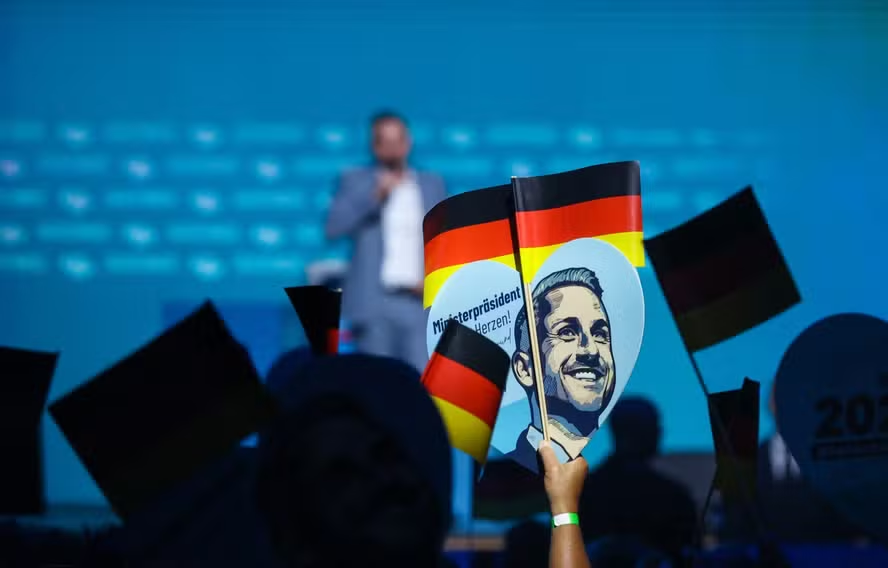
What was an idea within the German metiê gained shape and strength. The Alternative for Germany (AfD) party, an acronym created just over ten years ago and usually understood by German state intelligence as a dangerous far-right group, was the main winner in the regional elections in the state of Saxony-Anhalt, in the east of the country, last weekend.
The party obtained 44% of the votes, which places it as the main force in the state parliament, responsible for choosing the next name that will govern the state. To obtain a majority, it will have to face more than explicit resistance from practically all political forces in Germany: a kind of “cordon sanitaire”, created by parties ranging from left to right, and which is used as a way of isolating the AfD as much as possible. No agreements or support, for example.
For decades, Germany’s political scene rejected the mere idea that any far-right party could govern a state in the German federation. Both in the divided Germany, which prevailed from the post-Second World War until the fall of the Berlin Wall, to the unified Germany that was built from the beginning of the 1990s until now, the theme touched and continues to affect the historical wounds of German society, which sees in the Nazism of the last century something beyond the humanitarian limit, which should not be exceeded.
To date, the AfD has won 39 of the 83 seats in the local legislature. With a possible abstention from BSW, the votes of far-right parliamentarians would be enough to choose the new government. The person who presented himself as the strongest name for the position was the AfD candidate, Ultich Siegmund.
What led a former East German state to choose, at this historical moment, a more radical right-wing party to govern it? The answer is not simple, as nothing is exactly simple in a country marked by late unification (consolidated only in 1871, under the leadership of Otto von Bismarck), by the painful defeat in the First World War, by the rise and fall of Nazism, by the capacity for reconstruction and by countless internal divisions.
The topic was the topic of the most recent episode of the podcast O Estrangeiro, available on the Brasil de Fato channel on YouTube. Check out the full videocast:
For journalist and historian Rafael Targino, a researcher at the Federal University of Rio de Janeiro (UFRJ), the historical process resulting from the most recent unification helps explain the AfD’s victory.
“The restructuring process in Germany, with the fall of the Wall, created a region that was effectively incorporated. We lived in a system that provided employment, housing, education and health. A closed system that suffered criticism, but which gave guarantees to the population. And then there was reunification with capitalism. This changes the dynamics of people’s lives”, he contextualizes, in conversation with the Brazil in fact.
Targino emphasizes that attributing the AfD’s victory solely to historical roots would be simplistic, and it is necessary to understand the current dynamics. “The party has managed to capture a discontent that, today, is very strong in Germany and, to some extent, in the rest of the world. It is discontent with the political system itself.
The name of the acronym is suggestive: Alternative for Germany. And the situation begins to lean towards the party when there is a beginning of economic slowdown in Germany, the issue of the war in Ukraine and the increase in living costs. “So, what was a party that, in the beginning, had a very strong focus on migration, is now a party that claims to present an alternative to the political-economic system”, ponders the historian.
Meanings of the AfD victory
One of the dilemmas of German society lies in the fact that the AfD has not grown by chance, but has been able to capture voters not only who voted for the right, but for left-wing acronyms. According to a survey carried out by Infratest Dimap, 67% of voters stated that the AfD would have understood better than other parties the fact that the population in Saxony-Anhalt would no longer feel safe.
In addition, more than 50% of the electorate also think that the AfD would be closer to the population’s concerns than other German political parties. The preference is even greater among younger people, who rarely point to the Christian Democrats or Social Democrats (two of the acronyms that have made up the German political establishment in recent years) as capable of providing satisfactory answers to the challenges for the country’s future.
“The mistake is simply that you don’t do politics for your voters [da AfD] and, by erecting a ‘cordon sanitaire’, the very opportunity to win back these disappointed people through joint conversations and activities is eliminated. Not all AfD voters are far-right or fascist. On the contrary, they are citizens who are angry with the system and the way this policy is conducted. In turn, the BSW recognized this and, for this reason, is marginalized by the other parties. The right thing to do would be to find, together with BSW, a way to implement a policy for the benefit of common people”, he ponders when Brazil in fact German political analyst Carsten Hanke, former member of Die Linke and independent political observer.
For the German left, according to Hanke, there is a lack of a strong and united political force, “that defends the rights of the working class, the socially vulnerable and the disadvantaged, and that also maintains the internationalism that is so necessary among all progressive movements”.
Interestingly, the leftmost party in the Saxony-Anhalt parliament amplifies the gravity of the German scenario. Known as Bündnis Sahra Wagenknecht (BSW), the party has already signaled that it can make the AfD’s intentions to govern the state viable by abstaining from voting on the choice (made by a simple majority) of the next government.
The acronym BSW was created by Sahra Wagenknecht, former member of the European Parliament, as a result of Sahra’s own dissatisfaction with the acronym The Left (Die Linke), created in 2007 due to the merger of the Democratic Socialism Party (PDS) and the Electoral Alternative for Work and Social Justice (WASG). Since then, BSW has been defending not only the need for social protection and greater presence of the German State in the country’s economy, but is critical of migration policies and identity agendas. BSW, like the AfD, demands that the country stop sending resources to Ukraine in the war with Russia, for example.
In the case of the election in Saxony-Anhalt, BSW began by arguing that the best solution would be the composition of a “supra-party” government, which would be able to dialogue with the different parties. Faced with the impossibility of the proposal, the party admitted that it must abstain in choosing the new head of government, opening space for the AfD’s definitive arrival in power.
“By abstaining from voting for the president of the state government in relation to the AfD, the BSW becomes guilty of strengthening fascism”, summarizes Hanke. The analyst problematizes the cordon sanitaire erected against the AfD, recognizing the seriousness of the rise of the extreme right in the country, but pointing out that it is necessary to understand what has led part of German society to adhere to the acronym’s agenda, so that it is possible to face this process.
The German impasse
It is not new that Germany, known for its vigorous industry, is facing economic problems. In 2025, the German Gross Domestic Product (GDP) did not increase more than 0.2%, after falling 0.5% in 2024 and 0.9% in 2023. Not even last year’s timid growth can be so celebrated in Europe’s main economy: in the last month of July, the country’s exports fell for the first time in five months, indicating that the German economic recovery may lose steam.
As a result of such a crisis, many companies have declared bankruptcy or closed factories and stores, worsening the unemployment situation. According to data from the Leibniz Institute for Economic Research in Halle (IWN), the insolvency rate among partnerships and capital companies in the country, in June, was 80% higher than the average recorded for the month of June between 2016 and 2019, in the period immediately before the Covid-19 pandemic.
In the European country, these two categories of companies are responsible for around 90% of the jobs affected by insolvency and for almost all the credit involved in processes of this nature. The same institute showed that the number of insolvencies there, in 2025, was the highest in the last two decades, totaling 17.6 thousand cases. In the industrial sector alone, 11 thousand companies closed their activities last year.
Crisis scenarios like this usually affect the populations of eastern German states. Reunification, roughly speaking, caused an important part of the eastern population to end up moving to the west. Even though the states of the former German Democratic Republic represent just over a third of the country’s current territory, the population in the east is no more than 15% of the entire German population.
There, the spread of the liberal economic model did not overcome social inequalities. Widespread privatizations blocked the promises made in the early 1990s. And what the liberal conformation of the period promised was far from being fulfilled.
“The particularity in the region of the former GDR is the fact that precisely this generation of mine, with the GDR past, and their children were the first to experience how they were attracted to the capitalist system through false promises”, he tells the Brazil in fact German political analyst Carsten Hanke, former member of Die Linke and independent political observer.
Born in the 1960s in Rostock, Hanke highlights that the right to free education and medical care was a hallmark of the former communist Germany, and that the country was among the ten most industrialized in the world, despite Western sanctions.
What to expect?
For the future, it remains to be seen whether last weekend’s victory will take the AfD to even greater heights. And how German society can organize itself in order to avoid repeating history. Commenting on the results of the polls, Chancellor Friedrich Merz said he was “deeply shocked” and accused the AfD of promoting “ethnic cleansing”.
For Rafael Targino, it is unlikely that parties with greater political muscle will begin to cooperate with the AfD. Still, according to the historian, last weekend’s result may have been “a taste of what could happen from now on”.
Messages to Europe, as a whole, were also given. Spanish Prime Minister Pedro Sánchez defined the result as “a warning that the threat from the extreme right, thanks in part to the surrender of the traditional right, is gaining ground in Europe and the world”. Meanwhile, countries like Spain itself, as well as Italy and France, are preparing for elections in 2027.
In France, the far-right National Rally (RN), led by Marine Le Pen, appears as the favorite for the presidential elections in April next year. From a political runt to the main threat to German democratic institutions, the AfD, mixing past and present, may have displaced the current European political axis.
Source: www.brasildefato.com.br