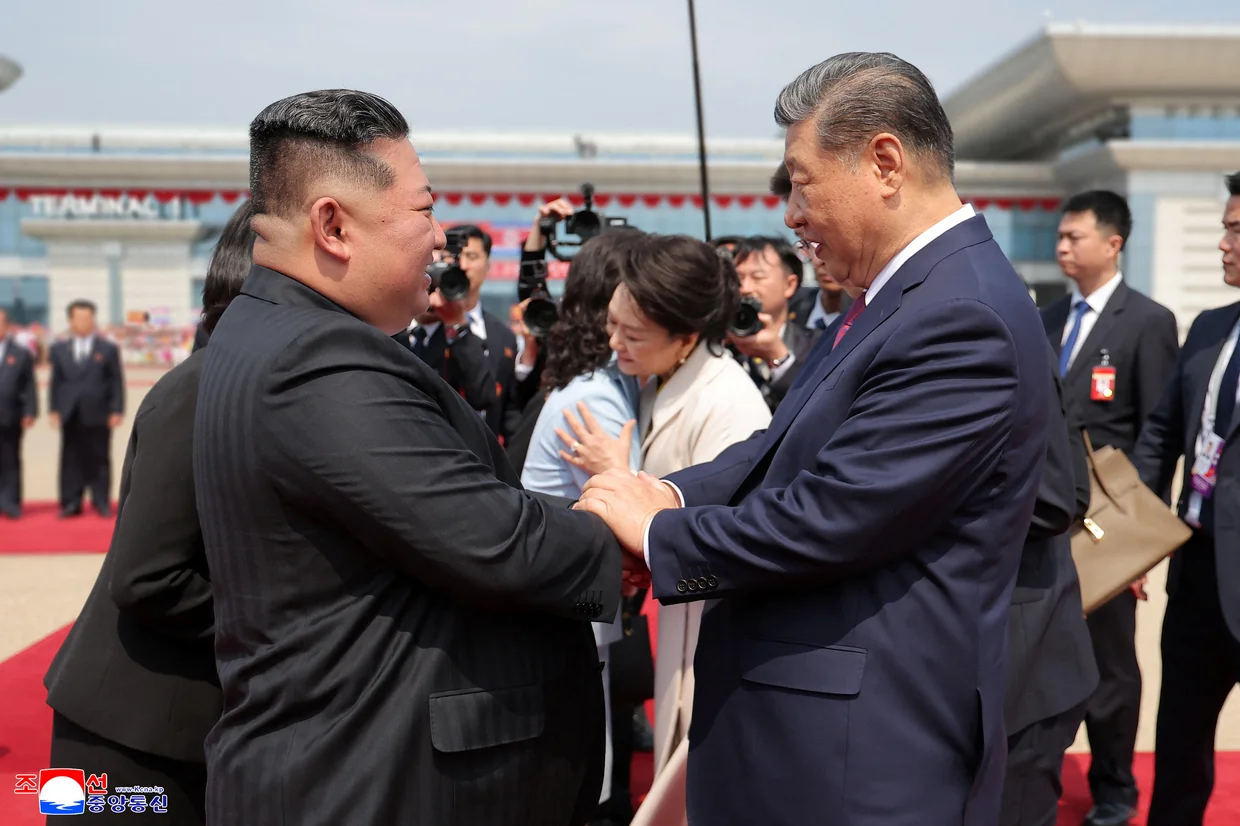
On the day that the Democratic People’s Republic of Korea (DPRK) celebrates its 78th anniversary, Beijing once again highlighted the strategic nature of the relationship with Pyongyang. In a message sent this Wednesday (9) to North Korean leader Kim Jong Un, Chinese President Xi Jinping praised the progress made by the country and stated that preserving, consolidating and developing bilateral relations remains China’s “unshakable” policy.
Recalling the 78 years of the DPRK, Xi said that under the leadership of the Workers’ Party of Korea, the North Korean people have achieved “vigorous development” in different areas of socialist construction, supported by self-reliance, unity and hard work. The Chinese president also highlighted the results obtained in recent years.
Xi also said he trusts that the North Korean people will fulfill the goals and tasks set by the 9th Congress of the Workers’ Party of Korea, held in February, and will open up new prospects for the development of the party and the state. According to Xi, under the leadership of Kim Jong Un, the North Korean party and people have been promoting economic and social development and achieving a series of results that arouse “sincere delight” in China.
In the message, Xi was direct in defining the relationship between the two countries. China and North Korea, he said, are “friendly socialist neighbors who stand side by side and share joys and hardships.” The Chinese president added that preserving, consolidating and developing these ties is an “unshakable” policy of the Communist Party of China and the Chinese government.
For Beijing, the relationship with Pyongyang goes beyond the current international situation. It is supported by decades of political and historical ties between the two countries. Xi also recalled his state visit to North Korea, which took place in June. According to him, the meeting with Kim Jong Un “opened a new chapter” in relations between the two parties and the two countries.
The Chinese leader said he was willing to work with Kim to continue “strengthening the strategic orientation” of relations, promote the development of the two countries’ respective causes, improve the well-being of the two populations and deepen bilateral friendship. The objective, Xi added, is also to contribute to “peace, stability, development and prosperity” in the region and the world.
More than a protocol anniversary message, the declaration reinforces Beijing’s willingness to maintain its partnership with Pyongyang and expand coordination between the two countries.
A friendship forged in war
To understand the weight of this relationship for China, it is necessary to go back to the Korean War.
The conflict began on June 25, 1950, when North Korean forces crossed the 38th parallel and advanced into South Korea. The United States intervened in support of Seoul and assumed a central role in the forces organized under the command of the United Nations. After recovering Seoul, US-led forces advanced to the north of the peninsula, crossed the 38th parallel, occupied Pyongyang and reached the vicinity of the Yalu River, on the Chinese border.
For Beijing, the advance represented a direct threat to the country’s security. In October 1950, the Chinese People’s Volunteers crossed the Yalu to support North Korea. Chinese entry changed the course of the war and prevented US-led forces from advancing to the Chinese border. In Beijing’s official historical narrative, fighting alongside the North Koreans lies behind a friendship that Chinese diplomacy often describes as “forged in blood.”
The human cost was high. According to official Chinese data, 197,653 members of the Chinese People’s Volunteers died during the conflict.
The war ended on July 27, 1953 with the signing of the Armistice of Panmunjom. The agreement ended hostilities and established the Demilitarized Zone, but did not result in a definitive peace treaty. More than seven decades later, the peninsula remains formally without a peace agreement. It is in this scenario that Beijing defends dialogue, respect for sovereignty and the creation of conditions to reduce tensions.
65 years of a strategic treaty
The friendship built during the war gained an institutional basis on July 11, 1961, when China and North Korea signed the Treaty of Friendship, Cooperation and Mutual Assistance. The agreement completed 65 years in 2026 and continues to be presented by Beijing as one of the foundations of the bilateral relationship.
The anniversary of the treaty occurs in a period of intensified contacts between the two countries. In April, Chinese Foreign Minister Wang Yi visited Pyongyang. In June, Xi Jinping paid his first visit to North Korea in seven years. During the meeting, the two leaders reaffirmed the importance of traditional friendship and discussed ways to expand cooperation. Xi advocated strengthening high-level contacts, political trust, practical cooperation, people-to-people exchanges and strategic coordination.
Links also advanced in the area of infrastructure. In March, passenger rail service between Dandong and Pyongyang resumed after six years of suspension. On the border, work is progressing on the North Korean side of the New Yalu River Bridge, which connects Dandong, in China, to Sinuiju, in North Korea.
With approximately three kilometers, the Chinese side of the bridge was completed in 2014, but remained inoperative due to the lack of corresponding structures in North Korean territory. In 2026, work resumed and progressed quickly, including the construction of customs and immigration facilities. The bridge has not yet been opened.
As early as September 7, North Korea and Russia opened their first border road bridge over the Tumen River. About 1 kilometer long, the link connects the two countries and should facilitate the transport of goods and expand bilateral economic exchange.
The new connections add to North Korea’s resumption of transport and trade contacts with its two main neighbors.
Commerce also grew again. Exchanges between China and North Korea reached approximately US$2.73 billion in 2025, an increase of 25% compared to the previous year and close to the levels recorded before the pandemic. But the relationship is not limited to trade numbers. For Beijing, ties with Pyongyang also involve a shared political history and a common experience of socialist construction.
Between sovereignty, dialogue and military pressure
The Chinese reaffirmation comes amid new military tensions in East Asia.
Between September 7 and 11, the United States, South Korea and Japan carry out the Freedom Edge exercise, a trilateral military operation in international waters east and south of Jeju Island. Pyongyang considers this type of exercise a threat to its security and criticized the maneuvers, warning that it could take stronger measures in response.
For Beijing, the problem is broader. The expansion of military mechanisms and the increased presence of external forces in the region could further fuel the confrontation on the peninsula. Chinese diplomacy has been defending another approach, based on dialogue and the reduction of tensions.
In August, Minister Wang Yi stated that the fundamental causes of instability on the peninsula need to be addressed and defended the creation of conditions for the resumption of dialogue. Beijing also called on Washington to abandon a hostile policy toward North Korea.
For Beijing, the region’s security needs to take into account the interests of all countries involved, instead of relying exclusively on military mechanisms. At the same time, Beijing maintains diplomatic channels with South Korea and seeks to preserve its role as an interlocutor on the peninsula.
The rapprochement between Pyongyang and Moscow also helps explain the new regional scenario. Vladimir Putin sent a message to Kim Jong Un on the DPRK’s anniversary, reaffirming the strategic partnership between the two countries.
Faced with the strengthening of military alliances led by the United States in Asia-Pacific, China, Russia and North Korea have been deepening their own cooperation mechanisms.
The relationship between Beijing and Pyongyang, however, predates the current geopolitical dispute. Its origins lie in the fighting of the Korean War and, since then, it has undergone decades of political, economic and diplomatic cooperation.
Seventy-eight years after the founding of the DPRK and 65 years after the signing of the friendship treaty, Xi Jinping reaffirms that this relationship will continue to be preserved, consolidated and developed.
The message sent this Wednesday makes Beijing’s position clear: the historic friendship with North Korea remains strategic, coordination between the two countries must be strengthened and the partnership is presented as part of efforts in favor of peace, stability, development and prosperity in the peninsula, Asia and the world.
Source: www.brasildefato.com.br