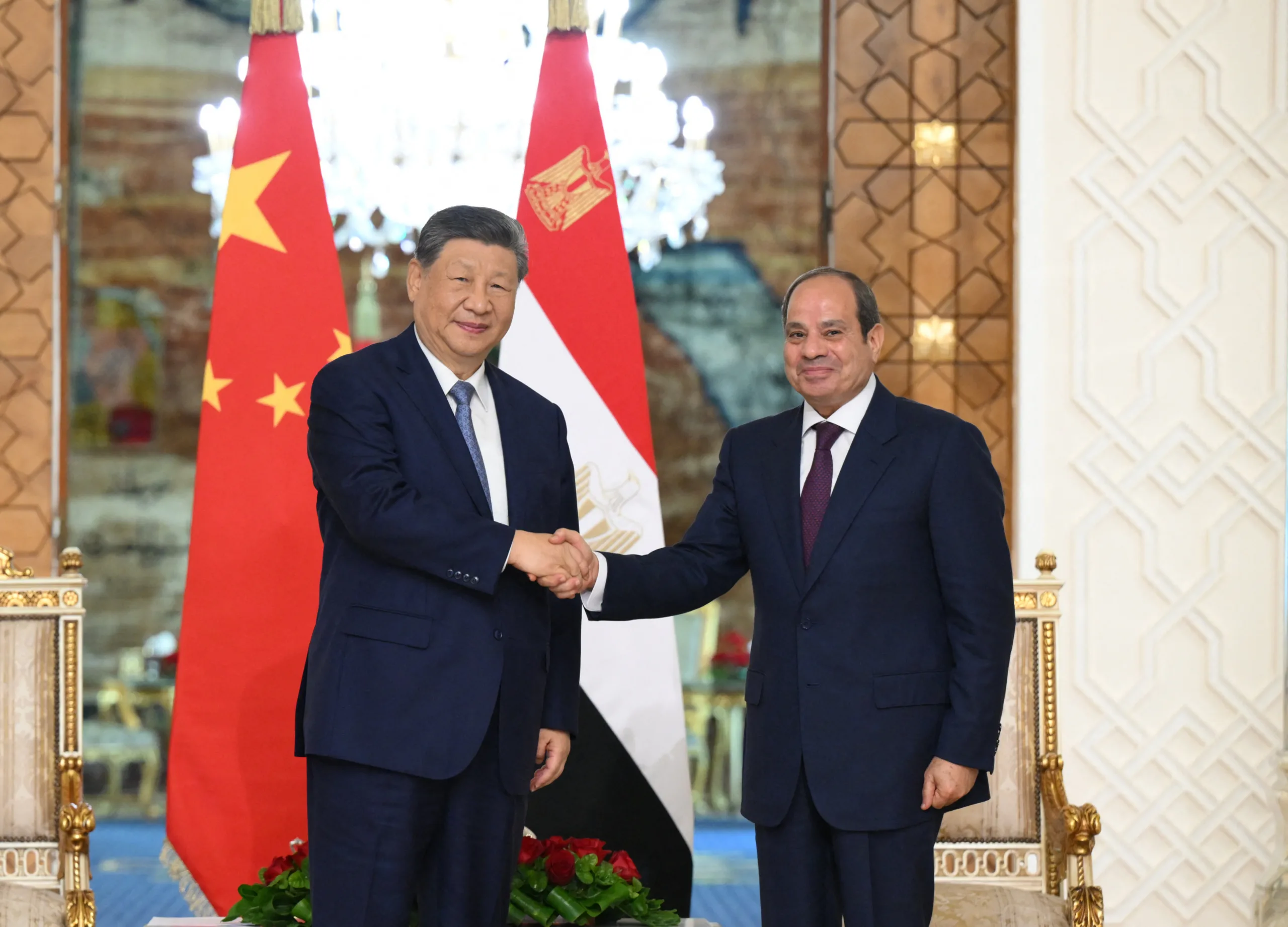
China and Egypt defended the creation of an independent and sovereign Palestinian state, delimited by the 1967 borders and with East Jerusalem as its capital. The statement came in a joint note published on Wednesday (2), at the end of President Xi Jinping’s state visit to Cairo, where he met with his counterpart, Abdel Fattah Al-Sisi
The governments rejected any initiative aimed at the forced displacement of the Palestinian people and reiterated their support for the mandate of UNRWA (United Nations Relief and Works Agency for Palestinian Refugees in the Near East).
In the document, the two countries expressed concern about the “dangerous escalation of Israel’s actions in the West Bank and East Jerusalem, including high levels of settler violence, land grabs and settlement construction.” Both reaffirmed the need to preserve the integrity of the Palestinian territory.
This was Xi Jinping’s first official visit to the African country in ten years and also resulted in the signing of more than 20 cooperation agreements in sectors such as science, technology, transport, energy, education and the digital economy.
In the economic area, China and Egypt agreed to use more local currencies for their trade and investments.
Security in West Asia
During a meeting with the Egyptian president, Xi presented a four-pronged proposal for the regional security architecture of the Middle East or West Asia region.
The first is the rejection of external interference: the people of the region must be the protagonists of their own affairs, said the Chinese leader, according to the Chinese state channel CCTV. The second advocates broad solutions, with the Palestinian issue at the center of any lasting peace arrangement. The third points to development as the basis for security, including the protection of international shipping routes. The fourth proposes to strengthen multilateral coordination based on the UN Charter and international law. At this point, the president stated that external powers must abandon the double standard in the region.
Al-Sisi expressed gratitude for China’s “consistent, objective and impartial” stance on the Middle East issue, and said Egypt will maintain diplomatic coordination with China to alleviate conflicts in the region.
Diplomatic ties dating back to Bandung
The meeting also marked seven decades of bilateral relations. In 1956, Egypt became the first country in the Arab world and the African continent to formally recognize the People’s Republic of China. The recognition came under the Egyptian leadership of Gamal Abdel Nasser, who had previously built good relations with Chinese Prime Minister Zhou Enlai during the Bandung Conference, the first major anti-colonial meeting of leaders from 29 Asian and African countries.
The two governments committed to deepening the integration of the Belt and Road Initiative with the Egypt Vision 2030 plan and to expanding the voice of the Global South in multilateral forums, including the UN, BRICS (to which Egypt joined in 2024) and the G20.
There was also an agreement to encourage the use of local currencies in commercial exchanges and to continue supporting the Sino-Egyptian Suez Economic and Commercial Zone, a space created in 2008 that houses more than two hundred companies and generates around 10 thousand direct jobs in Egypt. The two countries agreed to prioritize investments in artificial intelligence, energy transition (wind and solar), electric vehicles and digital technology.
Source: www.brasildefato.com.br