In the vast expanse of our universe, where billions of galaxies spin in cosmic dance and trillions of stars burn across incomprehensible distances, humanity has long wondered whether we are truly alone. Among the countless mysteries that have captured the imagination of scientists and dreamers alike, few stand out as prominently as the enigmatic “Wow! Signal” detected on August 15, 1977. This brief but powerful radio transmission remains one of the most compelling pieces of evidence suggesting that extraterrestrial intelligence might exist beyond our pale blue dot.
A Historic Discovery at Big Ear Observatory 🔭
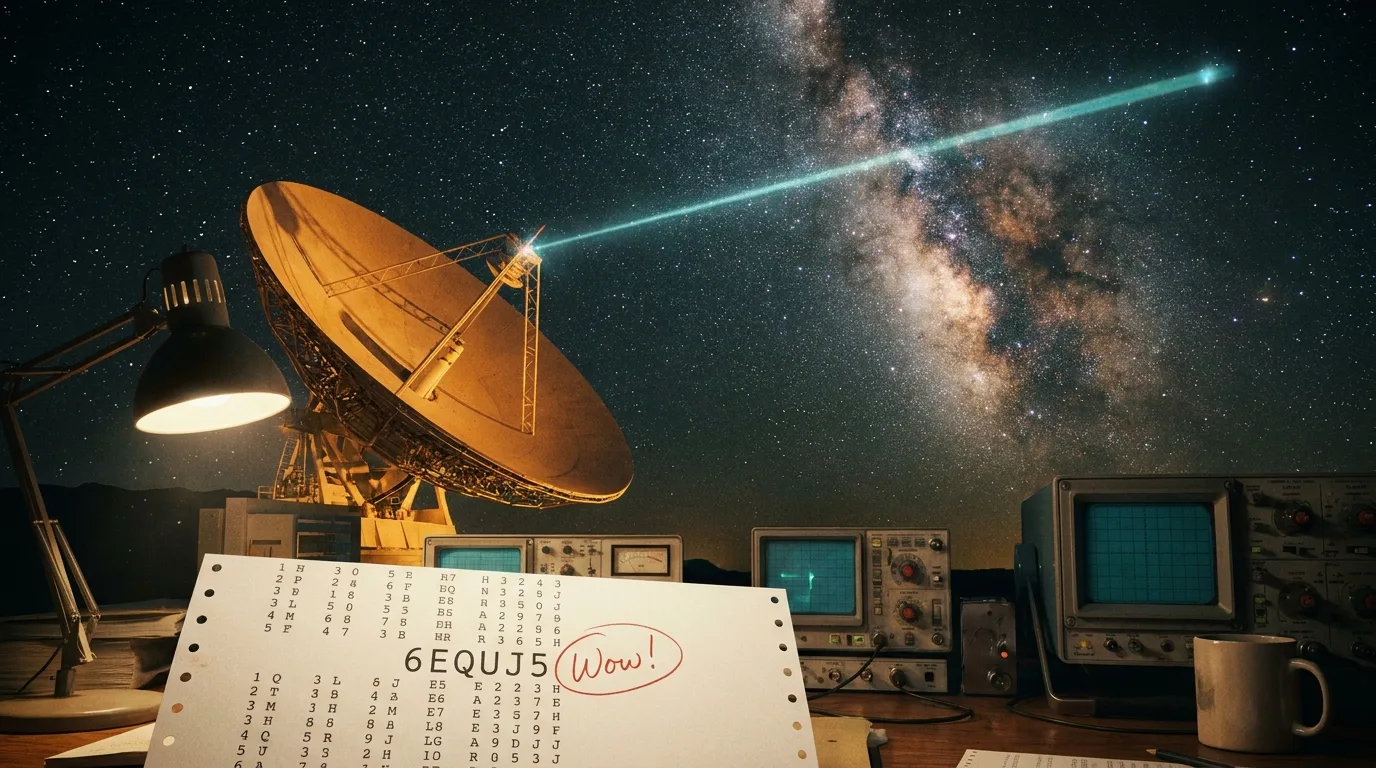
The story begins at Ohio State University’s Big Ear Observatory, a unique radio telescope facility designed to scan the heavens for signs of intelligent life. On that fateful summer evening in 1977, astronomer Jerry Ehman was analyzing data collected by the telescope when he noticed something extraordinary. Amidst pages of computer printouts showing typical background noise from space, one sequence stood out dramatically: a string of characters reading “6EQUJ5.”
This alphanumeric code represented signal intensity measurements, with each character corresponding to a specific strength level. The number 6 indicated an exceptionally strong signal, far exceeding anything previously recorded. When Ehman calculated the signal-to-noise ratio, he found it reached an astonishing value of over 30 sigma, meaning the signal was thirty times stronger than the normal background radiation. Such intensity was unprecedented in radio astronomy.
Recognizing the significance of this discovery, Ehman circled the sequence on the printout and wrote “Wow!” in the margin, giving the signal its now-famous name. The transmission lasted approximately 72 seconds, matching exactly what would be expected from a distant source as Earth rotated beneath the telescope’s fixed beam. This duration provided crucial evidence that the signal originated from space rather than terrestrial interference.
Characteristics That Defied Explanation 📡
What made the Wow! Signal particularly intriguing were its specific technical characteristics. The transmission occurred at a frequency of 1420.4056 megahertz, which corresponds to the hydrogen line frequency. This particular frequency holds special significance in astrobiology because hydrogen is the most abundant element in the universe, and many scientists believe that any advanced civilization attempting interstellar communication would naturally choose this universal reference point.
The signal appeared to be narrowband, meaning it occupied a very small range of frequencies. Natural astronomical phenomena typically produce broadband emissions spread across wide frequency ranges. The narrowband nature of the Wow! Signal suggested artificial origin, as such precise frequency control would require sophisticated technology. Additionally, the signal showed no modulation patterns that could indicate intentional encoding of information, though this absence does not rule out intelligent origin.
Perhaps most remarkably, despite numerous attempts to detect the signal again using the same equipment and similar configurations, researchers never succeeded in capturing a repeat transmission. The Big Ear Observatory continued operations for nearly two decades after the initial detection, scanning the same region of sky thousands of times without finding anything comparable. This elusiveness has only deepened the mystery surrounding the event.
Scientific Investigations and Alternative Explanations 🔬
In the years following the discovery, the scientific community engaged in rigorous investigation to determine the signal’s origin. Researchers proposed various natural explanations, including cometary hydrogen emissions, reflections from space debris, or unusual stellar phenomena. However, each hypothesis faced significant challenges when examined against the observed data.
Comets were considered a leading candidate for several years. Some astronomers suggested that hydrogen clouds surrounding comets passing through the telescope’s field of view could produce signals at the hydrogen line frequency. In 2017, researcher Antonio Paris proposed that comets 266P/Christensen and P/2008 Y2 (Gibbs) might have been responsible. However, subsequent analysis revealed problems with this theory. The comets’ positions did not align precisely with the signal’s origin point, and their hydrogen emissions would likely have been too weak and broadband to match the observed characteristics.
Other natural explanations included pulsars, quasars, or solar flares, but these sources typically produce different signal patterns and frequencies. Human-made interference from satellites or aircraft was also considered, but the signal’s properties did not match known terrestrial sources. The combination of narrowband emission, hydrogen line frequency, appropriate duration, and complete absence of repetition makes the Wow! Signal uniquely puzzling.
The Search for Extraterrestrial Intelligence Context 👽
The Wow! Signal emerged during a period of growing interest in the Search for Extraterrestrial Intelligence, commonly known as SETI. Founded in the 1960s, SETI represents humanity’s systematic effort to detect signs of intelligent life beyond Earth through radio astronomy and other methods. The project operates on the assumption that advanced civilizations might use electromagnetic radiation for communication across interstellar distances.
Frank Drake, a pioneer in SETI research, formulated the famous Drake Equation to estimate the number of active communicative civilizations in our galaxy. While the equation involves many uncertain variables, it provides a framework for thinking about the likelihood of detecting alien signals. The Wow! Signal represented exactly the type of detection that SETI researchers hoped to find, making it a landmark event in the field’s history.
Despite decades of searching since 1977, no similarly compelling signal has been detected. Modern SETI efforts employ more sophisticated equipment and broader search strategies, yet the Wow! Signal remains unique. This fact raises profound questions about whether the signal was a one-time occurrence, perhaps an accidental leakage from distant technology, or whether we simply lack the capability to detect similar transmissions consistently.
Cultural Impact and Ongoing Speculation 🌍
Beyond scientific circles, the Wow! Signal captured public imagination and became a cultural touchstone in discussions about extraterrestrial life. Books, documentaries, and articles have explored the mystery from multiple angles, examining both scientific evidence and philosophical implications. The signal’s name itself, derived from Ehman’s spontaneous reaction, perfectly captures the sense of wonder and surprise that continues to surround the event.
Science fiction writers have incorporated the Wow! Signal into narratives about first contact and alien communication. The idea that we might have already received a message from another civilization, even if we cannot fully understand or verify it, resonates deeply with human curiosity about our place in the cosmos. Some enthusiasts argue that dismissing the signal as unexplained natural phenomenon represents premature closure of an important question.
Recent advances in technology have renewed interest in revisiting the Wow! Signal mystery. Modern radio telescopes possess far greater sensitivity and resolution than the Big Ear Observatory’s equipment. Projects like Breakthrough Listen, funded by entrepreneur Yuri Milner, represent billion-dollar efforts to conduct comprehensive searches for technosignatures. These initiatives employ machine learning algorithms capable of identifying subtle patterns that human analysts might miss.
Current Perspectives and Future Possibilities 🚀
Today, the scientific consensus regarding the Wow! Signal remains cautiously agnostic. Most researchers acknowledge that the signal’s characteristics are consistent with an artificial origin but emphasize that extraordinary claims require extraordinary evidence. Without replication or additional corroborating data, definitive conclusions remain elusive. However, the possibility that we detected genuine extraterrestrial communication cannot be entirely dismissed.
Some scientists propose that future observations should focus on the constellation Sagittarius, where the signal apparently originated. Advanced telescopes like the Square Kilometre Array, currently under construction, may provide the sensitivity needed to detect faint or intermittent signals that earlier equipment missed. Additionally, multi-wavelength observations combining radio, optical, and infrared data could reveal patterns invisible to single-frequency searches.
The Wow! Signal serves as a powerful reminder of how much we still do not know about the universe. In an era when we discover exoplanets regularly and develop increasingly sophisticated instruments for cosmic exploration, the mystery endures. Whether the signal represents humanity’s first contact with alien intelligence or merely an unusual natural phenomenon, it continues to inspire scientists to keep listening, keep searching, and keep wondering.
As we stand on the threshold of new discoveries in astrobiology and space exploration, the Wow! Signal remains a beacon of possibility. It challenges us to maintain open minds while demanding rigorous evidence, to balance skepticism with curiosity, and to recognize that in the infinite vastness of space, the unexpected may always await discovery. Until we solve this forty-year-old puzzle, the universe keeps its secrets close, whispering hints across the cosmic void that we are only beginning to understand.