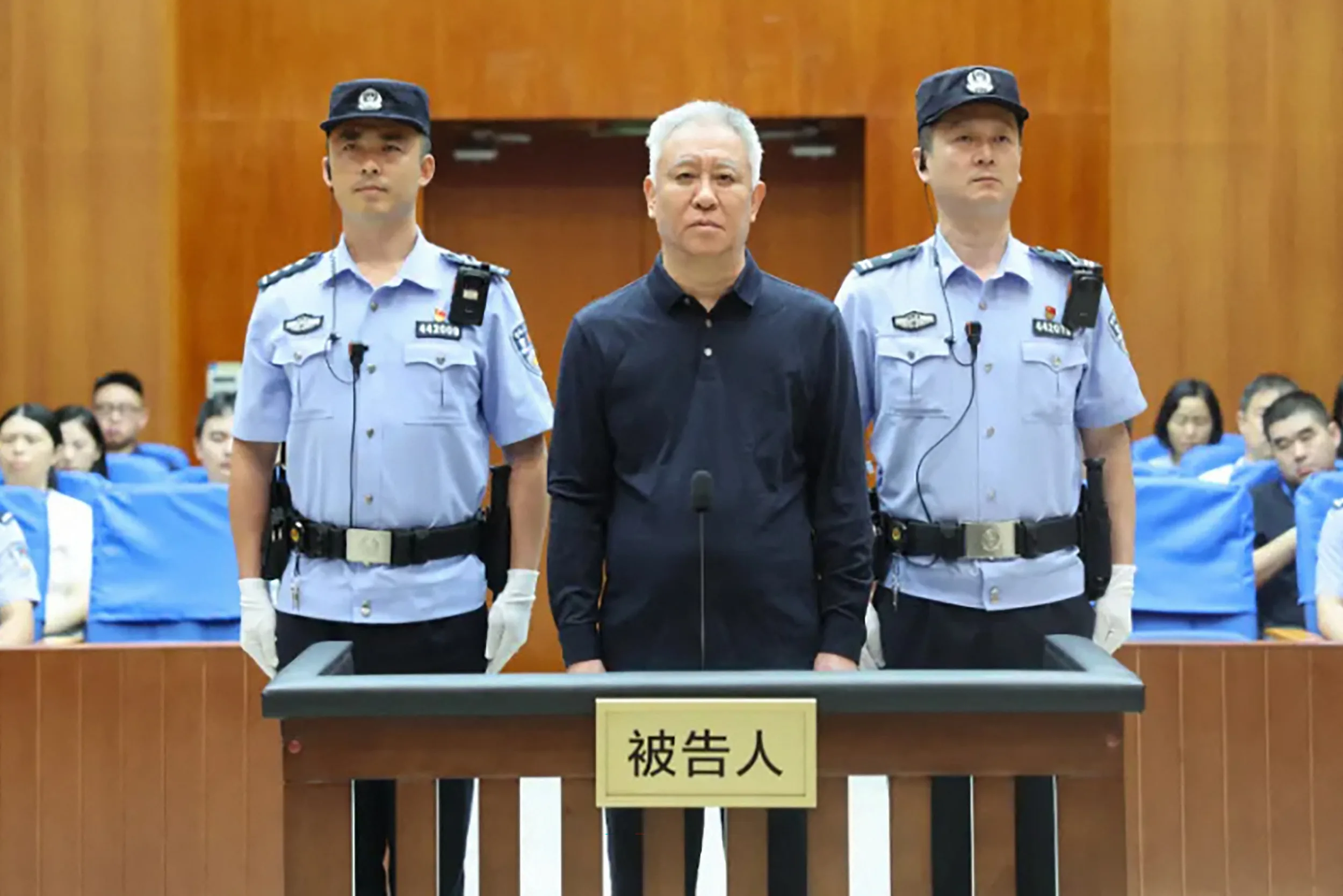
The Shenzhen Intermediate People’s Court sentenced, this Thursday (20), the founder and former president of the construction company Evergrande, Xu Jiayin, to life imprisonment, determining the permanent loss of political rights and confiscation of all personal assets. The Evergrande real estate group was fined 8.82 billion yuan (around R$7.2 billion) and the subsidiary Evergrande Imobiliária, 7 billion yuan (around R$5.7 billion).
According to the court’s decision, compensation for victims has priority over the payment of fines and the enforcement of confiscated assets.
The crimes
Between 2016 and 2021, Xu Jiayin was responsible for systematic and large-scale financial fraud by artificially inflating assets and hiding liabilities, according to the court. The now former billionaire was convicted of eight crimes: irregular collection of deposits from the public, fraud in fundraising, illegal issuance of loans, fraudulent issuance of securities, irregular disclosure of relevant information, bribery by a legal entity, irregular use of resources and embezzlement of funds due to position.
The court concluded that the crimes involved “exceptionally high values”, “extraordinarily large economic losses” and “extremely severe social damage”.
The Evergrande group was convicted of the first six crimes; the subsidiary Evergrande Imobiliária, for fraudulently issuing securities.
A slow fall
Xu Jiayin was born in 1958 in Taikang, Henan province, and worked in the state-owned steel sector before moving to Shenzhen in 1992. He founded Evergrande in 1996, in a period of accelerated growth in the Chinese real estate market. In 2017, Hurun topped the country’s ranking of billionaires. The company even sponsored Guangzhou Evergrande, a club that won two Asian Champions League titles and eight national championship titles.
Evergrande’s growth was based on a model of continuous debt: borrowing to acquire land, selling properties before building them and using this money to pay previous creditors and finance new projects. Since 2016, the company has had the highest level of debt among almost 200 Chinese real estate developers.
As of 2020, the so-called “three red lines” policy restricted developers’ access to credit. The following year, Evergrande did not repay more than US$100 million to external creditors and had around 1.5 million properties undelivered. The loss was 476 billion yuan (more than R$329 billion).
In May 2024, the China Securities Regulatory Commission (CRVM) fined the group 4.17 billion yuan (R$3.1 billion) for fraud in the 2019 and 2020 financial reports and permanently banned Xu Jiayin from the capital market.
The British multinational PricewaterhouseCoopers (PwC), the company’s auditor, received a fine of 325 million yuan (R$245.7 million) and had the license of its branch in Guangzhou revoked for failing audits.
In August 2025, Evergrande’s shares were delisted from the Hong Kong Stock Exchange after the company was unable to present a debt restructuring plan, which reached more than 2.4 trillion yuan (more than R$1.8 trillion).
The three red lines in the real estate sector
In August 2020, the Ministry of Housing and Urban-Rural Development and the People’s Bank of China called the country’s main developers to a meeting in Beijing and announced financing rules that became known as the “three red lines”, according to the China Reform Newsa vehicle linked to the National Development and Reform Commission.
The rules determined that liabilities over assets (excluding customer advances) must be less than 70%; net debt to equity, less than 100%; and the ratio between cash and short-term debt, greater than 1.
Based on the number of criteria violated, developers were classified into four categories by color. The “green” ones, which met all the criteria, could increase interest-bearing debts by up to 15% per year; the “yellow” ones (a criterion violated), 10%; the “oranges” (two), 5%; and the “red” could not increase any debt with interest.
When the policy came into force, Evergrande already violated all three criteria.
In January 2026, the China Index Institute reported that regulators no longer require developers to send indicators monthly. “The policy objectives have been achieved,” said Liu Shui, director of corporate research at the institute. Liu assessed that, after four years of profound adjustment, developers have abandoned the debt-supported growth model and are oriented towards high-quality development, according to the Chinese portal The Paper.
In January 2024, the Hong Kong court ordered the liquidation of the group’s holding company. Judicial administrators took control of 33 offshore companies linked to Xu Jiayin and froze accounts and assets, such as properties, jets and vehicles, around the world, with the aim of recovering funds for international creditors.
In mainland China, the government took control of operations through state working groups, prioritizing the delivery of properties already paid for by buyers.
Combating real estate speculation
In 2017, in the report to the 19th National Congress of the Communist Party of China, Xi Jinping established the line that would come in the following years: “We must not forget that housing is for living and not for speculating”. Containing real estate debt became part of the fight against the “disorderly expansion of capital”.
In 2023, when investigations into Evergrande were advancing, Josef Gregory Mahoney, professor at East China Normal University, already anticipated that the response would be different from that adopted by the American government in the 2008 financial crisis.
“The United States, for example, would tend to favor executives, bail out banks and allow everyone to have golden parachutes,” Mahoney told Brazil in fact at the time. “China will probably not be as benevolent towards senior executives,” concluded the professor.
The Shenzhen Court and the Nanshan District Court also sentenced 56 other defendants in the case, with sentences ranging from 1 year and 10 months to 18 years in prison, plus fines or confiscation of assets, according to the two courts.
Source: www.brasildefato.com.br