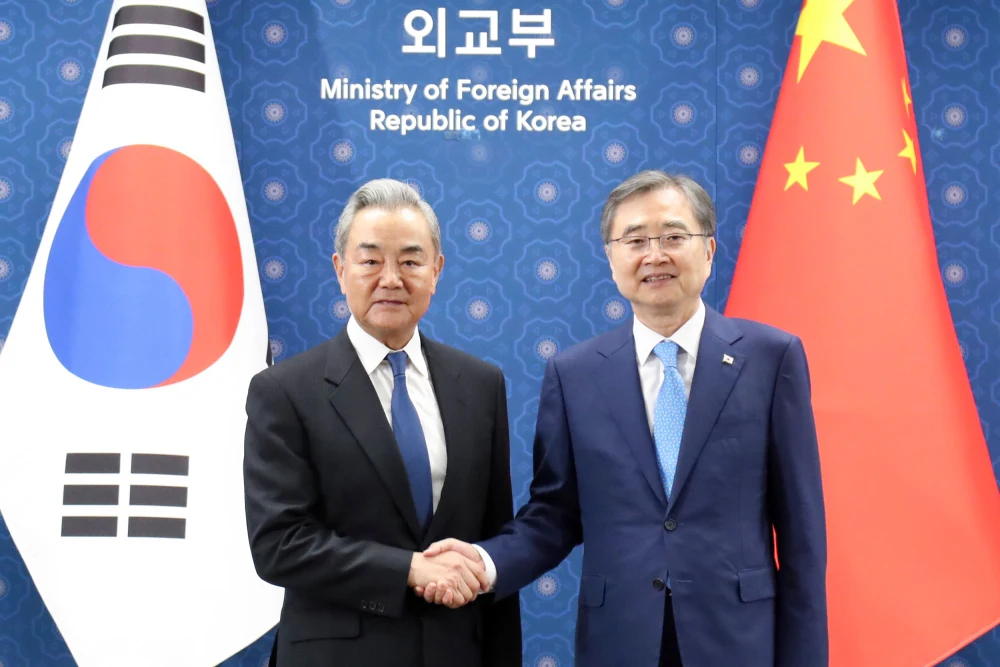
China and South Korea took new steps to restore bilateral dialogue during Chinese Foreign Minister Wang Yi’s visit to Seoul, which ended this Thursday (20). The trip took place at a time of tension on the Korean peninsula and growing dispute between the United States and China for influence in Asia.
It was the first visit by a Chinese foreign minister to South Korea in five years. Within two days, Wang met with South Korean Foreign Minister Cho Hyun, President Lee Jae-myung and National Security Advisor Wi Sung-lac. Upon receiving Wang, Lee stated that relations between the two countries had reached a “complete recovery” and advocated closer communication with Beijing on the situation on the peninsula.
The agenda included trade, technology, supply chains, exchanges between people and the situation on the peninsula. Seoul also reiterated its position of respect for the one-China principle, an issue considered central by Beijing in bilateral relations.
Economic rapprochement amid regional tension
China and South Korea established diplomatic relations in 1992. More than three decades later, Beijing remains Seoul’s main trading partner, giving economic weight to the rapprochement. Trade between the two countries reached around US$272.7 billion in 2025, involving strategic sectors such as semiconductors, electronics, batteries and industrial components.
During the visit, the two governments agreed to accelerate negotiations on the second phase of the free trade agreement and expand cooperation in trade, investment, technology and supply chain stability. They also decided to strengthen exchanges between young people, universities, media, research centers, sports and local governments. Wang invited Cho Hyun to visit China, and the South Korean foreign minister accepted the invitation.
The two countries also hope to exceed 10 million annual trips between their populations. The resumption of these exchanges is part of a broader attempt to recover links between societies after years of political difficulties.
The importance of China for the South Korean economy appears particularly clearly in the semiconductor sector. Mainland China and Hong Kong received US$17.2 billion from South Korean chip exports, maintaining the Chinese market as a strategic destination for companies in the sector. Samsung Electronics and SK Hynix, two of the world’s largest memory chip makers, also maintain operations in China.
At the same time, Washington has been pressuring its allies to restrict certain technology transfers to the Chinese market. It is one of the reasons why Seoul needs to carefully manage its relationship with Beijing: its economy is deeply integrated into Chinese production chains, while its security structure remains linked to the United States.
Between Washington, Beijing and the Korean peninsula
The issue of regional security was at the center of the conversations. Wang Yi stated that Beijing supports a political and peaceful solution to the Korean issue and that China intends to continue contributing to the stability of the peninsula. Chancellor Cho, in turn, asked Beijing to help create conditions for Pyongyang to return to dialogue.
China has also criticized Washington’s policy toward North Korea. Wang defended a change in the United States’ stance and the resumption of dialogue and trust between the parties. The Chinese position comes just as Washington tries to reopen the channel with Pyongyang: Donald Trump once again expressed his willingness to talk to Kim Jong-un and ordered a reduction in joint military exercises between the United States and South Korea.
The Ulchi Freedom Shield, which began on August 17th and was scheduled to last 11 days, will end on Friday (21st), six days earlier than the original schedule. Reducing exercise, however, did not eliminate the tension. This Thursday, as Wang concluded his visit to Seoul, North Korea launched more than ten short-range ballistic missiles toward the East Sea, according to South Korean officials. Pyongyang had considered the reduction in exercises insufficient.
It is in this scenario that Beijing advocates that South Korea maintain greater strategic autonomy and not be forced to choose between China and the United States. Wang called on Seoul to maintain balanced relations with major powers and avoid bloc-based confrontation. The Chinese position gains weight in the face of the American military presence: around 28,500 United States military personnel are stationed in South Korea.
Seoul thus occupies a particular position. China is its main trading partner, while the United States remains its main military ally. The rapprochement with Beijing does not mean that South Korea is abandoning Washington, but it expands its negotiating margin in a regional environment increasingly marked by competition between the two powers.
For Beijing, the rapprochement also has economic and diplomatic importance. In addition to strengthening ties with one of Asia’s main industrial countries, China seeks to prevent the region from being organized exclusively around rivalry with Washington. The issue of the peninsula adds another dimension: Beijing maintains historic relations with Pyongyang, but has been defending the reduction of tensions and the resumption of negotiations.
New encounters
The next test of this relationship could come in Shenzhen, in southern China. In November, the city will host the Apec leaders’ meeting, which brings together 21 Asia-Pacific economies. During Wang’s visit, Beijing said it was considering holding a meeting between Xi Jinping and Lee Jae-myung on the sidelines of the summit. The possibility has not yet been officially confirmed.
A meeting in Shenzhen would be an opportunity to consolidate the rapprochement between Beijing and Seoul and discuss both the economic agenda and the situation on the peninsula. For China, it would also represent another step in rebuilding a relationship with an important Asian country amid the strategic dispute with Washington.
Wang Yi’s visit does not eliminate the differences between China and South Korea, nor does it resolve the Korean issue. But it shows that the two countries have once again invested in dialogue channels and that there is interest on both sides in preserving economic cooperation, despite political and security differences.
If the meeting between Xi Jinping and Lee Jae-myung is confirmed in November, Shenzhen could become the next scene of this rapprochement — and another space for negotiation on the direction of Asia amid the dispute between Washington and Beijing.
Source: www.brasildefato.com.br