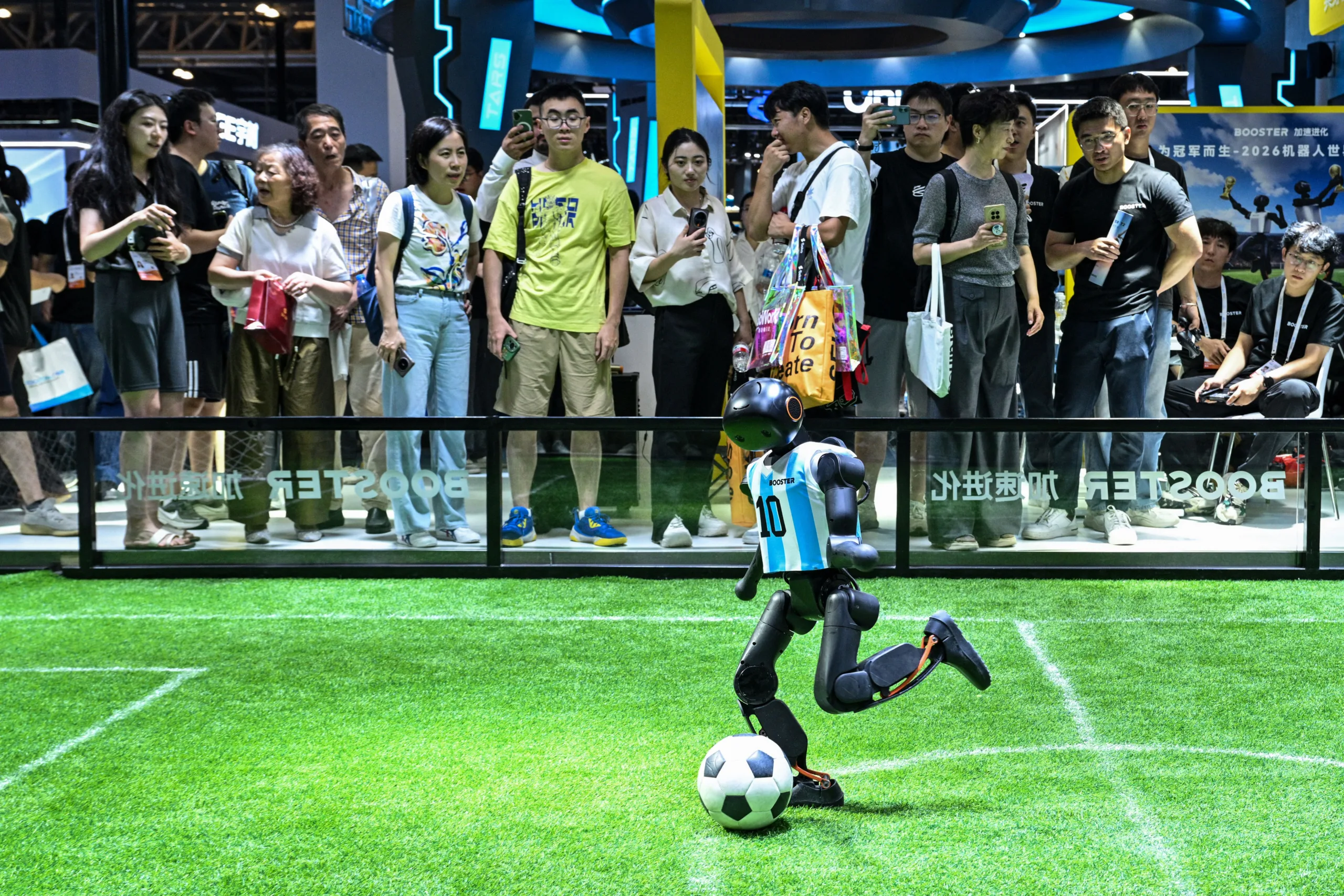
Data from the first half of this year show that China now accounts for around 70% of global sales of quadruped robots, a type of equipment with four legs designed to operate on uneven terrain.
The Asian giant also accounts for more than half of the 400 humanoid robot models available in the world, according to Wang Weiming, chief engineer at the Chinese Ministry of Industry and Information Technology, at a press conference at the State Council Information Office, this Monday (20), in Beijing.
The interview, part of the government’s regular economic data release cycle, also featured the participation of Tao Qing, director of the Operational Monitoring and Coordination Office, and Xie Cun, director of the Communications and Information Management Office, both spokespersons for the ministry.
In the first half of 2026, the production of industrial robots grew by 28% compared to the same period in 2025, and that of service robots, by 11.9%, according to Wang Weiming. More than 230 companies in China have products in the intelligent robot category with their own physical form, which includes humanoids and quadrupeds. The ministry expects total production in the category to exceed 100,000 units throughout this year.
Industrial and medical applications
Inspection robots began to operate in underground mines and high-voltage tunnels, replacing workers in dangerous or unhealthy environments. In medicine, robotic orthopedic and laparoscopy surgical systems performed more than 3,000 minimally invasive procedures remotely, via 5G connection. In automobile welding lines, industrial robots already operate at scale throughout the entire production cycle.
Artificial intelligence vision systems are detecting microscopic defects in parts with five times the efficiency of manual work, according to the ministry. In the 500 factories classified as “excellent” in the official industrial automation program, average productivity rose 25% compared to the period before conversion. The country has more than 56 thousand factories at the basic level of automation, more than 9 thousand at the advanced level and 15 installations at the pilot level.
Industrial-scale artificial intelligence models have also accelerated the screening of antibodies and molecules for new medicines, according to Wang Weiming.
The adoption rate of artificial intelligence in manufacturing companies above the designated size exceeded 30% in the half-year period, as reported by the ministry. Open-source AI models developed in the country have accumulated more than 10 billion downloads worldwide. In China, large companies are defined by the criterion of “above designated size”, which currently means that a company has annual revenue of 20 million yuan (R$15.5 million) or more.
The sector’s growth follows the principle of the “new quality of productive forces”, formulated by Xi Jinping and incorporated into the 15th Five-Year Plan (2026-2030), which guides the transition from the labor-intensive industrial model to sectors with high technological content. The high-tech industry grew 13.3% in added value in the semester, more than double the industrial average, according to Wang Weiming.
Source: www.brasildefato.com.br