The Secretary of State of the United States, Marco Rubio, said this Monday (20) that the USA will be “very involved” in the dialogue process between the government and a sector of the opposition in Venezuela, scheduled to begin in the first week of August.
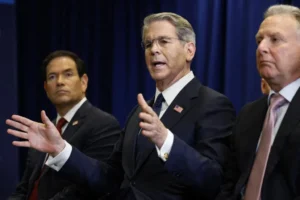
In a press conference held at Andrews Air Force Base, before heading to an agenda in the Philippines, the head of US diplomacy classified the establishment of negotiations as very good news
“I believe that the first official talks will begin in the first week of August. I thought this was a very significant proposal. Obviously, we will see how this evolves, but we believe that this agreement was received in Venezuela as very good news and, naturally, it is something in which we will be very involved”, he claimed.
However, Venezuelan authorities have not confirmed the direct participation of US officials in the conversations.
The date mentioned by the Secretary of State coincides with the official work schedule announced by the president of the National Assembly of Venezuela (ANV), Jorge Rodríguez, last week, when the deputy officialized the beginning of a joint work route with former members of parliament who served in the period between 2015 and 2020.
The group of opponents in question consists of a group of former deputies who do not have an official mandate and act as a parallel structure, which for years maintained political articulations with financial support from the United States in attempts to destabilize the government of President Nicolás Maduro.
“As part of the call for national unity to jointly face the consequences of the devastating double earthquake and with the aim of strengthening democracy, we announce the launch of a joint work plan with former members of the National Assembly from the 2015-2020 period, starting on August 1st,” said the statement published on July 14th, which mentions international support without reference to any specific country.
“The unanimous international support for our people and the national government in facing this tragedy highlights that only together can we move forward in rebuilding and maintaining peace”, the text concludes.
According to Rodríguez, the State’s current priority is the reconstruction of the affected areas and the maintenance of social stability. The deputy pointed out that the economy needs to move towards a dynamism that makes the population feel the social benefits after more than ten years of international economic blockade.
At this Monday’s press conference, Rubio even spoke of a “transition process” without, however, giving details.
“[O] group representing the 2015 National Assembly — the last democratically elected National Assembly and the group we recognize as the legitimate government of Venezuela — met with the interim government and agreed to establish a format and a forum not just for reconciliation talks, but to begin the transition process, which is what the Venezuelan people need,” he said.
The announcement made by Washington comes in a context where the neighboring country is seeking to recover from a double earthquake that occurred on June 24, which has resulted in more than 5,000 deaths to date and destroyed hundreds of buildings in Caracas and La Guaira, in the north-central region of the country.
Constitutional limits and hypotheses for new elections
Despite pressure from sectors of the far-right opposition to immediately hold new presidential elections, there is no constitutional provision for such a call in the current scenario. Jurists heard by the Brazil in fact point out that the country has been experiencing an unprecedented situation since January 3, 2026, when elected president Nicolás Maduro was kidnapped by foreign forces and taken to the United States as a prisoner of war.
According to the Bolivarian Constitution, early elections only occur in cases of absolute absence of the president. Article 233 of the Venezuelan Magna Carta lists the situations that constitute this lack, such as the death of the ruler, his resignation, dismissal by sentence of the Supreme Court of Justice (STJ), permanent physical or mental incapacity approved by parliament, abandonment of office or revocation of the mandate via referendum.
Faced with this legal vacuum, the TSJ determined that Delcy Rodríguez, then vice-president, would assume the interim presidency for an indefinite period. As the current presidential term only ends in 2031, only the interim president herself or the National Assembly would have the power to call a new election before that deadline.
In turn, the government maintains that the immediate focus should be on managing the State and improving the quality of life, while the National Electoral Council (CNE) would still need to undergo technical renewal processes to guarantee the trust of all political actors.
In this debate, the opposition led by María Corina Machado has defended a roadmap for free elections in the shortest possible time, conditioning the process on the restoration of political rights for ineligible people. However, the Amnesty Law approved in February 2026 explicitly excludes crimes of instigating the invasion of the country and coups d’état, accusations that weigh against Machado.
While the dialogue progresses, Delcy Rodríguez’s government is working to lift the economic sanctions against the country that remain in force. The objective is to recover assets such as Citgo, which was the target of legal disputes on US soil during the previous administration of Donald Trump.
Chavismo still bets on strengthening communes and territorial self-management as a way of shielding the political process against far-reaching setbacks, regardless of the electoral calendar that may be defined in the future.
Source: www.brasildefato.com.br